
Categories: AI Assistant, AI Call Center, AI Customer Service, AI Developer Tools, AI Lead Generation, AI Scheduling, AI Transcription, AI Voice Assistants
Adola Review: AI Voice Assistants For Your Phone?

I swear, if I have to listen to one more tinny hold-music version of a forgotten 80s pop song, I might just give up on phones altogether. You know the drill. You call a business, navigate a maze of options by pressing ‘3’ then ‘5’ then ‘#’, only to be put on hold for twenty minutes. It’s a terrible experience. We’ve sent people to the moon, yet we can’t seem to solve the simple act of getting a straight answer from a business over the phone.
But the winds are changing. The AI wave isn’t just about writing essays or making weird pictures of cats in space; it’s starting to creep into the nooks and crannies of our daily lives. And the telephone, that old reliable workhorse, is next on its list. That’s why I got pretty interested when I stumbled across a new platform called Adola. It’s still in Beta, which in today’s tech world means ‘It’s cool, it works, but don’t bet your entire company on it just yet’. But what it promises is intriguing enough to pay close attention.
So, What Exactly is Adola?
Let’s break it down. At its core, Adola is a service that gives your phone number an AI brain. Imagine being able to hook up a custom-trained AI assistant directly to a phone line, ready to talk to your customers, book appointments, or answer questions 24/7. That’s the goal here. It acts as a bridge between the incredibly powerful conversational AI we’re all getting used to (think ChatGPT) and your standard phone system.
It’s not just a fancy robocall system. This is about creating genuine, two-way voice conversations. Think of it like giving your company’s Siri or Alexa a dedicated phone number and a very specific job to do. For anyone who’s ever wished they had an extra person just to handle the phones… well, this is a pretty compelling idea.
Visit Adola AI
Who Is This For? The Two Sides of Adola
From what I’ve seen, Adola is playing to two distinct crowds right now, which is a smart move. They’re catering to the people who build the tech and the people who will eventually use it in their day-to-day operations.
For the Tinkerers and Developers
If you’re like me and love to get your hands dirty with new tech, their ‘Developer Playground’ is where the fun starts. They’ve made the process feel almost ridiculously simple. The website lays it out in three steps: choose a phone number (they have US, Austrian, and German numbers for now), connect your OpenAI account via an API key, and then pick which of your OpenAI assistants you want to put on the line.
This is gold for developers. It lowers the barrier to entry so much. You don’t have to be a telephony expert or build a complex infrastructure. You just bring your AI, and Adola handles the rest. They even give you a 7-day free trial to get started. Honestly, for anyone who’s been curious about building voice-based AI applications, this is a fantastic sandbox to play in.
For the Business Owner on the Grind
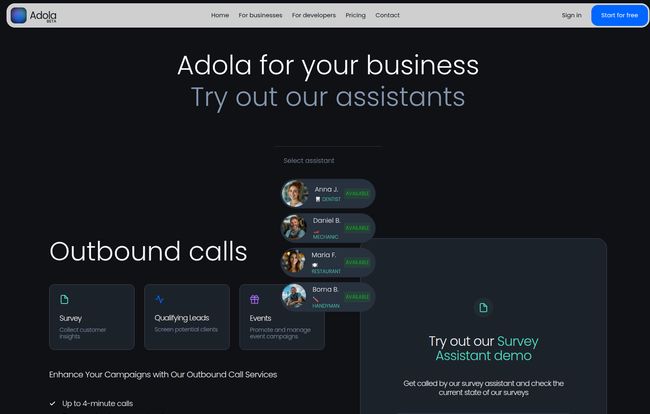
Okay, so what if you’re a dentist, a mechanic, or run a restaurant? You don’t care about APIs; you care about fewer missed calls and more booked appointments. Adola has a whole section labeled “For Businesses – Coming soon,” and this is where the real-world impact becomes clear.
They are building pre-made AI assistants for specific industries. Imagine your restaurant’s phone being answered instantly, any time of day, by an AI that can handle reservations. Or a dental practice where the AI can book cleanings and answer questions about insurance without a human ever having to pick up the phone. They also highlight outbound call services for things like lead qualification or event promotion. This isn’t just about saving time; it’s about generating revenue and improving the customer experience. This side of the platform is still baking, but the ingredients look mighty tasty.
My First Impressions and A Walkthrough
Curiosity got the better of me, so I had to try their demos. The website itself has a clean, dark-mode aesthetic that feels very current. It’s not cluttered; it gets straight to the point. You can select an assistant demo—like one for surveys—and have it call your phone. I popped in my number and a few seconds later, my phone was ringing.
The voice was powered by ElevenLabs, which is one of the top-tier AI voice generators out there, so the quality was crisp and surprisingly natural. The AI asked me a few survey questions, and the interaction was smooth. There wasn’t that awkward, robotic pause you get with older systems. It felt… responsive. While you can still tell its an AI if you’re listening for it, it’s miles ahead of the automated systems we’re used to fighting with. The multilingual support is also a huge plus, showing they have a global mindset from the start.
The Good, The Bad, and The Beta
No tool is perfect, especially one that proudly wears the ‘Beta’ badge. So let’s get real about what’s working and what’s still a work in progress.
What I’m Genuinely Excited About
The integration with phone systems connects without a hitch, and that’s a big deal. The real magic here is the simplicity. The idea of AI call agents isn’t new, but platforms like Adola are democratizing it. You don’t need a corporate budget to get started. For a small business, the potential to automate appointment booking or initial lead screening is a game-changer. And I have to say, their developer-first approach is smart. By getting developers to build cool things on their platform, they are building a community and an ecosystem before they even fully launch their business products.
Where It Needs to Grow
Let’s be honest, it’s still early days. The biggest limitation right now is that it only works with OpenAI assistants. Some folks might argue that they’d want to plug in other models like Claude or Gemini, and I’d agree that more options will be necessary for long-term success. The limited phone number options are another hurdle; if your business isn’t in the US, Austria, or Germany, you’ll have to wait. And while the conversations are advancing, they are still foundational. We’re not at the point of having a truly human-like chat, but we are getting scarily close. But then again, a year ago this was pretty much science fiction for the average person.
Let’s Talk Money: The Adola Pricing Structure
So, what’s the damage? For developers, the pricing is straightforward and, in my opinion, very reasonable. It’s a subscription model that gets you in the door and lets you build.
| Plan | Cost | Includes |
|---|---|---|
| For Developers | $25 monthly | 7-day free trial, build your own voice bot, 25 minutes included, then $0.04 – $0.25 per minute. |
The $25 a month fee is your entry ticket. The variable per-minute rate likely depends on factors like the complexity of the AI task or call destination. The business-focused plans are still under wraps, but I’d expect a tiered system based on call volume and features once they launch.
The Bigger Picture: Where Does Adola Fit in the AI Gold Rush?
We’re in a strange and exciting time. AI is being shoehorned into everything, sometimes successfully, sometimes not. Adola feels like one of the more practical applications I’ve seen lately. It’s not trying to write a novel; it’s trying to solve a common and frustrating business problem: managing phone calls efficiently.
This is part of a much larger trend towards ‘AI agents’—autonomous systems that can perform tasks for us. We’re moving away from just using AI as a passive tool and towards using it as an active assistant. The potential for hyper-personalized marketing or incredibly efficient customer service is massive. Adola is positioning itself as a key piece of that puzzle, specifically for voice interactions.
Final Thoughts: Is Adola Worth Your Time (and Money)?
So, what’s the verdict? If you’re a developer or just a tech enthusiast who wants to experiment with the future of voice AI, my answer is a resounding yes. The $25 price point and free trial make it a low-risk, high-reward playground. Go build something cool.
If you’re a business owner, my advice is to keep Adola on your radar. Bookmark their site. Sign up for their newsletter. The full-fledged business solutions aren’t here yet, but the potential is enormous. When those features drop, they could seriously change how you operate. This isn’t just another SaaS tool; it feels like a glimpse into a future where our phones actually work for us, instead of the other way around. And I, for one, am here for it.
Frequently Asked Questions
What is Adola?
Adola is a platform that integrates conversational AI voice assistants with phone systems. It allows developers to build their own voice bots and will soon offer pre-built AI assistants for businesses to handle tasks like appointment booking and customer service over the phone.
How much does Adola cost?
The developer plan costs $25 per month, which includes a 7-day free trial and 25 minutes of call time. After that, the rate is between $0.04 and $0.25 per minute. Pricing for their upcoming business-specific plans has not been released yet.
Can I use Adola for my business right now?
The dedicated commercial features for businesses are listed as “Coming soon.” While you could technically build a solution using the developer plan, the turn-key assistants for specific industries like restaurants or dental offices are not yet available.
What AI does Adola use?
Currently, Adola integrates exclusively with assistants built on OpenAI‘s platform. This means you need an OpenAI account and assistant set up to connect to the Adola system.
Do I need to be a programmer to use Adola?
For the current developer playground, some technical knowledge (like getting an API key from OpenAI) is needed. However, their upcoming business solutions are designed to be user-friendly and will likely not require any programming skills.


