
Categories: AI Speech Synthesis, AI Text-to-Speech, AI Voice Assistants, AI Voice Generator
ChatGPT’s Advanced Voice: The Future of AI Chat?

You ask your phone a question, and the response comes back in that same, soul-crushingly monotone, slightly-too-perfect voice. You know the one. It sounds like a GPS navigator from 2008 who’s had a really, really long day. For years, as an SEO and tech blogger, I’ve seen AI make incredible leaps in text generation, image creation, and data analysis. But voice? Voice has always felt like the last, stubborn frontier.
It’s always been the uncanny valley of audio. Close, but no cigar. Until now, maybe.
OpenAI has been making some serious noise (pun absolutely intended) with its new Advanced Voice capabilities, built right into ChatGPT. They’re not just talking about a slight improvement; they’re talking about a fundamental shift in how we interact with AI. So, naturally, I had to see—or rather, hear—what all the fuss was about. Is this just another incremental update, or is it the start of our own personal Her-like future? Let’s get into it.
What Exactly is This “Advanced Voice” Thing Anyway?
At its core, Advanced Voice from ChatGPT is a new voice synthesis model designed to close that gap between human speech and machine speech. Think of it less as text-to-speech and more as thought-to-speech. Instead of just reading words off a screen, it’s built to understand tone, emotion, and conversational flow in real-time. The goal is to make talking with an AI feel less like issuing commands to a computer and more like, well, a conversation.
Remember the last time you were on a customer service call with an automated system? The awkward pauses, the robotic cadence, the complete inability to understand you if you sneeze mid-sentence. That’s the problem this technology is designed to solve. It’s about creating an interaction so smooth and natural that you might just forget you’re talking to a complex algorithm that lives in the cloud. A pretty ambitious goal if you ask me.
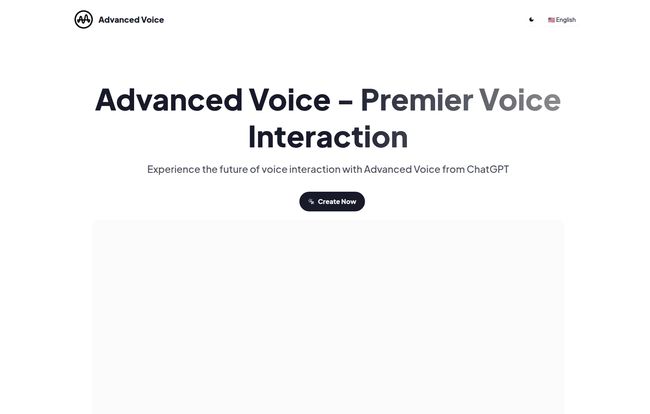
Visit Advanced Voice
The Sound of the Future: Breaking Down the Key Features
So, what’s under the hood? I’ve been playing around with it, and a few things really stand out. It’s not just one single improvement; it’s a collection of upgrades that work together to create a pretty compelling experience.
More Human Than Human? Natural Speech Generation
This is the big one. The voice doesn’t just sound clear, it sounds alive. It has intonation. It laughs (yes, really). It can adopt different tones, from enthusiastic and cheerful to thoughtful and serious. I asked it to tell me a joke, and it delivered the punchline with a subtle, knowing chuckle. It was… frankly, a little weird, but in a good way. It’s one of those things you have to hear to believe. The stilted, robotic delivery we’ve all come to associate with AI is gone, replaced by something much more fluid and, dare I say it, human.
No Awkward Pauses: Real-Time Processing
Speed is everything in a conversation. The old model had this noticeable lag: you’d finish speaking, and there would be a two-to-three-second pause while the AI processed the text, generated a response, and then converted it to audio. It completely breaks the illusion. The new Advanced Voice processes audio in real-time. You can interrupt it, it can interrupt you—it feels dynamic. This enhanced speed turns a clunky Q&A session into a genuine back-and-forth. It’s a game-changer for anyone who wants to use AI for brainstorming or as a thinking partner.
A Chorus of Voices: Variety and Customization
Variety is the spice of life, and it seems OpenAI gets that. There’s a selection of different voices to choose from, each with distinct personalities and improved accents. This isn’t just about changing the pitch; it’s about providing a different conversational flavor. While the initial setup is impressive, this is one area where I’m hoping for more. The current “customization” is more about selecting from a preset menu. The true holy grail will be when we can fine-tune a voice’s personality or even clone our own (with ethical guardrails, of course!). For now, the variety is a great step forward, but power users might find the options a bit limited.
Putting It to the Test: My Real-World Experience
Alright, enough with the specs. How does it actually feel to use? I decided to integrate it into my workflow for a day. Instead of typing out my usual morning brainstorm for blog topics, I just talked to it.
“Hey, I need some ideas for an article about the future of voice AI,” I started. The response wasn’t just a list. It was a question back at me: “That’s a great topic! Are you thinking more about the technical side, like synthesis models, or the cultural impact?”
That right there. That’s the magic. It didn’t just dump information; it engaged. We went back and forth for about 10 minutes, and by the end, I had a solid outline. The speed made it feel collaborative instead of transactional. It’s like having a hyper-intelligent, always-available intern who never needs a coffee break.
The Good, The Bad, and The… Interesting.
No tool is perfect, and as exciting as Advanced Voice is, it’s important to keep our feet on the ground. After spending some quality time with it, here’s my honest breakdown.
The advantages are obvious and impressive. The natural, human-like synthesis is top-tier, rivaling specialized platforms like ElevenLabs. The high-quality audio and real-time processing create an incredibly smooth interaction that feels miles ahead of the competition from big tech assistants. It’s fast, it’s fluid, and it’s genuinely pleasant to listen to. For applications like creating audio content, aiding visually impaired users, or just having a more natural way to interact with AI, its a massive leap forward.
However, there are a few reality checks. The biggest one is that this isn’t a standalone product. It’s a feature of ChatGPT. To get access, you need to be in the ChatGPT ecosystem, which for the most advanced features, typically means a ChatGPT Plus subscription. Also, as I mentioned, the customization options feel a bit like a walled garden right now. You can choose from their curated voices, but you can’t create something truly bespoke. I expect this to change over time, but it’s a limitation for now.
So, Who Is This For? And What About the Price?
This is where the conversation gets practical. Who should be jumping on this right away?
- Content Creators: Podcasters, YouTubers, and audiobook narrators could find this immensely useful for creating drafts, temporary voice-overs, or even fully synthetic audio content.
- Developers: Integrating this level of voice interaction into applications could revolutionize customer service bots, in-car assistants, and accessibility tools.
- Everyday Users: Anyone who uses ChatGPT as a learning tool, a creative partner, or a personal assistant will find the experience much more engaging and efficient.
Now, for the million-dollar question: the pricing. As of writing this, OpenAI is rolling this out as part of its newer models, like GPT-4o. The access model seems to be tied to their subscription tiers. While there is a free tier for GPT-4o with some limitations, the full, unthrottled experience of Advanced Voice will almost certainly be a perk for ChatGPT Plus subscribers. There isn’t a separate, per-word pricing model for the voice feature itself, which simplifies things but also means you’re buying into the whole package.
The Broader Picture: Is This the “Her” Moment for AI?
Every time a big AI innovation drops, the same question comes up: are we one step closer to the sci-fi future we’ve been promised (or warned about)? With Advanced Voice, it’s hard not to think of the movie Her, where the protagonist falls for his AI assistant, largely due to the intimacy and personality of her voice.
We’re not there yet, let’s be clear. But this is a significant step in that direction. The ability for an AI to express emotion, to pause thoughtfully, to laugh—it builds connection. It moves AI from a mere utility to something that feels more like a companion. This has massive implications, both good and bad, that we’ll need to navigate as a society. But from a purely technological standpoint, it’s undeniably exciting.
The bottom line is that ChatGPT’s Advanced Voice is more than just a cool feature. It feels like a statement of intent from OpenAI. They’re not just building a better chatbot; they’re building a new kind of interface for technology, one based on the most natural form of human communication: conversation. It’s still early days, and there are kinks to iron out, but this feels like a genuine inflection point. The robotic voices of the past are officially on notice.
Frequently Asked Questions
1. What is ChatGPT Advanced Voice?
It’s a new, highly advanced voice synthesis feature within ChatGPT that allows for natural, real-time, and emotionally expressive conversations with the AI. It aims to eliminate the robotic sound and lag of older text-to-speech systems.
2. How is this different from Siri or Google Assistant?
The main differences are the real-time processing and emotional range. Advanced Voice can be interrupted and responds with human-like intonation, laughter, and tone, making the conversation feel much more fluid and natural than the more command-and-response style of current assistants.
3. Do I need a special subscription to use it?
While OpenAI is rolling out some features to free users via its GPT-4o model, the most robust and consistent access to Advanced Voice is expected to be part of the paid ChatGPT Plus subscription. It’s best to check OpenAI’s official site for the latest access details.
4. What are some practical uses for this technology?
You can use it for anything from hands-free brainstorming and learning new topics to creating draft audio for podcasts or videos. It’s also a powerful accessibility tool for those who find typing difficult and can be used to build more engaging customer service bots and virtual assistants.
5. Is it completely free to use?
Not entirely. While access is being expanded, it is primarily positioned as a premium feature. Think of it as an integral part of the ChatGPT subscription package rather than a separate, free tool. Usage limits may apply to the free tier.
6. Can I customize the voice to sound like me?
Not at this time. Customization is currently limited to choosing from a variety of pre-designed voices provided by OpenAI. The ability to create deeply customized or cloned voices is not yet available to the public.
Reference and Sources
For more detailed, official information on the technology behind these new voice capabilities, I recommend reading OpenAI’s own announcement.
- OpenAI. (2024). Hello GPT-4o. OpenAI Blog. Retrieved from https://openai.com/index/hello-gpt-4o/


