
Categories: AI Agent, AI Assistant, AI Code Generator, Large Language Models (LLMs)
AiPy Review: An AI Python Agent That Actually Works?

For the past couple of years, we’ve been absolutely drowning in AI hype. We were promised self-driving cars, and we got chatbots that are really good at writing sonnets about our cats. We were promised automated agents that would handle our tedious work, and instead, we got tools that just… well, they suggest how we could do the tedious work ourselves. It’s been a bit of a letdown.
But every now and then, a tool pops up on my radar that makes me lean in a little closer. A tool that doesn’t just talk the talk. That’s how I felt when I stumbled upon AiPy. Their tagline alone—calling it an “AI Beast of Burden”—had me intrigued. It’s bold. A little aggressive, even. And I gotta say, I love it.
So, is AiPy just another flash in the AI pan, or is it the real deal? An agent that can actually shoulder some of our digital workload? I’ve been playing around with it, and I have some thoughts. A lot of them, actually.
So, What Exactly Is AiPy?
Okay, let’s cut through the jargon. AiPy is an AI assistant that mashes together a Large Language Model (the ‘brain’ you talk to, like in ChatGPT) with the raw power of Python scripting. Here’s the magic trick: it doesn’t just give you Python code. It writes the code and then runs it for you. It can control applications on your computer, mess with your files (in a good way!), and analyze data sitting right there on your local hard drive.
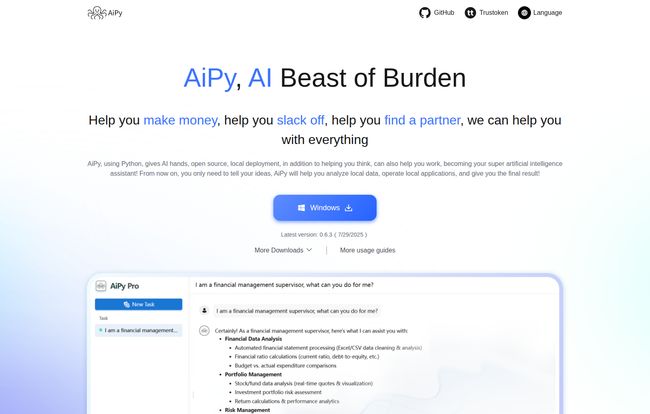
Visit AiPy
Think of it less like a consultant and more like a hyper-caffeinated junior developer who lives on your machine. You give it a task in plain English, like “scan all the PDF invoices in this folder, extract the total amount from each, and put them in an Excel sheet.” A normal chatbot would give you a Python script and say, “Good luck!” AiPy says, “On it,” and then actually does the work. That’s a fundamental difference.
The Big Shift: From AI Assistants to AI Agents
This is the core of what AiPy is trying to do. For years, AI has been a passive assistant. It could think and provide information. We’d ask a question, it would give an answer. The doing was still on us. AiPy represents the shift to an active agent. An AI that does.
It’s the difference between asking for a recipe and having a chef actually cook the meal for you. The AiPy model is designed to:
- Write its own programs to solve a problem.
- Run those programs on your local machine.
- Control other applications and access the network.
- And most importantly, iterate until the job is done.
This is a huge leap forward, and it’s where the entire industry is heading. We’re finally getting the tools that feel less like a search engine and more like a proper teammate.
Putting AiPy to the Test: What Can It Actually Do?
On their site, they list a few use cases that are pretty compelling. It’s not just about summarizing text files. We’re talking about real, complex tasks.
Handling Complex Documents and Data
They show examples like revising purchase contracts and extracting speech from video files. This is the kind of grunt work that eats up hours in any office. Imagine feeding it a 50-page vendor contract and saying, “Find all the liability clauses and tell me if they seem standard.” Or giving it an hour-long Zoom recording and asking for a transcript of only one person’s speaking parts. That’s not just a time-saver; it’s a game-changer for legal teams, financial analysts and project managers.
Controlling Your Local Environment
This is where it gets really interesting, and a little wild. The site mentions things like “Local Network Prayfor Control” and “Mobile Code Control.” Now, I’m going to assume “Prayfor Control” is either a very niche technical term I’ve never heard of or a fantastic typo for ‘Proxy’ or something similar. Either way, the implication is powerful. AiPy can be directed to manage network devices or execute code on mobile platforms. It’s an AI that can reach out from your computer and manipulate its environment. For developers and system admins, the possibilities are… huge.
The Open-Source Advantage: AiPy vs. The Competition
The landing page features a direct comparison with a tool called “Manus.” I haven’t used Manus personally, but the comparison table tells a familiar story in the tech world: the battle between open-source freedom and the closed-off walled garden.
| Feature | Why It Matters |
|---|---|
| Open Source | You can see the code. You can modify it. You’re not locked into one company’s ecosystem. For security and customization, this is everything. |
| Intranet Deployment | This is a security blanket for companies. It means you can run AiPy entirely within your own private network, so your sensitive data never touches the public internet. |
| Control of Local Apps & Files | AiPy isn’t stuck in a browser tab. It can genuinely act as an assistant on your device, opening software and managing folders like a real user would. |
| Handles Large Files (10GB+) | Most cloud-based AI tools choke on large files. The ability to analyze massive datasets locally is a massive advantage for data scientists and video editors. |
In my experience, when you have a choice, betting on the open-source community is usually the right move in the long run. It’s more transparent, more flexible, and it tends to evolve in ways that actually serve its users, not just a corporate bottom line.
Getting Started: The Good, The Bad, and The Techy
Alright, so it sounds great. But this isn’t some polished, one-click app you download from an app store. There are a few things you need to know before you jump in.
The Technical Hurdles
First off, you’ll need Python 3.9 or higher. For a developer, that’s nothing. For a marketing manager who just wants to automate some reports, it could be the first stumbling block. Configuration requires some comfort with a command line and, lets be real, a willingness to read some documentation on GitHub. This is a tool built by developers, for people who are at least a little bit developer-ish.
A Word on Performance
It’s also important to remember that AiPy is like the puppet master, but the quality of the show depends on the puppet—in this case, the LLM you hook it up to. The tool’s effectiveness is directly tied to the capabilities of the underlying language model. If you connect it to a powerful brain, you’ll get brilliant results. If you use a weaker model, your ‘beast of burden’ might be more of a confused pony.
What’s the Catch? A Look at AiPy’s Pricing
So, the big question. How much does this magic cost? I clicked on their pricing page to find out, and… I was greeted with a beautiful “404 Not Found” error. And you know what? I wasn’t even mad. It felt strangely authentic. It tells me this is a team so focused on building the tech and pushing code to GitHub that they haven’t gotten around to updating the marketing site. I kind of respect that.
The reality is, because it’s open-source, AiPy itself is free. You can download it, install it, and run it right now without paying a dime. The cost comes from the LLM you use. Some are free, others have API costs. But the tool itself? It’s all yours. I suspect they might add enterprise-level support or a managed cloud version later on, but for now, the only price of admission is your own time and technical curiosity.
Conclusion: A Promising Beast, Not Yet Fully Tamed
So, my final verdict? AiPy is legitimately exciting. It’s a genuine step towards the future of AI agents that we’ve all been hearing about. It’s powerful, its open-source nature is a huge plus, and its focus on local execution is a critical feature for privacy and performance. It lives up to the name ‘Beast of Burden’—it’s built for heavy lifting.
But it’s not a pet you bring home to the family just yet. It’s a wild animal that needs a skilled handler. It’s in the early stages of development, and it requires a certain level of technical confidence to get the most out of it. If you’re a developer, a data analyst, or just a power user who isn’t afraid to get your hands dirty, you should absolutely check out AiPy. It might just be the most productive new teammate you’ve had in years.
Frequently Asked Questions about AiPy
- What is AiPy in simple terms?
- Think of it as a smart assistant on your computer that can not only understand your instructions in English but also write and run Python code to complete tasks, like organizing files, analyzing data, and even controlling other apps.
- Is AiPy free to use?
- Yes, the AiPy software itself is open-source and free to download and use. However, you may incur costs depending on which Large Language Model (LLM) you connect it to, as some have usage-based API fees.
- Do I need to be a programmer to use AiPy?
- While you don’t need to be an expert programmer to give it commands, having some technical knowledge is very helpful. You’ll need to be comfortable with installing software like Python and potentially doing some light configuration via a command line.
- How is AiPy different from ChatGPT?
- ChatGPT gives you information or code snippets. AiPy takes it a step further by actually executing the code it writes to perform actions on your computer. ChatGPT is a knowledge source; AiPy is a workforce.
- Is AiPy safe for my private data?
- One of AiPy’s biggest strengths is its focus on local processing. Because it can be deployed on your own machine or private network (intranet), you can use it to analyze sensitive data without that data ever leaving your control, which is a significant security advantage.
- What is Manus, and how does AiPy compare?
- Manus appears to be a competing, closed-source AI agent. According to AiPy’s comparison, AiPy offers more flexibility and control because it’s open-source, can be deployed on a private network, and has deeper integration with the local computer’s files and applications.
Reference and Sources
- AiPy Official Website
- Official AiPy GitHub Repository
- Ben’s Bites on the Rise of AI Agents – For general context on the trend towards AI agents.


