
Categories: AI Code Generator, AI Script Writing, AI Testing, Large Language Models (LLMs)
Alumnium Review: AI Test Automation That’s Actually Smart

Okay, let’s have a real chat. Every other week, my inbox gets flooded with pitches for the “next big thing” in AI. It’s usually some tool promising to revolutionize my workflow, make me a 10x engineer, and probably do my laundry. Most of the time, I give a polite nod, archive the email, and get back to debugging a ridiculously flaky end-to-end test. It’s the life we chose, right?
But then something called Alumnium crossed my desk. The tagline, “Bridge the gap between human and automated testing,” didn’t just catch my eye; it spoke to a deep, dark place in my QA-loving soul. A place haunted by misunderstood bug reports and test scripts so complex they need their own documentation.
So, I brewed a strong coffee, put on my skeptic hat (it’s a very worn-in hat), and decided to see if Alumnium was just more AI snake oil or something genuinely useful. And you know what? I’m actually… intrigued.
So, What Exactly is Alumnium?
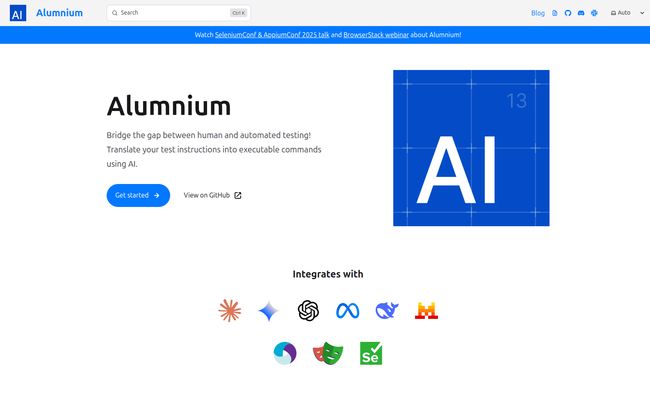
In a nutshell, Alumnium is an AI-powered test automation tool that acts like a translator. You give it simple, human-readable instructions, and it translates them into executable code for tools you already know and use. Think of it less like a self-driving car that you blindly trust, and more like an incredibly advanced cruise control system for your testing suite. You’re still steering, but it’s handling the boring, repetitive stuff on the highway for you.
It’s designed to work with the heavy hitters of web automation—we’re talking Playwright and Selenium. Right now, its heart beats in Python, integrating with frameworks like Pytest and Behave. So it’s not trying to replace your stack, just make it a whole lot smarter.
Visit Alumnium
How It All Clicks Together
This isn’t some black-box magic. The process is surprisingly transparent, which is the first thing that earned my respect. It’s not about uploading a blurry screenshot and hoping for the best. It’s a structured, three-step dance.
Step 1: Write Tests Like You’re Talking to a Colleague
You write your test cases in a Python file using simple commands that Alumnium provides. Look at this little snippet from their site:
from alumnium.tools import testdef test_add_todo_item(): test.visit("https://todomvc.com/examples/react/#/") test.type("new-todo", "Write my first test") test.press("Enter") test.verify("There is 1 item left") assert "1" == test.get("count of pending tasks")See that? `visit`, `type`, `verify`. It’s clean. It reads like a BDD feature file, but it’s actual code. This is a massive win for bridging the communication gap between product owners, manual testers, and the engineers writing the automation. You can almost read the test case and know exactly what it’s supposed to do, without deciphering complex XPath selectors.
Step 2: The AI Puts on its Work Boots
This is where the secret sauce is. When you run the test, Alumnium’s AI doesn’t just guess. It actively inspects the application’s DOM and, crucially, its accessibility tree. It uses this context to understand what “new-todo” or “count of pending tasks” actually means on the screen. It then translates your `type(“new-todo”, …)` command into the precise Playwright or Selenium action needed to find that element and interact with it. It’s using powerhouse LLMs like models from OpenAI, Google, and Anthropic on the backend to make this happen.
The Real Reason This Feels Different
I’ve seen dozens of codeless automation platforms. They demo great, but the moment you hit a complex, dynamic application, they fall apart. You’re left fighting the tool more than you’re fighting the bugs. Alumnium sidesteps this trap in a pretty clever way.
It’s Built for Engineers, Not Against Them
This is the big one for me. The ‘Engineer-Centric Flexibility’. Alumnium doesn’t hide the code or lock you into a proprietary ecosystem. You are still in your Python environment. You can still write your own `assert` statements. You can still drop into regular Playwright code if you need to handle a super tricky edge case. The AI is a powerful assistant, not a new boss. It gives you back the time you’d normally spend on tedious element selection and boilerplate, so you can focus on the actual test logic. That’s a tool I can get behind.
The Good, The Bad, and The ‘Coming Soon’
No tool is perfect, especially a new one. Here’s my breakdown of what’s got me excited and what gives me pause.
On the one hand, the potential to speed up test creation is immense. Just think of the time saved not having to hunt for the perfect CSS selector for the fifth time. The natural language approach is also a huge plus for team collaboration. But on the other hand, it’s currently a Python-only club. If your team is running on a JavaScript or Java stack, you’re on the outside looking in for now. They do say more languages are planned, which is promising.
The other point is its reliance on external AI providers. While this is a smart way to leverage best-in-class models, it also introduces an external dependency. What happens if your chosen provider has an outage during a critical release? It’s a valid concern for teams thinking about enterprise-level adoption. And of course, the classic “mobile support is coming soon.” We’ve all been burned by that one before, so I’ll believe it when I see it. But, I’m optimistic.
What’s the Price of Admission?
Here’s the million-dollar question. When I went looking for a pricing page, I found… well, a very nice 404 page (I guess even test automation tools have bugs, eh?). As of right now, there’s no public pricing. The homepage has a field to get notified when “Alumnium Pro” is launching. This suggests a model I’m actually a big fan of: an open-source or free-to-start core with a paid ‘Pro’ tier for advanced features, support, or team collaboration. For now, you can get started and try it out, which is the most important part.
Who Should Be Trying Alumnium Right Now?
Based on what I’ve seen, Alumnium is a fantastic fit for a few specific groups. If you’re a software or QA engineer working in a Python environment, you should absolutely give this a spin. Especially if you’re already using Playwright or Selenium. If your team is trying to implement BDD but struggles to keep the feature files and the test code in sync, this could be a game-changer. It’s also backed by some reputable names like AWS Startups and LambdaTest, which gives it a bit more credibility.
However, if your team is deeply invested in a JavaScript ecosystem with a tool like Cypress, or if you need robust, day-one mobile testing, you might want to wait a bit and keep an eye on their progress.
Your Questions, Answered
Is Alumnium just another codeless testing tool?
Not really. I’d call it ‘code-adjacent’. It automates the tedious parts of writing code (like finding elements) but leaves the engineer in full control of the test logic, assertions, and overall structure within a standard Python environment.
Do I need to be an AI expert to use it?
Absolutely not. The whole point is to abstract away the AI complexity. You just need to know how to write the simple, human-readable commands like test.visit() and test.type().
Is Alumnium free?
It appears to be open-source and free to get started with. They are planning an ‘Alumnium Pro’ version, which will likely be a paid product with additional features, but the core functionality seems accessible now.
What programming languages does Alumnium support?
Currently, it is primarily focused on Python. The team has stated that support for other languages is on their roadmap for the future.
How reliable is the AI for complex web applications?
It’s more reliable than simple screen scrapers because it analyzes the page’s DOM and accessibility tree for context. However, like any automation tool, it will likely face challenges with extremely complex or unconventional web components. The good news is you can always fall back to standard Playwright/Selenium code for those edge cases.
Does Alumnium replace Selenium or Playwright?
No, it’s a layer on top of them. It uses AI to generate the Selenium or Playwright commands for you, but those tools are still the engines running the tests under the hood.
My Final Verdict on Alumnium
I came in a skeptic, and I’m walking away a hopeful realist. Alumnium isn’t a magic wand that will eliminate all testing challenges. But it is one of the most pragmatic and well-thought-out applications of AI in the QA space that I’ve seen in a long time. It focuses on a real, nagging problem—the tedious and brittle nature of test script creation—and offers a solution that empowers engineers instead of trying to replace them.
I’m adding Alumnium to my “watch this space” list. It’s a genuinely interesting tool that might just make me complain a little less about writing end-to-end tests. And for me, thats a pretty high bar.


