
Categories: AI Developer Tools, AI For Data Analytics, AI Models
Anomalo Review: AI Data Quality Monitoring Worth It?

I still have mild PTSD from a Tuesday morning back in 2021. I walked into the office (well, my home office), pulled up the daily revenue dashboard, and my stomach just dropped. The numbers were… zero. A big fat goose egg. For a company that definitely, absolutely made money on Monday, this was, to put it mildly, not great.
Panic ensued. Emails flew. Engineers were pulled from their actual projects to go data spelunking. Hours later, we found the culprit: an upstream API change, completely unannounced, had started sending `customer_id` as a string instead of an integer. Our entire ETL pipeline choked on it, silently failing in the dead of night. We call this “data downtime,” and it’s the silent killer of trust in any data-driven organization.
We’ve all been there, right? Staring at a broken dashboard, wondering which of the hundred tables feeding it decided to betray you. It’s why the field of data observability has exploded. We need watchdogs. We need sentinels. We need something that taps us on the shoulder before the CEO sees a flatlining revenue chart. And that, my friends, is the promise of tools like Anomalo.
What Even Is Anomalo? (And Why Should You Care?)
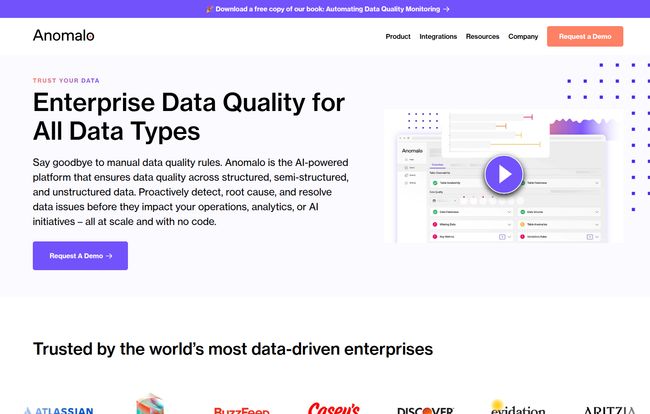
Okay, let’s get the marketing-speak out of the way. Anomalo is an “AI-powered automated data quality monitoring platform.” Phew, what a mouthful.
In human terms? Anomalo is a watchdog for your data.
You connect it to your data warehouse—think Snowflake, BigQuery, Databricks, the usual suspects—and its AI gets to work. It starts by just… watching. It learns the rhythm of your data. What’s a normal volume of new rows on a Monday? What’s the typical range for a `transaction_value`? How often should that `last_updated` column actually be updated? It builds a baseline of what “normal” looks like, without you having to spell it all out.
Why does this matter? Because running a business on bad data is like building a skyscraper on a foundation of mud. Every report, every machine learning model, every strategic decision you make is compromised. I’ve seen it happen. It’s not pretty. Having a tool that automatically validates your data is no longer a nice-to-have; for any serious company, it’s table stakes. And seeing names like Atlassian, BuzzFeed, and Discover on their client list tells me they’re playing in the big leagues.
Visit Anomalo
The “Magic” Under the Hood: How Anomalo Works
The whole process feels refreshingly simple, which is a welcome change in the often-overcomplicated world of data infrastructure. They boil it down to four steps:
- Connect your Data: This is the initial setup. You point Anomalo at your warehouse.
- Enable AI-Powered Monitoring: You flip the switch, and the platform’s machine learning algorithms start profiling your tables automatically.
- Customize with No-Code Rules: This is where it gets interesting. The AI does the heavy lifting, but you can add your own specific checks. More on that in a sec.
- Detect, Alert, and Find the Root Cause: When something goes wrong—a sudden spike in NULL values, duplicate entries, data freshness issues—it alerts you. And crucially, it helps you figure out why.
This automated approach to anomaly detection is the core of the platform. Instead of you having to write hundreds of tests saying “This column should never be NULL” or “This number should be between 1 and 100,” Anomalo learns those patterns. When a new value of 101 suddenly appears, it flags it. It’s a huge shift from the old way of doing things.
The No-Code Promise: A Dream for Overworked Teams?
Let’s be real. Most data teams are stretched thin. Writing and maintaining data quality tests is often the first thing to get pushed down the priority list when a hot new analytics project comes in. I’ve spent countless hours writing tests in `dbt` or configuring `Great Expectations`. They’re powerful tools, for sure, but they require engineering time and expertise.
Anomalo’s biggest flex is its no-code UI. This isn’t just a gimmick; it’s a strategic move to democratize data quality. It means your analytics engineer, a sharp data analyst, or even a product manager can define what “good” looks like for their data without having to file a ticket with the data engineering team.
“Anomalo has made a ten difference around what we’re able to do. Before, it was a data engineer or an analytics engineer who wrote all the data quality rules. Now, the business user who understands the data and therefore the indicators about its quality is able to implement the rules themselves.” – Discover Financial Services
This quote from Discover on their site really nails it. It closes the gap between the people who understand the data and the people who have the technical skills to write tests for it. The speed. That’s the real win here. You can implement a rule that checks for data freshness or validates the distribution of a categorical column in a few clicks. That’s a huge force multiplier for any team.
The Good, The Bad, and The AI-Powered
No tool is perfect, and I’m always skeptical of anyone who tells you otherwise. After digging through their materials and talking to folks in the industry, here’s my balanced take.
The Good Stuff
The automated, AI-driven monitoring is the clear standout. It’s like having a junior data analyst who never sleeps, never complains, and has seen billions of rows of data. The ability to get up and running quickly, detecting real issues in days rather than months, is a massive advantage. The root cause analysis tools also seem genuinely useful, helping to cut down on that painful debugging time and fight the dreaded “alert fatigue” by pointing you closer to the source of the fire.
The Not-So-Good Stuff
Like any powerful platform, there’s an initial setup. Connecting your data sources and getting the permissions right always takes a minute, so don’t expect a 5-minute miracle. It’s an enterprise tool, after all. Also, their monitoring for unstructured data is still in a private beta, so if your world is all PDFs and audio files, this might not be your silver bullet… yet. My biggest philosophical reservation is the reliance on AI. While incredible, AI can sometimes get it wrong. It’s essential to have a human in the loop to validate the alerts and ensure the machine isn’t chasing ghosts. You cant just set it and completely forget it.
What’s the Damage? Anomalo Pricing
Ah, the question every CFO and budget-conscious manager wants to know. If you’re looking for a pricing page with neat little tiers, you won’t find one. Anomalo, like most enterprise-grade B2B SaaS platforms, uses a “Request a Demo” model.
Don’t be scared off by this. It’s standard practice. It means pricing is customized based on your specific needs—likely a combination of data volume, the number of tables monitored, the connectors you need, and the feature set you require. You’ll have to talk to their sales team to get a quote. Expect it to be a significant investment, but one that you can hopefully justify by calculating the cost of not having it (think wasted engineering hours, bad business decisions, etc.).
My Final Take: Is Anomalo the Answer to Your Data Woes?
So, what’s the verdict? I’m genuinely impressed. In a space crowded with complex, code-heavy solutions, Anomalo’s focus on automation and user-friendliness is a breath of fresh air. It’s not trying to be everything to everyone. It’s trying to be the best and easiest way to ensure your structured data is accurate and trustworthy.
If you’re a small startup with one data analyst and a handful of tables, it might be overkill. But if you’re an established company with a modern data stack, a growing data team, and a tangible cost associated with data downtime, then Anomalo is absolutely worth a serious look.
For my money, the time saved and the trust rebuilt in your data are likely to far outweigh the cost. It’s a tool that lets your engineers get back to building, your analysts get back to analyzing, and your executives get back to making decisions with numbers they can actually believe in. And that, in itself, is pretty priceless.
Frequently Asked Questions
- What is Anomalo used for?
- Anomalo is primarily used for data quality monitoring. It automatically checks the data in your enterprise data warehouse (like Snowflake or BigQuery) for issues like missing data, incorrect values, duplicates, and sudden, unexpected changes in patterns or volume.
- Is Anomalo a data governance tool?
- It’s a key part of a data governance strategy. While it doesn’t handle things like access control on its own, its data validation and lineage features provide the observability needed to enforce governance rules and ensure data integrity, which is a core pillar of good governance.
- How does Anomalo detect data anomalies?
- Anomalo uses a suite of machine learning algorithms to learn what’s “normal” for your data. It analyzes metadata, freshness, data volume, and the statistical distribution of values. When it detects a drift from this established baseline—for instance, a sudden spike in NULLs—it flags it as an anomaly.
- Does Anomalo require coding?
- One of its main selling points is that it is a no-code platform. While the AI handles most checks automatically, users can define custom validation rules and track KPIs through a graphical user interface without writing any SQL or Python.
- Who are Anomalo’s main competitors?
- The data observability space is growing. Anomalo competes with other platforms like Monte Carlo Data, Soda, and Bigeye. It also competes with open-source frameworks like Great Expectations, though it offers a more managed, automated, and less code-intensive solution.
- How much does Anomalo cost?
- Anomalo does not have public pricing. It’s an enterprise software platform with pricing tailored to each customer’s needs. You must contact their sales team and get a custom quote based on the scale of your data operations.


