
Categories: AI API, AI App Builder, AI Code Generator
API Fabric Review: An AI App Generator Put to the Test

As someone who’s been in the SEO and digital trenches for years, I’ve seen more ‘game-changing’ tools than I can count. Every week, there’s a new platform promising to revolutionize how we work, build, and generate traffic. It’s a constant cycle of hype and, often, a little bit of disappointment. So, when I stumbled upon API Fabric, my professional curiosity was piqued, but my internal skeptic was on high alert.
The promise is huge: an AI that builds a full-stack application—we’re talking backend API and a frontend—from a simple text prompt. It sounds like magic. The kind of thing you’d dream up after a long week of debugging someone else’s spaghetti code. But does it work? Let’s get into it.
First Off, What Are We Calling This Thing? API Fabric or WebGenAI?
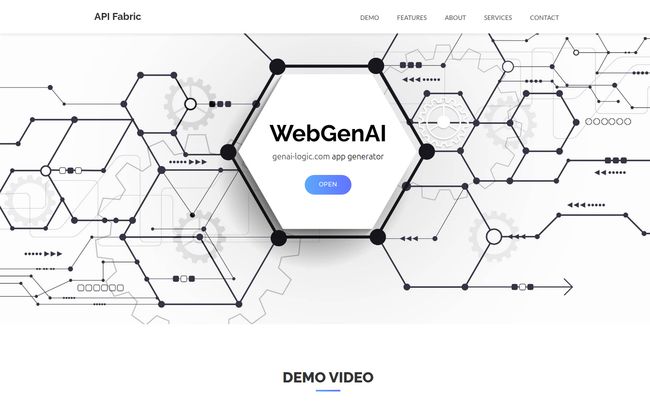
Right out of the gate, there’s a little bit of an identity crisis. The website URL is genai-logic.com, the browser tab says ‘API Fabric’, but the main logo plastered in the center of the hero image is for ‘WebGenAI’. For the sake of clarity, I’m going to stick with API Fabric since that seems to be the product name, but it’s a bit messy. Not a deal-breaker, but it’s the kind of small detail that makes you raise an eyebrow.
Identity questions aside, the core concept is straightforward. API Fabric is an AI App Generator. You describe the application you want to build to its generative AI backend, which it mentions is powered by GPT. The system then designs the database schema, builds the API, and even generates a frontend to interact with it. It’s like having a junior dev on speed dial who never needs a coffee break. The goal is rapid application development, getting you from idea to a functional MVP in a fraction of the usual time.
Visit API Fabric
The Features That Actually Matter
Okay, so it builds apps with AI. Cool. But the devil is always in the details, right? I dug into their feature list to see what makes this thing tick.
Generative AI Is the Brains of the Operation
This is the main event. The entire platform is built on the idea that you can prompt your way to a new application. Instead of manually defining data models, endpoints, and relationships, you just… ask. For anyone who has spent days scaffolding a new project, setting up boilerplate code and configuring databases, the appeal here is obvious. It’s all about speed.
Business Logic in Plain English
This one really caught my eye. API Fabric claims to have a business logic layer where you can define rules using natural language. For example, you could supposedly state things like, “A user can only have five active projects at a time,” or “Orders over $1000 require manager approval.” This is huge. Business logic is often the most complex and bespoke part of an application. Translating human rules into code is where most of the bugs and headaches are born. If this works as advertised, its a pretty big deal.
Frontend Integration via JSON:API
For the devs in the room, this is a nod to good practice. Instead of inventing some proprietary data format, API Fabric uses the JSON:API specification. This is a standardized way for an API to format requests and responses. Why does this matter? It means your frontend developers (or you, if you’re wearing that hat) can connect to the AI-generated backend without learning a weird, custom system. It promotes a clean separation between the frontend and backend, which is just solid architecture.
An Open-Source Heart for Customization
The platform is built with open-source components. This is smart. It means you’re not entirely locked into their black box. They list a pretty standard and respectable tech stack:
- Frontend: Angular, Gnome
- Backend: Python, SQLAlchemy
- Infrastructure: Docker, Nginx
- Databases: SQLite, Postgres, MySQL, Oracle, SQL Server
The ability to work with so many popular databases is a massive plus. The open-source nature suggests that if the AI gets you 80% of the way there, a skilled developer can pop the hood and customize the remaining 20%. That’s a much more realistic proposition than a completely closed, no-code system.
The Good, The Bad, and The AI-Generated
No tool is perfect, especially one leaning this heavily on bleeding-edge tech. Based on their own info and my years of experience, here’s my breakdown.
The upsides are pretty clear. Speed, speed, and more speed. The ability to spin up a prototype or an internal tool over a weekend is incredibly powerful for startups, agencies, and even enterprise teams testing a new idea. The use of standards like JSON:API and support for major databases shows a maturity of thought behind the architecture. It isn’t just a gimmick; it’s built on a solid foundation.
However, the cons are just as important. The primary one is an almost total reliance on the AI’s interpretation of your prompt. What happens when your app’s logic has nuance that the AI misses? We’ve all seen ChatGPT confidently give a completely wrong answer. The same risk applies here. For a simple CRUD app, it’s probably fine. For an application with complex, interdependent business rules, you might spend more time trying to re-prompt the AI than it would take to just code it yourself. There’s also the fact that true customization will likely require technical chops. So it’s not quite a ‘no-code’ solution for complex projects.
My Little Adventure on Their Website (And a Wild 404 Appears!)
Here’s where the story takes a turn. I was clicking around the site, getting a feel for things, and I naturally hit the big ‘DEMO’ button in the navigation bar. I wanted to see this thing in action!
And I got… a 404 Not Found page.
Ouch. For a tech company selling a product that builds websites and APIs, having a broken link to your own demo is not a great look. It’s like a baker advertising fresh bread but the shop door is boarded up. It instantly tempers my excitement with a heavy dose of reality. Maybe the product is amazing, but the polish isn’t quite there yet. This could be a temporary glitch, of course, but it’s a reminder that we should always approach new tools with a ‘trust but verify’ mindset.
So, How Much Does This Magic Cost?
This is the million-dollar question, isn’t it? I scoured the site for a pricing page, a link, a hint—anything. And I found nothing. Nada. Zip.
In the world of B2B and SaaS, this usually means one of a few things:
- It’s a very new product, and they haven’t figured out pricing yet.
- It’s aimed squarely at enterprise clients with ‘Contact Us for a Quote’ pricing.
- They operate on a per-project consultancy basis, using the tool internally.
Given their ‘Services’ section lists things like Backend Development and Infrastructure Integration, I’m leaning towards a mix of #2 and #3. Don’t expect a simple, tiered monthly subscription plan here. You’ll likely need to get in touch with them directly.
FAQs About API Fabric
- Is API Fabric a no-code tool?
- It’s more of a low-code tool. While you can generate the initial application without writing code, any significant customization or handling of complex logic will likely require a developer’s expertise.
- What technology does API Fabric use on the backend?
- The backend is built with Python and SQLAlchemy, a popular Object-Relational Mapper (ORM) for interacting with databases.
- Can I connect API Fabric to my existing database?
- Yes, it supports a wide range of popular SQL databases, including PostgreSQL, MySQL, Oracle, and MS SQL Server, so integration with existing infrastructure is a key feature.
- Do I need to be a developer to use it?
- To generate a basic application from a prompt, probably not. To verify, debug, and customize the output for a production-ready system, you will almost certainly need development skills.
- What is JSON:API and why is it important?
- JSON:API is a specification for how to build APIs. Using a standard like this makes it much easier for frontend applications to work with the API, as there are established conventions for things like fetching, filtering, and sorting data.
- Is API Fabric free?
- There is no pricing information available on their website, which strongly suggests it is not a free tool. You’ll need to contact them for pricing and engagement models.
Final Thoughts: A Promising Tool With a Few Wrinkles
So, what’s the verdict on API Fabric? I’m cautiously optimistic. The core idea is fantastic and aligns perfectly with the direction our industry is heading. Using generative AI to eliminate the grunt work of setting up new applications is a powerful value proposition.
The tech choices seem solid, and the focus on natural language for business logic is genuinely innovative. However, the slightly confusing branding and the broken demo link give me pause. It feels like a brilliant piece of technology that’s maybe not quite ready for primetime public consumption, or is perhaps more of a consultancy tool than a self-serve product.
Would I recommend it? I’d say it’s one to watch. If you’re a startup needing to build an MVP yesterday or a company that frequently builds internal tools, reaching out to them for a real demo (one that works!) might be well worth your time. For now, it remains a fascinating glimpse into the future of app development—a future that just needs to fix its 404 errors.
Reference and Sources
- API Fabric / WebGenAI Official Website: https://genai-logic.com/
- JSON:API Specification: https://jsonapi.org/


