
Categories: AI For Data Analytics, AI For Finance, AI Healthcare, AI Medical Diagnosis
Apixio Review: AI for Healthcare Risk & Payments?

The world of healthcare data is a jungle. It’s a sprawling, tangled mess of clinical notes, billing codes, patient histories, and insurance claims. For years, we’ve talked about the power of this data, but getting it to talk back in a way that makes sense? That’s another story entirely. It’s like having a library where all the books are written in different, ancient languages. Good luck finding what you need.
For a while now, I’ve been keeping an eye on companies trying to be the universal translator in this space. And one name that kept popping up on my radar was Apixio. They came in with a big promise: to use slick AI to connect the dots, making sure payments are accurate and patient care gets better. A noble goal, right? But as anyone in the tech or healthcare space knows, things are rarely that simple. And boy, has the Apixio story gotten… interesting.
So, What Was Apixio Supposed to Do?
At its core, Apixio’s mission was pretty straightforward. They built an AI-powered platform designed to ingest massive amounts of unstructured health data—think doctors’ handwritten notes, lab results, and long patient charts—and turn it into actionable insights. It’s a job that’s historically been done by armies of human coders, and it’s slow, expensive, and prone to error. Apixio basically built a super-powered Rosetta Stone for this medical Tower of Babel.
Their main customers? Health plans (the insurance folks) and providers (the doctors and hospitals). Both sides are desperate for clarity. Health plans want to make sure they’re paying the right amount for the right care, and providers want to get reimbursed fairly for the work they do, all while improving patient outcomes. Apixio positioned itself as the bridge between the two.
The Core Solutions That Made Apixio Tick
The platform wasn’t just one magic button. It was a suite of tools, each tackling a specific, gnarly piece of the healthcare puzzle.
Taming the Data Beast with Health Data Management
First things first, you have to get all your data in one place. Apixio’s platform was built to connect and unify data from all over the place. This is the foundational stuff. Without a clean, centralized data source, any AI is just guessing. It’s the unglamorous but absolutely critical first step.
The High-Stakes Game of Risk Adjustment
This is a big one. Risk adjustment is how insurers predict how much care a patient will likely need in the future. A healthier patient has a lower risk score; a patient with multiple chronic conditions has a higher one. Getting this score right is everything—it determines how much money a health plan gets to care for that patient. Apixio’s AI would scan through patient records to find documented conditions that might have been missed, ensuring the risk score was accurate. It’s a huge driver of revenue and a massive compliance headache, so a tool that does it better is worth its weight in gold.
Keeping Payments Honest with Payment Integrity
On the flip side of getting paid correctly is not paying incorrectly. Payment integrity is all about finding and preventing improper payments, from simple coding errors to outright fraud. It’s about saving money and reducing waste. We’re talking millions, even billions, of dollars across the industry. Apixio’s tools helped automate the process of reviewing claims to make sure they were legit before the money went out the door.
The Elephant in the Room: The Datavant and Machinify Shake-up
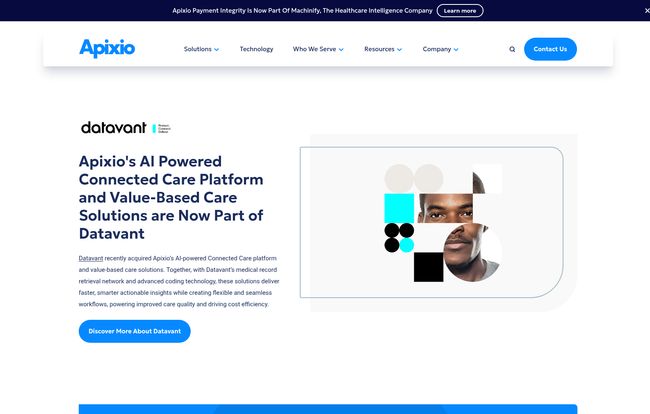
Okay, so you go to Apixio’s website today, and it’s… confusing. You’re greeted with banners saying, “Apixio is now part of Datavant” and also “Apixio Payment Integrity Is Now Part Of Machinify.”
Wait, what? I had to read that a couple of times myself.
From what I can piece together, it seems Apixio, the company, was acquired and its technology absorbed into Datavant, a massive player in connecting health data. At the same time, its specific Payment Integrity solution was sold off to a company called Machinify, which specializes in—you guessed it—using AI to refine healthcare payment processes.
This isn’t just a simple merger. It’s more like a corporate deconstruction. For a potential customer, this is a huge deal. Who do you call? If you loved their risk adjustment tech, do you talk to Datavant? If you need payment integrity, is Machinify your new contact? It turns a straightforward sales process into a bit of a detective story. Honestly, its a bit of a mess from a branding perspective, but it also shows that the underlying technology was valuable enough for two different major companies to want a piece of it.
Visit Apixio
What I Genuinely Admire About the Apixio Approach
Despite the current corporate confusion, I have to give credit where it’s due. The original Apixio vision was spot on. They weren’t just chasing the AI hype; they were applying it to a real, tangible problem that costs the healthcare system billions and directly impacts patient care. I’ve always felt the best tech solves a boring problem, and healthcare billing is about as boring—and important—as it gets.
Their focus on using unstructured data was also brilliant. So much of the real story of a patient’s health is locked away in free-text notes. Any platform that can successfully parse that is doing some serious heavy lifting. It’s the difference between just looking at a map and actually having a local guide tell you where to go.
Potential Hurdles and My Reservations
Let’s circle back to the obvious red flag: the corporate split. Navigating who owns what and who to contact is a genuine hurdle. It creates uncertainty, and if you’re a massive health system, uncertainty is not your friend.
Beyond that, a platform this powerful is never a simple plug-and-play solution. Integrating with existing EMRs (Electronic Medical Records) and internal systems is a massive project. This isn’t like signing up for a new email service; it’s more like performing a data transplant. It requires time, resources, and a ton of IT cooperation.
And then there’s the price… which we’ll get to next.
So, What’s the Price Tag on This Tech?
You won’t find a pricing page on the Apixio, Datavant, or Machinify websites. And you never will. This is classic enterprise software territory. The cost is entirely dependent on the scale of your organization, the specific solutions you need, and the complexity of the integration.
My educated guess? It’s not cheap. This is a premium solution for a high-value problem. You’re gonna have to get on the phone, sit through a demo, and get a custom quote tailored to your organization. It’s the “if you have to ask, you can’t afford it” model, though a more accurate version is “if you have to ask, we need to figure out how much value we can provide you and then price it accordingly.”
Frequently Asked Questions about Apixio
What is Apixio?
Apixio was a healthcare technology company that developed an AI-powered platform to analyze health data. Its primary goals were to improve risk adjustment accuracy for health plans and ensure payment integrity by identifying incorrect claims. Its technology is now part of Datavant and Machinify.
Who typically uses Apixio’s solutions?
The main users are health insurance plans, healthcare providers (like hospital systems), and Accountable Care Organizations (ACOs) who need to manage patient risk and financial performance.
Is Apixio now part of Datavant?
Yes. The core Apixio platform, particularly its risk adjustment and data management technologies, has been integrated into Datavant, a larger company focused on connecting the world’s health data.
Where did Apixio’s Payment Integrity solution go?
Apixio’s Payment Integrity business was acquired by Machinify, another company that uses AI to optimize healthcare administrative and payment processes.
Is Apixio’s platform easy to set up?
No, it’s typically a complex process. Integrating such a platform requires significant technical effort to connect with existing systems like Electronic Health Records (EHRs) and claims processing software.
How much does Apixio (or its new versions) cost?
Pricing is not publicly available. It is provided on a custom-quote basis after consulting with sales teams at either Datavant or Machinify, depending on the solution you need.
Final Thoughts on the Apixio Legacy
So, where does that leave us? Apixio, as a standalone brand, might be fading into the background, but its DNA is very much alive within Datavant and Machinify. The fact that its technology was split and absorbed by two major players is probably the biggest compliment it could receive. It proves the tech works and is incredibly valuable.
For anyone in the healthcare space looking to solve these data challenges, the mission remains the same, even if the names on the door have changed. The need to translate messy data into clear, accurate financial and clinical decisions isn’t going away. In fact, it’s only getting more critical. Apixio was a key player in that fight, and its legacy will continue to shape the industry for years to come.


