
Categories: AI Assistant, AI Research Tool, AI Resume Builder
Applyindex Review: The AI Tool for Your PhD Application?

I still get a cold sweat thinking about my own grad school application days. The endless spreadsheets. The color-coded tabs for ‘Emailed,’ ‘Replied,’ and the soul-crushing ‘Ghosted.’ I spent months trawling through arcane university websites, trying to figure out which professors had funding, whose research actually aligned with mine, and whether my profile was even in the same universe as their typical student. It was, to put it mildly, a grind.
It’s a process that feels fundamentally broken, a weird mix of high-stakes professional networking and sending messages in a bottle. So whenever I see a new tool pop up that claims it can fix this mess, my inner SEO-nerd and former stressed-out applicant both sit up and pay attention. The latest one to cross my desk is called Applyindex. It makes a bold claim: to save you months of work by using AI to streamline your Master’s, PhD, or Postdoc application.
Bold claims require a closer look. So I rolled up my sleeves and did just that.
What Exactly is Applyindex? (And Why Should You Care?)
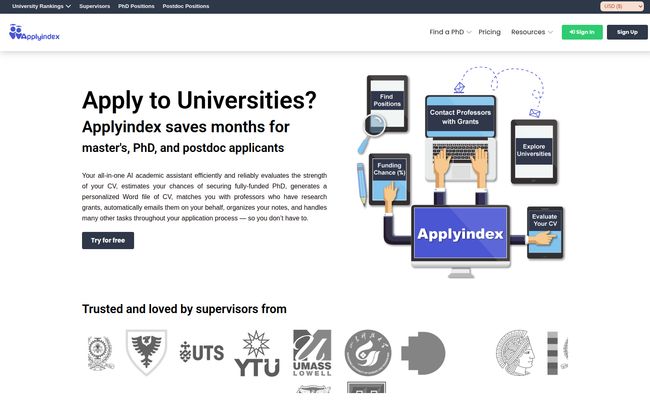
At its core, Applyindex isn’t just another job board listing PhD positions. Think of it more like an intelligent command center for your entire application strategy. It’s designed to be an all-in-one AI assistant that takes on the most tedious parts of the process. We’re talking about matching you with supervisors, figuring out your odds of getting funding, and even helping you organize your notes and contacts.
It’s an attempt to bring a data-driven approach to a world that has long run on prestige, personal connections, and a whole lot of guesswork. For anyone who’s ever felt like they’re just shouting into the academic void, that’s a pretty compelling idea.
The Standout Features That Caught My Eye
I’ve seen a lot of platforms, but a few things about Applyindex felt genuinely different. It’s not just a database; it’s a suite of tools that work together.
The “a-index” – A New Way to Rank Universities?
First up is something they call the “a-index.” We’re all familiar with the big-name university rankings—QS, Times Higher Ed, ARWU. They’re useful, sure, but they often feel like they’re measuring legacy and brand recognition more than anything else. Applyindex sidesteps this with its own proprietary ranking. While they don’t give away the secret sauce, it seems to be built from the ground up with the applicant’s perspective in mind, likely weighing factors more relevant to active research and funding opportunities. I’ve always felt the traditional rankings can be a bit of a trap, and a new perspective is always welcome. It’s a gutsy move, and I’m here for it.
AI-Powered Supervisor Matching
This is the heart of the platform. You build a profile, upload your CV, and its AI gets to work trying to find professors whose work aligns with your own. The real kicker, though, is a feature for premium members: finding supervisors with grants. Anyone who’s been through this knows that’s the golden ticket. A professor can love your work, but if they don’t have funding, the conversation is often a non-starter. Filtering for this specifically could save an unbelievable amount of time and heartbreak. It’s like a dating app where you can filter for people who are actually emotionally and financially available. A revolution!
The Crystal Ball: Funding and CV Strength Estimation
Applyindex gives you two metrics that immediately grab your attention: a CV strength score and an estimate of your chances for a fully-funded position. Now, let’s be real. An AI can’t truly know the complex, human whims of an admissions committee. This is an estimate, a data-driven guess. But here’s the thing: it’s better than the zero data we usually operate with. Seeing a score, even if it’s just an algorithmic projection, gives you a baseline. It can tell you, “Hey, maybe you should get another paper published before you apply,” or “You’re a strong candidate, apply with confidence.” It turns that shapeless anxiety into something you can actually work with.
Beyond Matching: The Application Toolkit
This is where the platform shows it was designed by someone who understands the struggle. It includes a comprehensive notes system, letting you jot down thoughts directly on supervisor and university profiles. Goodbye, messy spreadsheets! It also offers a CV generator that can create a Word file for you, and for premium users, access to samples of successful CVs, Statements of Purpose (SoP), and cover letters. These are the little quality-of-life features that, when combined, add up to a much less chaotic and more organized application process.
Visit Applyindex
Let’s Talk Money: Applyindex Pricing Breakdown
So, what’s the damage? This is often where these promising platforms fall apart, hiding their best features behind a massive paywall. I was pleasantly surprised by Applyindex’s approach. They have a few tiers, mainly aimed at applicants.
| Membership Plan | Price | Key Features for Applicants |
|---|---|---|
| Basic | $0 (Lifetime) | a-index, funding chance estimate, manual supervisor tracking, notes on universities, up to 50 applications. |
| Premium | $19 / Year | Everything in Basic, plus CV generation, supervisors with grants, notes on supervisor profiles, more applications, document samples. |
| Group | $39 / Year | All Premium features for up to 3 users. |
The Basic plan is genuinely free for life, not a 14-day trial. And it’s not a useless, stripped-down version either. You get the core estimations and organizational tools. It’s a perfect way to get a feel for the platform with zero risk.
But in my opinion, the Premium plan at $19 a year is the sweet spot. For less than the cost of a couple of movie tickets, you get the ‘supervisors with grants’ filter and the document samples. Just one successful connection from that feature could be worth thousands of dollars in funding. It feels like a no-brainer for any serious aplicant.
The Good, The Bad, and The AI
No tool is perfect, and a good review needs to be balanced. So let’s break it down.
What I loved was the sheer efficiency. It consolidates so many disparate, agonizing tasks into one dashboard. The data-driven insights, while not gospel, provide a much-needed anchor in a sea of uncertainty. And connecting applicants with funded supervisors is just… smart. It’s targeting the single biggest bottleneck in the entire process.
Where would I be cautious? Well, it’s an AI. Its effectiveness is only as good as its algorithms and the data it’s fed. It can’t capture the human element—the spark of a research idea that a professor might find brilliant even if it’s outside their main focus. It can’t tell you if a supervsor’s management style is a nightmare. You still have to do the human work. You have to read their papers, write a thoughtful, personalized email, and build a genuine connection. This tool doesn’t replace that; it just clears away the underbrush so you can get to that part faster.
So, Is Applyindex Worth Your Time and Money?
After spending some time with it, my verdict is a pretty strong yes. Applyindex isn’t a magic wand that will get you a PhD. It’s a powerful assistant. It’s a force multiplier for your own efforts.
If you’re an international student trying to make sense of a foreign academic system, it could be invaluable. If you’re applying to a dozen or more programs and your brain is turning to mush, its organizational tools will be a lifesaver. And if you’re someone who just feels completely lost and overwhelmed by the sheer scale of the application process, it provides a structured, actionable path forward.
Think of it as a sherpa for your academic Everest. You still have to do the climbing, but now you’ve got an expert guide pointing out the best routes and telling you where the hidden crevasses are. For $19? That sounds like a pretty good deal to me.
The academic world can be slow to change, but the application process is ripe for disruption. Tools like Applyindex are a sign that things are heading in the right direction—towards a more transparent, data-informed, and slightly less terrifying future for aspiring researchers. And that’s something we can all get behind.
Also Read: Hachi AI Review: A Safe AI for Curious Kids?
Frequently Asked Questions (FAQ)
- How accurate is the Applyindex funding chance estimation?
- It should be seen as a data-driven guideline, not a guarantee. The AI uses your profile data to make an educated guess, which can help you gauge your competitiveness. But the final decision always comes down to the admissions committee and the professor.
- Can Applyindex guarantee me a PhD position?
- No, and you should be wary of any service that claims it can. Applyindex is a tool to optimize your search and application process, increasing your chances by connecting you with relevant, funded opportunities. The rest is up to you and the quality of your application.
- Is the Basic (free) plan enough to get started?
- Absolutely. The free plan is surprisingly robust and gives you access to the core features like CV strength estimation and the a-index rankings. It’s a great way to test the platform and organize your initial search without any cost.
- What is the a-index and how is it calculated?
- The a-index is Applyindex’s proprietary university ranking system. While the exact formula is not public, it’s designed to offer an alternative to traditional rankings by focusing on metrics more directly relevant to research applicants, likely related to supervisor activity and funding.
- Does Applyindex help with Master’s and Postdoc positions too?
- Yes. The platform is designed to assist applicants for Master’s, PhD, and Postdoctoral positions, covering a wide range of the academic research career path.
- Who uses the “Gold” and “VIP” memberships?
- Those memberships are for the other side of the marketplace: professors and universities. They use these plans to post open positions and get matched with qualified applicants from the platform’s pool, making it easier for them to recruit top talent.


