
Categories: Other
Asymmetric Data Review: A Better Keyword Clustering Tool?

I’ve been in the SEO game for a while now. Long enough to remember when our most sophisticated tool was an Excel spreadsheet and a whole lot of VLOOKUPs. I have a distinct, slightly traumatic memory of a project involving a 30,000-row keyword export from Ahrefs. My mission? To group them into logical content topics. It took me the better part of a week, a gallon of coffee, and a piece of my sanity I’ll never get back.
We’ve all been there, right? Staring at a sea of keywords, trying to divine Google’s intent from the ether. Do “best running shoes for men” and “men’s running sneakers” belong on the same page? Probably. What about “running shoes for flat feet”? Hmm, maybe a separate article. It’s a process that’s part science, part art, and mostly a massive time sink.
So, when a tool comes along promising to turn that week-long headache into a task that takes mere minutes, my professional curiosity gets piqued. That tool is Asymmetric Data, and I’ve been kicking its tires to see if it lives up to the hype.
First, What Even is Keyword Clustering?
Before we get into the nitty-gritty of the tool, let’s have a quick chat about keyword clustering. If you’re new to this, think of it as organizing your messy closet. You don’t just throw all your clothes in there. You put shirts with shirts, pants with pants. Keyword clustering is the same idea but for your content strategy.
It’s the process of grouping keywords that share a similar search intent. The goal is to create one comprehensive page that can rank for a whole cluster of related terms, rather than creating dozens of thin, competing pages. This approach is the bedrock of building topical authority, which is basically telling Google, “Hey, I’m an expert on this subject.” And Google loves experts.
Meet Asymmetric Data: The Smart Shortcut to Content Strategy
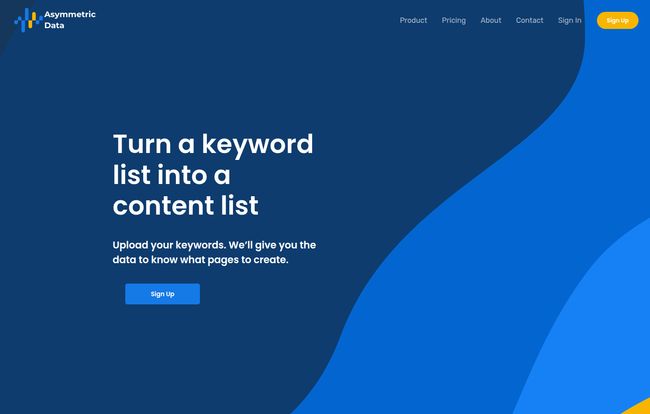
Okay, so Asymmetric Data’s big, bold claim is that it can “Turn a keyword list into a content list.” And honestly, that’s a pretty accurate summary. It’s a specialized tool designed to do one thing and do it exceptionally well: automate the keyword clustering process.
You feed it your raw, chaotic list of keywords, and it hands you back a neatly organized spreadsheet that’s essentially a content plan. It groups your keywords into topics, showing you exactly what terms you can target on a single page.
The Secret Sauce: It’s All in the SERPs
Here’s what I find really compelling. Asymmetric Data doesn’t just guess at groupings based on shared words. That’s old-school and, frankly, not very effective. Instead, it does what a smart SEO would do if they had unlimited time: it checks the Google search results pages (SERPs) for you.
The logic is simple but powerful. If Google is ranking the same top 10 URLs for “best protein powder for beginners” and “good protein powder to start with,” it’s a giant, flashing sign from Google itself that these two keywords have the same intent. They belong together. Asymmetric Data automates this analysis across your entire keyword list, comparing the SERP overlap for every term. It’s like having a tireless robot assistant doing the most tedious part of your job. For me, that’s a game-changer.
Visit Asymmetric Data
Diving into the Asymmetric Data Feature Set
A tool can have a great concept, but it’s the execution and features that determine if it actually fits into your workflow. Here’s what stood out to me.
From a Messy Spreadsheet to a Tidy Content List
The main output is beautiful in its simplicity. You get a spreadsheet with your keywords grouped by a suggested article or page. No more guesswork. It tells you, “These 15 keywords? They all go on one page about Topic X.” It instantly transforms an abstract list of search terms into an actionable hit list for your content team.
Seeing the Future with Opportunity Scoring
This is a nice touch. Beyond just grouping keywords, the tool also provides data on rank, estimated traffic, and an “opportunity” score for each keyword you upload. This helps you prioritize. Once you see your clusters, you can immediately identify which potential articles have the highest traffic potential, helping you decide what to write first. It’s about working smarter, not just harder.
A Tool for the World
I was also impressed with its global reach. It supports keyword clustering for a huge list of countries, from the US and UK to Japan and Sweden. If you do any international SEO, you know how valuable this is. Search intent can vary wildly between regions, and this tool takes that into account by pulling the SERPs for the specific country you’re targeting.
The Big Question: What’s the Price Tag?
Alright, let’s talk about the money. This is often where great tools lose me, with complicated tiers and expensive monthly subscriptions. Asymmetric Data takes a different, refreshingly simple approach: pay-as-you-go.
There are no monthly plans. No contracts. You buy credits, and you use them when you need to cluster keywords. The credits are good for a year, which is more then fair. At their special launch pricing, it’s a flat $4 per 1,000 keywords. This is incredibly transparent.
Here’s a quick breakdown of what that looks like:
| Number of Keywords | Clustering Cost |
|---|---|
| 5,000 Keywords | $20 |
| 10,000 Keywords | $40 |
| 25,000 Keywords | $100 |
| 100,000 Keywords | $400 |
For a freelancer or a small agency that might have a big project one month and a smaller one the next, this model is fantastic. You’re not paying for a tool to sit idle. As Kane Jamison from Content Harmony noted in his testimonial, it’s often more cost-effective than competing services or trying to do it yourself.
Don’t Just Take My Word For It
It’s always good to see what other folks in the industry think. I saw a quote from Cyrus Shephard, a well-respected name in SEO, who said, “Asymmetric Data uncovers traffic-driving topics I wouldn’t have previously discovered. It’s a shortcut to a winning content strategy.”
When someone like Cyrus, who has seen it all, calls something a “shortcut to a winning content strategy,” I pay attention. It validates my own experience with the tool—that it’s not just about saving time, but about finding better opportunities.
A Reality Check: Where It Might Fall Short
No tool is perfect, and a good review should be an honest one. Asymmetric Data is a sharp, focused tool, but that focus comes with a couple of things to keep in mind.
First, it’s not a keyword research tool. It’s a keyword clustering tool. You still need to bring your own list of keywords to the party. You’ll need a subscription to a platform like Ahrefs, Semrush, or a good process with free tools to generate that initial list. This tool is step two, not step one.
Second, while the pay-as-you-go pricing is great for many, if you’re working with absolutely massive keyword lists (we’re talking 200,000+), the cost can start to add up. You just need to be mindful of the scale and budget accordingly. For most projects, though, the pricing feels very reasonable for the value it provides.
So, What’s the Verdict on Asymmetric Data?
After spending some quality time with it, I’m genuinely impressed. Asymmetric Data is a perfect example of a tool that gives you an “unfair advantage,” just like their mission statement says. It automates one of the most critical but mind-numbing tasks in content SEO.
Who is this for? I’d say it’s a must-try for SEO agencies, in-house content managers, and freelance SEOs who are serious about building a data-driven content strategy. It saves an incredible amount of time, and the SERP-based methodology is the right way to approach clustering in 2024.
It takes the messy, artistic guesswork out of content planning and replaces it with cold, hard data from Google itself. And in my book, that’s a huge win. It frees you up to focus on the truly creative parts of our job: writing great content and building great sites.
It won’t replace your brain, but it will act as a powerful, efficient extension of it. And it will definitely save you from that 30,000-row spreadsheet nightmare. Trust me on that one.
Your Questions Answered (FAQ)
- What is Asymmetric Data in simple terms?
- It’s an online tool that takes a big list of keywords and automatically groups them into topics for content creation. It does this by analyzing Google’s search results to see which keywords are already ranking on the same pages.
- How does the pricing for Asymmetric Data work?
- It uses a simple pay-as-you-go model. You buy credits to process keywords, currently at a rate of $4 per 1,000 keywords. There are no monthly subscriptions, and your credits are valid for 12 months.
- Do I need another SEO tool to use it?
- Yes, you’ll need to generate your initial keyword list using a tool like Ahrefs, Semrush, or another keyword research method. Asymmetric Data is for organizing that list, not creating it from scratch.
- What makes it different from other clustering tools?
- Its core strength is its methodology. It relies on real-time SERP overlap data, which is considered the most accurate way to determine search intent and group keywords, as opposed to simpler methods that just match words.
- Is it suitable for international SEO campaigns?
- Absolutely. It supports a wide range of countries and languages, allowing you to pull SERP data specific to your target region, which is crucial for effective international SEO.
- Can beginners use Asymmetric Data?
- Yes, the tool itself is very easy to use—you just upload a list. However, to get the most out of it, a basic understanding of keyword research and content strategy is helpful.


