
Categories: AI Developer Tools, AI For Data Analytics, AI Models, Large Language Models (LLMs), Open Source AI Models
BasicAI Review: A Free Data Annotation Platform?

Alright, let’s have a real chat. If you’re in the AI or machine learning space, you know the drill. You’ve got this brilliant model, this game-changing idea… but it’s starving. It needs data. Not just any data, but clean, perfectly labeled, high-quality training data. And that, my friends, is usually where the budget, timeline, and your sanity go to die a slow, painful death.
For years, data annotation has been the unglamorous plumbing of the AI world. It’s incredibly necessary, but it’s tedious, expensive, and a massive bottleneck. I’ve managed projects that have ground to a halt because the labeling process was just taking too long or costing way more than we’d budgeted. So, whenever a new platform pops up claiming to make this whole process faster, cheaper, and even… enjoyable? My skepticism meter goes through the roof. But so does my curiosity.
Enter BasicAI. The name itself is kind of unassuming, isn’t it? But the promise is anything but. They’re throwing around phrases like “Free AI-powered Training Data Platform” and claiming to speed up labeling tasks by an insane 82 times. Yeah, you read that right. So, I decided to roll up my sleeves, push past the marketing gloss, and see if there’s real fire behind all that smoke.
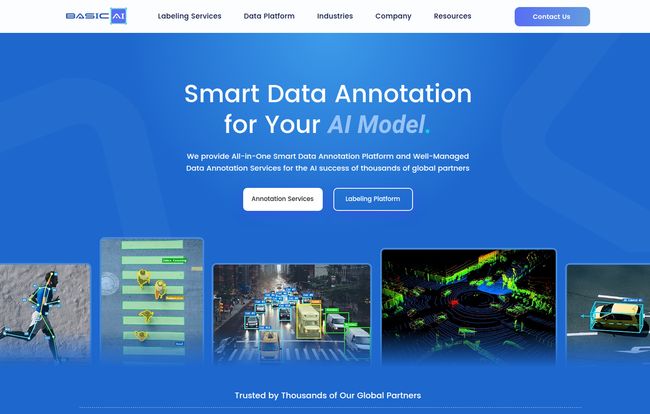
Visit BasicAI Cloud
So, What is BasicAI, Really?
At its core, BasicAI is a platform designed to help teams manage and annotate the massive datasets required to train AI models. Think of it as a supercharged workspace for your data labelers. It provides the tools to draw bounding boxes on images, segment pixels, track objects in videos, and even tackle the beast that is 3D point cloud data from LiDAR sensors.
But the secret sauce, the thing they’re betting the farm on, is their suite of AI-powered tools. This isn’t just about giving you a better pencil to draw with; it’s about giving you a semi-sentient pencil that starts drawing the lines for you. We’re talking auto-annotation, object tracking suggestions, and intelligent segmentation that learns as you go. It’s less of a simple tool and more of a collaborative command center for your entire data operation.
Why Quality Data Annotation Still Keeps Me Up at Night
Let me tell you a quick story. A few years back, I was on a project for an autonomous vehicle startup. Our task? Annotating thousands of hours of video and LiDAR data. The work was… grueling. We had a team of annotators, and managing the workflow, ensuring consistency, and performing quality checks was a full-time job in itself. Every single frame had to be perfect. A mislabeled pedestrian or a poorly tracked car could have serious consequences down the line.
We spent a fortune on a patchwork of software and a ton of manual effort. It was a logistical nightmare. And honestly, that’s the norm for so many companies. The promise of AI is huge, but it’s built on a foundation of human labor. This is the problem BasicAI is trying to solve. It’s not just about labeling; it’s about managing the entire, messy, human-in-the-loop process.
The Features That Actually Caught My Eye
Look, any platform can show you a shiny list of features. I’m more interested in what actually moves the needle on a real project. After digging around, a few things stood out.
AI That Genuinely Helps, Not Hinders
I’ve used some “AI-assisted” tools that were more trouble than they were worth. You’d spend more time correcting the AI’s weird mistakes than you would just doing it manually. BasicAI feels different. Their auto-segmentation and object tracking tools seem to provide a genuinely solid starting point. Think of it this way: instead of your team drawing every single outline from scratch, the AI takes a first pass. Your human annotators then just need to refine and correct. That’s where the massive time savings—that claimed 82x speedup—starts to sound a little less like marketing fantasy and a little more like a possibility.
Team Management That’s Not an Afterthought
This is huge. For any project bigger than a one-person-show, you need to manage people. BasicAI has robust features for creating custom workflows, assigning roles and privileges (annotator, reviewer, project manager, etc.), and tracking performance. You can build a multi-step quality assurance process right into the platform. For example, a junior annotator labels the data, a senior annotator reviews it, and a manager gives the final sign-off. Having this all in one place instead of juggling spreadsheets and Slack channels is a godsend.
It Speaks More Data Languages Than a Polyglot
This might be the most impressive part for me. So many tools specialize. They do images or they do video. Maybe they’ll bolt-on text. BasicAI is designed from the ground up to be versatile. It handles:
- Images & Video
- Text
- Audio
- 3D Point Clouds (LiDAR)
- Sensor Fusion (combining data from, say, a camera and LiDAR)
This is critical for complex industries like automotive, robotics, or agriculture where you’re often working with multiple data streams at once. The fact that it even supports 4D radar (in beta) shows they’re looking ahead.
Let’s Talk Turkey: The Pricing Model
Okay, this is where things can get confusing, so let’s break it down. I saw “Free Platform” and “Starts at $6,600/y” on their site, which feels like a contradiction. It’s not, really—it’s just two different products for two different audiences.
| Plan | Price | Best For | Key Details |
|---|---|---|---|
| BasicAI Cloud | Free | Individuals, startups, research teams, smaller projects. | Generous free tier with up to 50 seats, 100GB storage, and 1,000 AI model calls. It’s a fantastic way to get started and test everything out. |
| Private-Cloud Deployment | Starts at $6,600/year | Enterprises, large teams, projects with high security/compliance needs. | On-premise or private cloud deployment. Fully customizable seats, storage, roles, and support. This is the heavy-duty, enterprise-grade solution. |
My take? The free BasicAI Cloud offering is genuinely impressive. It’s not a crippled demo; it’s a fully functional platform that a lot of teams could use for real projects without paying a dime. The limitations (like 100GB of storage) are fair and you only need to look at the paid options when you start to scale up significantly.
A Few Caveats and My Honest Opinion
No tool is perfect, and it would be dishonest to say otherwise. While the platform is powerful, it’s also comprehensive. There will be a learning curve. This isn’t a tool you master in an afternoon. To really leverage the advanced workflows and AI features, you’ll need to invest some time in learning the system. That’s not really a flaw, just a reality of any professional-grade software.
Also, if you’re a large company with massive datasets, you’ll almost certainly need to move beyond the free tier and look at the private deployment. The free plan is a fantastic gateway, but be realistic about your needs as you grow.
Frequently Asked Questions
- Is BasicAI really free to use?
- Yes, the BasicAI Cloud platform has a very generous free tier that includes up to 50 users and 100GB of storage. For larger needs, security, or on-premise solutions, they offer a paid Private-Cloud Deployment.
- What kinds of data can I label with BasicAI?
- It’s incredibly versatile. You can annotate 2D images, videos, audio, text, 3D LiDAR point clouds, and even complex sensor fusion data that combines multiple sources.
- How does the AI-powered annotation actually work?
- It uses pre-trained models to perform tasks like suggesting object locations (auto-annotation), automatically segmenting parts of an image, or tracking an object from one video frame to the next. Your team then acts as reviewers, correcting and refining the AI’s work, which is much faster than starting from scratch.
- Is BasicAI good for large enterprise projects?
- Absolutely. While the free Cloud version is great for smaller teams, the Private-Cloud Deployment is built specifically for enterprises. It offers enhanced security, on-premise hosting, and full customization to handle large-scale, sensitive data annotation projects.
- What is 3D sensor fusion annotation?
- It’s the process of labeling data that comes from multiple sensors at once, like a camera and a LiDAR scanner. For example, you would draw a 3D box around a car in the LiDAR data and simultaneously link it to the 2D box around the same car in the camera image. It’s crucial for training robust perception systems in self-driving cars and robotics.
The Final Verdict
So, is BasicAI the tool we’ve all been waiting for? It just might be. For too long, companies have had to choose between clunky, expensive software or trying to build a fragile system of scripts and spreadsheets themselves.
BasicAI strikes a really interesting balance. It provides a powerful, free entry point for startups and researchers to get off the ground with professional-grade tools. At the same time, it offers a clear, scalable path for enterprises that need security and customization. The focus on AI-assistance and robust team management shows they understand the real-world pain points of data labeling. It’s not just another annotation tool; it feels like a well-thought-out platform for the entire data pipeline. I, for one, am impressed.


