
Categories: AI Beauty, AI Face Analyzer, AI Image Recognition, AI Robot

Beauty.AI: When Robots Judge Human Beauty

I’ve seen a lot of weird things pop up in the digital marketing and tech space over the years. Trends that burn bright and fade fast, tools that promise to change everything and then just… don’t. But every now and then, I stumble across something from the archives of the internet that makes me stop and just say, “Wow. They really did that, huh?”

Today’s trip down memory lane is about one such project: Beauty.AI. An international beauty contest judged not by humans, but by a robot jury.

Yes, you read that right. A beauty pageant for our new robot overlords. What a concept.

So What in the World Was Beauty.AI?

Picture this. It’s the mid-2010s. The AI hype train is just leaving the station. Everyone is buzzing about the potential of machine learning. And a group of biogerontologists and data scientists decide to ask one of humanity’s oldest, most subjective questions: What is beauty? But they didn’t just want to ask it. They wanted to solve it. With code.

The idea behind Beauty.AI was, on the surface, pretty straightforward. They created a platform with two sets of participants. On one side, you had regular people from all over the world. On the other, you had data scientists. Humans would submit their selfies, and the scientists would submit their algorithms to a central ‘Robot Jury’.

This jury of algorithms would then analyze the photos and pick the winners. No moody human judges, no backstage drama, just cold, hard data crowning the most beautiful people on Earth. It feels like an episode of Black Mirror, but it was completely real.
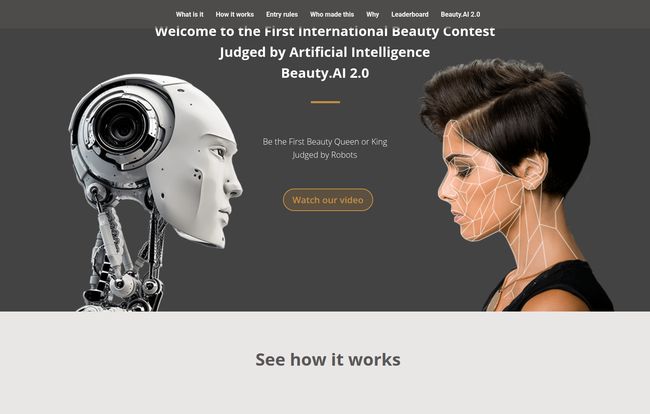
Beauty.AI
Visit Beauty.AI

The Rules of Engagement for Humans and Robots

The fascinating part was how they structured this digital showdown. It was a competition on two fronts.

So, You Think You’re Pretty? The Human Side

For us mere mortals, the entry requirements were simple and, honestly, a little clinical. You had to download their app and take a fresh-faced selfie. The rules were strict:

  • No make up.
  • No glasses.
  • No beard.

The goal was to strip away all the artifice and present a pure, unadulterated version of your face for the machines to analyze. You were literally feeding your face into the matrix, hoping it would spit back a ribbon. Kind of brave, when you think about it.

Calling All Data Scientists: The Robot Side

This, for me, is where it gets really interesting. This wasn’t just one company’s AI. Beauty.AI was a challenge to data scientists everywhere: build a better beauty bot. They were invited to create and submit their own algorithms to the jury. The AI would then be evaluated based on its ability to judge human faces against a set of predetermined parameters. These included:

  • Wrinkles
  • Face symmetry
  • Skin color and tone
  • Gender
  • Age group
  • Ethnicity

So, you had a contest for humans being judged by robots, which were themselves in a contest being judged by… well, by how well they judged the humans. It’s a bit of a Russian doll of competitions.

The Ambition Behind the Bot

Now, it’s easy to dismiss this as a quirky gimmick, but the team behind it had some lofty goals. According to their old website, they were a team of biogerontologists—scientists who study the biology of aging. Their stated purpose wasn’t just to crown a prom king and queen of the internet.

“The team of biogerontologists and data scientists, who believe that in the near future machines will be able to get a lot of information about a person’s health and lifestyle by just processing their photo.”

They hoped to find objective, data-driven markers of health and “healthy aging” that could be identified from a simple photograph. The idea was that by quantifying things like skin texture and facial symmetry, they could develop AI that might one day help people live longer, healthier lives. A noble goal, to be sure, but wrapping it in the language of a beauty contest? That’s where things get… complicated.

The Big, Glaring Problem with AI Judging Beauty

As any SEO or data analyst knows, our tools are only as good as the data we feed them. And this is the fundamental flaw at the heart of Beauty.AI. It ran headfirst into a problem we’re still grappling with today: AI bias.

An algorithm doesn’t ‘know’ what beauty is. It learns to recognize patterns from the data it’s trained on. If you train an AI on a dataset of photos that is overwhelmingly of one skin tone or facial structure, its idea of ‘beauty’ will become skewed toward that demographic. It’s not malicious; it’s just math. Garbage in, garbage out.

And that’s exactly what happened. When the results of the first contest were announced in 2016, a huge majority of the 44 winners were white. Out of thousands of contestants from around the globe, there were very few winners of color, and only one with dark skin. The public outcry was immediate and justified. The Robot Jury wasn’t objective; it was just reflecting the biases baked into its training data.

It’s like asking a calculator to judge a poem. It can count the syllables and measure the rhyme scheme perfectly, but it completely misses the emotion, the context, the soul of the work. Beauty is so much more than symmetry and a lack of wrinkles. It’s character, kindness, confidence, a spark in the eye—things you just can’t quantify in a dataset.

So, What Happened to Beauty.AI?

Well, if you try to visit their website today, you’ll be greeted by a ‘404 Page not found’ error. The project is a digital ghost town. After the controversy of the first competition, they did attempt a Beauty.AI 2.0, but it never regained momentum.

In my opinion, Beauty.AI is a perfect artifact of its time. A fascinating, deeply flawed experiment from a slightly more naive era of consumer-facing AI. It served as an early, very public lesson in the dangers of algorithmic bias. It forced a necessary and uncomfortable conversation about what happens when we try to outsource subjective human judgment to machines without considering the consequences.

FAQs about the Bot Pageant

What was the main goal of Beauty.AI?
Officially, the goal was to use AI to find objective markers of human health and aging by analyzing photos. The ‘beauty contest’ was the public-facing framework for this scientific experiment.
Did Beauty.AI have a cost to enter?
No, based on the available information, it was free for both humans to submit their selfies and for data scientists to submit their algorithms. There was no pricing information available.
Why was Beauty.AI so controversial?
The primary controversy stemmed from AI bias. The winning selections were overwhelmingly white, which suggested the algorithms were trained on biased data and couldn’t fairly judge beauty across different ethnicities. This raised serious ethical questions.
Can I still participate in Beauty.AI?
No, the project is defunct. The website is no longer active, and the contests have not run for several years.
What parameters did the AI use to judge beauty?
The algorithms evaluated faces based on factors like facial symmetry, wrinkles, skin quality, age, ethnicity, and gender.

A Beautifully Flawed Experiment

Looking back, Beauty.AI wasn’t a total failure. As a publicity stunt and a data-gathering exercise, it was pretty brilliant. But as a scientific or social experiment, it was a cautionary tale. It showed us, very clearly, that code is not neutral. It reflects the values, blind spots, and biases of its creators.

It was an early, clumsy step in a long conversation about AI and ethics that we’re still deeply enmeshed in today with generative art, deepfakes, and hiring algorithms. And for that, maybe this weird, forgotten beauty contest was more valuable than it ever intended to be.

Reference and Sources

Categories: AI Avatar Generator, AI Beauty, AI Face Swap Generator, AI Face Swap Video, AI Image Generator, AI Photo Editor

Beauty.AI: The AI Beauty Contest That Judged Humans

Remember when we all thought the robot takeover would look something like The Terminator? All chrome skeletons and ominous red eyes. Turns out, reality is often stranger, and sometimes, a lot more vain. Before AI was writing our emails and generating surreal art, one of its first big public gigs was, of all things, judging a beauty pageant.

Yes, you read that right. I’m talking about Beauty.AI, a project that flared up a few years back and caused quite a stir. It promised to be the first international beauty contest judged not by humans with their messy biases, but by the cold, objective logic of an algorithm. The idea was both fascinating and, let’s be honest, a little creepy. It felt like a Black Mirror episode waiting to happen.

As someone who’s watched search trends and viral crazes for years, this one stuck with me. It was a perfect storm of vanity, technology, and a good dose of controversy. So what was it all about, and where did it go?

What on Earth Was Beauty.AI?

The premise was deceptively simple. You, a human, would download their app, snap a selfie, and submit it. The catch? The rules were strict: no makeup, no glasses, no beard. The app would apparently even check to make sure you were playing fair. Your unadorned face would then be sent to the digital judging panel.

This wasn’t just one AI, but a whole jury of them. The system would analyze the photos based on a bunch of different parameters and then, with the digital rap of a gavel, the AI would choose the ‘Beauty Queen or King.’ The news of the world’s most objectively beautiful people would then, supposedly, spread like wildfire. It was a bold, weird, and wonderfully ambitious idea for its time (we’re talking circa 2016, an eternity in tech years).

The So-Called Science Behind the Bot Judges

This wasn’t just a gimmick for gimmick’s sake. Or at least, that wasn’t the official story. The creators—a team of biogerontologists and data scientists—claimed a higher purpose. Their theory, as stated on their old website, was that our perception of beauty is deeply linked to our health.

Beauty AI
Visit Beauty AI

They wanted to train algorithms to find correlations between facial features and health or age. The contest was, in essence, a massive data-gathering operation disguised as a pageant. The AI jury was being trained to evaluate things like:

  • Face symmetry
  • Wrinkles (one of their partners was an app literally called RYNKL, for wrinkle detection)
  • Skin quality and color
  • Age group and ethnicity markers

In my experience, whenever a company offers you something cool for free, you’re the product. In this case, your face was the product, feeding a machine that was learning to quantify aging. A bit unsettling, but you have to admire the cleverness of the approach.

The Controversy and The Inevitable Aftermath

Of course, the project was immediately swamped with criticism. Can an algorithm truly be objective? The data it’s trained on is human-generated, so it’s bound to inherit our biases. Reports from the contest’s results, like one from The Guardian, suggested the AI had a clear preference for white skin. It was a classic case of algorithmic bias, a problem the tech world is still wrestling with today.

And then… poof. It just sort of vanished.

If you try to go to the original Beauty.AI website now, you’re greeted by a lonely “404 Page not found” error. A digital ghost town. The deadlines on the original page were for January 2016. The project had its moment in the sun, sparked a debate, and then faded into the internet’s ever-growing attic of forgotten projects.

The Ghost in the Machine: Has the Concept Evolved?

But here’s where it gets interesting. The name ‘Beauty AI’ hasn’t completely disappeared. While the original contest is a relic of the past, the technology it pioneered—analyzing and manipulating faces—is more mainstream than ever. Today, if you search for ‘Beauty AI’, you’re more likely to find a modern visual AI platform that does something completely different.

These new tools aren’t here to judge you. They’re here to help you create.

A New Kind of “Beauty AI” for Content Creators

The modern iteration of a ‘Beauty AI’ is less about pageants and more about a pocket-sized special effects studio. These platforms use advanced AI to let you do some seriously wild stuff with your photos and videos, no complex skills required. We’re talking about features like:

  • AI Face Swap: The bread and butter. Seamlessly put your face on another body, in another picture, or even in a famous movie scene. The results can be hilarious and surprisingly high-quality.
  • Video Face Swap: This is where things get really impressive. Swapping faces in a moving video used to be Hollywood-level stuff. Now, you can do it from your browser.
  • Body Swap & Multiple Face Swap: Some tools even let you swap entire bodies or manage swaps with multiple people in a single image.

Instead of an AI judging your wrinkles, you now have an AI that can put your face on a GIF of a dancing cat. I think we can all agree that’s a much better use of technology.

The Good, The Bad, and The Temporary

Of course, it’s not all sunshine and flawlessly-swapped faces. These new tools have their own quirks. They are incredibly easy to use, which is a huge plus for those of us who never got the hang of Photoshop. Many offer a free trial or a set of free credits upon signing up, so you can test the waters before committing.

But there are downsides. The quality of your masterpiece is heavily dependent on the quality of the photos you upload. A blurry, low-lit photo will give you a blurry, nightmarish result. And one of the biggest gotchas I’ve seen with some of these platforms is that they only store your files for a limited time, sometimes just 7 days. If you’re not on the ball with downloading your creations, they could be gone forever. I’ve lost more than one good meme to the digital ether that way. Pricing information can also be a bit obscure, often based on a credit system rather than a straightforward monthly fee.

FAQs About Beauty.AI

What was the original Beauty.AI contest?

It was an international beauty contest held around 2016 where contestants submitted their selfies to be judged by an artificial intelligence, not human judges. The stated goal was to find links between perceived beauty and health markers.

Could an AI really judge beauty objectively?

That’s the big debate! The short answer is no. The AI is trained on data selected by humans, and it ended up showing the same biases found in society, for example, favoring certain skin tones. True objectivity in something as subjective as beauty remains a huge challenge for AI.

Is the original Beauty.AI website still active?

Nope. The project appears to be defunct. The original website now leads to a 404 error page, indicating it’s no longer maintained.

What are modern “Beauty AI” tools used for?

Today, tools with similar names are generally used for content creation and entertainment. Their main features include AI-powered face swapping in photos and videos, image enhancement, and generating funny memes or creative visuals.

Are these AI face swap tools free to use?

Most operate on a freemium model. They typically give you a certain number of free credits to try the service when you sign up. Once those are used, you’ll need to purchase more credits or subscribe to a plan to continue using the tool.

From Judgment to Creation: A Final Thought

The journey from the original Beauty.AI to the creative tools of today is a perfect snapshot of our evolving relationship with artificial intelligence. We’ve moved from a slightly dystopian experiment where we asked AI to judge us, to a creative partnership where we use AI to express ourselves. We’ve taken the power back.

While the original contest is now just a quirky footnote in tech history, its spirit lives on in the powerful, accessible, and sometimes downright weird creative tools we have today. And personally, I’d much rather have an AI that helps me make a funny GIF than one that tells me I need to work on my face symmetry.

Reference and Sources