
Categories: AI Agent, AI Copilot, AI Image Recognition, AI Models, AI Research Tool, Large Language Models (LLMs)
Bethge Lab: Where AI Meets the Brain’s Mysteries

The AI space is noisy right now. Every single day, there’s a new headline, a new model, a new tool that promises to write all your emails and plan your vacations. And honestly? A lot of it is pretty amazing. But after the initial ‘wow’ factor wears off, I always find myself asking a deeper question: are these things really learning, or are they just incredibly sophisticated parrots?
Most of the AI we interact with is trained on a massive, static dataset. It’s like cramming for a final exam. It might know all the answers from the textbook, but can it adapt when it gets to college? Can it learn a new skill without forgetting the old one? That’s a whole different ballgame. And that’s exactly the game that a fascinating group called the Bethge Lab is playing.
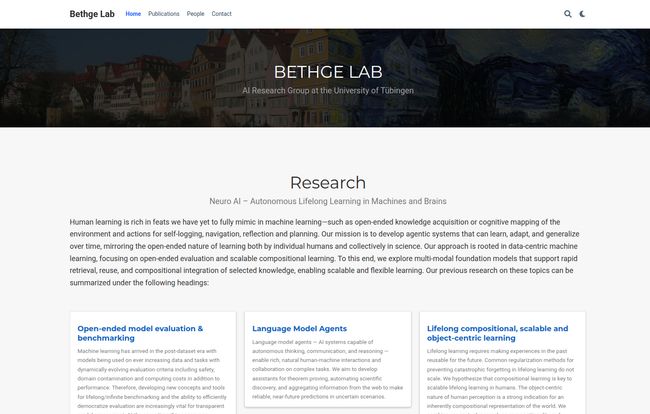
I stumbled upon their work at the University of Tübingen and was immediately hooked. This isn’t another company trying to sell you a chatbot. This is a research lab, led by Matthias Bethge, dedicated to one of the most mind-bending challenges out there: creating AI that learns continuously and autonomously, much like a human brain. They call it Neuro AI, and it’s the kind of stuff that keeps me up at night—in a good way.
Visit Bethge Lab
So, What’s the Big Idea at the Bethge Lab?
In a nutshell, the Bethge Lab is trying to bridge the gap between artificial intelligence and actual neuroscience. Instead of just building bigger models and feeding them more data (the current brute-force approach), they’re looking at the elegant, efficient systems that nature already built: our brains. They’re focused on creating what they call “agentic systems.”
Think of it like this: your Google Assistant is a tool. You ask, it answers. An agentic system, on the other hand, would be more like a digital apprentice. It could learn new tasks on the fly, combine different skills to solve novel problems, and get better over its entire lifespan without needing a complete re-training every six months. It’s the difference between a calculator and a mathematician. Both are useful, but one truly understands.
This research hub operates at the crossroads of academia and application, a sweet spot where theoretical breakthroughs meet real-world viability. It’s less about a quick win and more about building the foundational understanding for the next generation of AI.
The Research Pillars That Really Stand Out
When you browse their site, you don’t see product features. You see research pillars. And for a tech nerd like me, it’s like a candy store. Here are the bits that had me nodding along.
Building AI That Can Think on Its Feet
One of their focuses is on “Lifelong compositional, scalable and interpretable learning.” That’s a mouthful, I know. But the core idea is revolutionary. They want to build AI that doesn’t suffer from ‘catastrophic forgetting’—the tendency for neural networks to completely overwrite old knowledge when they learn something new. We’ve all seen this with certain models; they can be an expert on Shakespeare one minute, but after you train them on Python code, they forget who Romeo is. The Bethge Lab is working on systems that can accumulate and compose knowledge, like building with LEGOs, rather than just replacing the whole structure every time.
More Than a Chatbot: Creating True Language Agents
The work on “Language Model Agents” is another fascinating area. This goes beyond simple Q&A. They are exploring how to give models agency—the ability to plan, reason, and interact with their environment to achieve goals. It’s about turning a passive text-predictor into an active problem-solver. This is where AI starts to feel less like a tool and more like a collaborator.
Peeking Inside the AI’s ‘Brain’
This might be the coolest part for me. With their work on “Modeling brain representations & mechanistic interpretability,” they are trying to pop the hood on these complex systems. Right now, most advanced AI models are ‘black boxes.’ We know the input and we see the output, but the process in between is a mystery. The Bethge Lab is using what we know about the human brain to understand and even predict the inner workings of these artificial neural networks. They’re also studying “Attention in Humans and Machines,” trying to replicate the brain’s incredibly efficient ability to focus on what matters and ignore the noise. That’s a skill even I could use more of!
From the Ivory Tower to the Startup Garage
What I really appreciate about the Bethge Lab is that they’re not just publishing papers and calling it a day. Their dedication to “AI sciencepreneurship” shows a clear path from research to reality. They actively support spinning off their research into startups, fostering a cycle of innovation where academic discovery leads to tangible products and services that can solve real-world problems.
This is so important. I’ve seen too many brilliant academic projects wither on the vine because there was no bridge to the commercial world. By encouraging researchers to become founders, the lab ensures its groundbreaking work has a chance to make a real impact beyond the confines of a university. It grounds the high-level theory in practical application, which is a philosophy I can definitely get behind.
Who is this Research For, Really?
Let’s be clear: this is not for the casual user looking for a new app to try. You won’t find a download button or a pricing page (it’s a research lab, after all). The work being done here is highly specialized and, frankly, you’d probably need a strong background in AI or neuroscience to fully grasp the technical papers.
However, if you’re an AI developer, a machine learning engineer, a VC looking for the next tectonic shift, or just a deeply curious person like myself, then the Bethge Lab is a goldmine. It’s a window into the fundamental questions that will define the next decade of artificial intelligence. It’s for people who care about the why and the how, not just the what.
Digging through their site for specific datasets or project details can be a bit of a treasure hunt. I even hit a classic 404 page at one point while clicking around. And you know what? It was kind of perfect. It’s a humble reminder that even the people building the future of intelligence have to deal with the occasional broken link. It makes them feel more human, you know?
Frequently Asked Questions
- What is the main goal of the Bethge Lab?
- The primary goal is to understand and replicate the principles of autonomous lifelong learning as seen in biological brains. They aim to build ‘agentic AI’ systems that can learn, adapt, and generalize over time without constant human supervision or retraining.
- Can I use the Bethge Lab’s technology?
- Not directly as a consumer product. The Bethge Lab is a research group, not a software company. Their output consists of research papers, open-source contributions, and spin-off startups. The best way to engage with their work is by following their publications and the projects of their partner institutions.
- Is the Bethge Lab a company?
- No, it is an academic research group at the University of Tübingen, which is part of Germany’s Cyber Valley, a major European hub for AI research. However, it does actively encourage the creation of spin-off companies.
- What is Neuro AI?
- Neuro AI is a field that combines neuroscience and artificial intelligence. It uses insights from how the human brain processes information, learns, and pays attention to design more efficient, capable, and understandable AI models.
- How does the lab support the community?
- Beyond their core research, they are involved in broader impact initiatives like BWKI (a federal competition for artificial intelligence) and IT4Kids, which brings programming and digital education to young students. Its about inspiring the next generation.
Final Thoughts
In a world obsessed with the latest shiny AI object, it’s refreshing and incredibly exciting to see a group like the Bethge Lab focused on the deep, foundational challenges. They’re not just building a better mousetrap; they’re trying to understand the mouse. Their work on lifelong learning, interpretability, and agentic systems is laying the groundwork for an entirely new kind of artificial intelligence—one that’s more adaptable, more understandable, and maybe, just maybe, a little more like us.
I’ll be keeping a close eye on their work. Because while everyone else is watching the show, the Bethge Lab is busy building the stage for the next act. And I have a feeling it’s going to be a good one.
Reference and Sources
- Bethge Lab Official Website: https://bethgelab.org/
- Cyber Valley: https://cyber-valley.de/en


