
Categories: AI Agent, AI For Data Analytics, AI Workflow, No-Code&Low-Code
Boost.space Review: The AI Data Hub We’ve Been Waiting For?

If you’re running a business that’s more than a few years old, your tech stack is probably a tangled mess of digital spaghetti. Your CRM doesn’t talk to your support desk properly, your marketing automation data is slightly different from your sales data, and your finance team is pulling their hair out trying to reconcile it all. We’ve all been there. It’s the digital equivalent of having a dozen filing cabinets, all with a different organizational system. A nightmare.
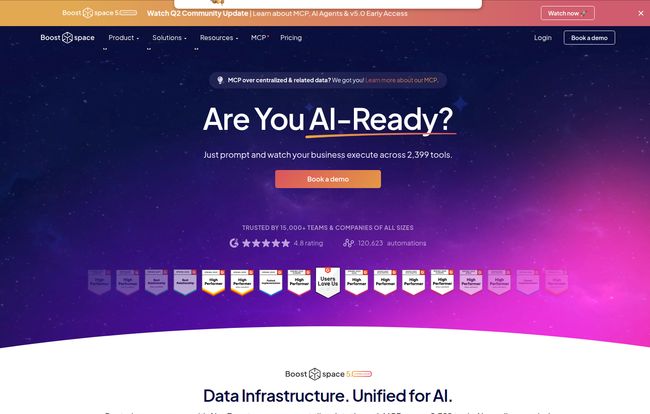
Every so often, a tool comes along that claims to be the universal translator, the one platform to rule them all. I’m naturally skeptical. I’ve seen countless tools promise seamless integration only to deliver a clunky, one-way data push that breaks if you look at it funny. So when I came across Boost.space, with its slick branding and bold claims of being an “AI-Ready Data Sync Platform,” my curiosity was piqued. But was it just another drop in the ocean of iPaaS (Integration Platform as a Service) solutions, or is it something… different?
Visit Boost.space
So, What is Boost.space, Really?
On the surface, Boost.space is a data integration and automation platform. Okay, fine. But digging a little deeper, its core mission seems to be creating a single, unified source of truth for all your company’s data. It’s not just about connecting App A to App B like a simple Zapier task. It’s about building a central hub where data from all your tools—over 2,000 of them, apparently—can be consolidated, standardized, and synchronized in real-time. Think of it less as a series of pipes connecting different buildings and more like a central nervous system for your entire business operation.
The platform is built on a no-code philosophy, which is a huge plus. It means you don’t need a team of developers on standby to connect your HubSpot to your Google Sheets or your Notion database to your project management tool. The goal is to democratize data management, making it accessible to the operations managers, marketers, and sales leaders who actually depend on that data every single day.
The Core Features That Actually Matter
A long feature list can be overwhelming. I prefer to focus on what actually moves the needle. For Boost.space, a few things really stand out from the typical marketing fluff.
True Two-Way Synchronization
This is a big one. So many integration tools only do one-way “pushes.” If a customer updates their address in your customer portal, you want that change reflected everywhere—in your CRM, your billing system, and your shipping software—instantly. One-way sync can’t do that reliably. Boost.space’s emphasis on two-way synchronization means data remains consistent across the board. An update in one system becomes an update in all connected systems. This is the holy grail for data integrity, and from the sound of it, they take it seriously.
No-Code with a Massive Integration Library
I can’t overstate the importance of their 2,000+ integrations. The sheer breadth means you’re very unlikely to find a tool in your stack that it can’t connect to. From industry giants like Salesforce and Skoda to the tools every startup uses like Notion and Slack, the coverage is impressive. And because it’s no-code, the person who understands the business process can be the one to build the automation, which is how it should be.
Getting Your Data ‘AI-Ready’ with MCP
Here’s where things get interesting and a bit… futuristic. Boost.space talks a lot about its “Model Context Protocol” (MCP). It sounds like complex jargon, but the idea is actually quite brilliant. Think of it this way: AI models are powerful, but they’re only as good as the data you feed them. If you feed an AI messy, unstructured, and out-of-context data, you’ll get garbage results. MCP is a system for standardizing and adding context to your data before it gets to an AI. It’s like a librarian meticulously cataloging every book with summaries, author bios, and genre tags, so when you ask for a “19th-century mystery novel,” you get exactly that, not a cookbook. By making your data AI-ready now, you’re not just solving today’s problems; you’re future-proofing your business for the next wave of technology.
Who Is This Platform Actually For?
Let’s be clear, this isn’t a tool for a freelancer looking to connect their calendar to their to-do list. The language, features like “Enterprise-Grade Security & Compliance,” and the testimonials from companies like Skoda and Slevomat point squarely at a specific market. Boost.space is designed for:
- Scaling Startups: Companies that are moving past the early-stage chaos and need to build a solid data foundation to support growth.
- Mid-Market Companies: Businesses with multiple departments, complex workflows, and a sprawling SaaS stack that’s becoming unmanageable.
- Large Enterprises: Corporations that need robust, scalable, and secure data infrastructure to drive efficiency and power advanced analytics and AI initiatives.
If you’re a team lead or C-suite executive who has ever sat in a meeting and heard “well, my numbers say something different,” you are the target audience.
Let’s Talk Money: Boost.space Pricing
Alright, the all-important question: what does this powerhouse cost? The pricing isn’t hidden, but it does confirm who this platform is for. It’s an investment in your data infrastructure.
Boost.space offers two main tiers, ‘Scale’ and ‘Enterprise’. The pricing page is pretty transparent about the starting point for the Scale plan, which I appreciate.
| Plan | Pricing | Key Features |
|---|---|---|
| Scale | Starting at $800/month | No-Code Automation Engine, Built-in AI Features, Remote MCP Server, Boost.space API. Good for businesses ready to centralize their data. |
| Enterprise | Custom | Everything in Scale, plus dedicated services, implementation support, on-premise options, and multicurrency databases. Built for complex, global needs. |
An $800/month starting price is significant, and it immediately separates the serious players from the window shoppers. This isn’t a tool you try out on a whim. It’s a strategic decision. However, when you consider the cost of developer hours, the price of bad data, and the missed opportunities from disconnected systems, that number starts to look a lot more reasonable.
The Good, The Bad, and The Realistic
No tool is perfect. After spending years in this space, I know to look for the trade-offs. Here’s my honest take on Boost.space.
The Strong Points
The biggest pro is the vision. They aren’t just building another connector; they’re building a central data hub with AI at its core. The massive integration library and the true two-way sync are huge practical advantages. As one of their clients, Jeremy from Rowe, puts it, they “expertly crafted and integrated our Meddix.io e-commerce platform with external tools and warehouses.
That’s a testament to getting the hard stuff right.
Potential Hurdles
First, a platform this powerful will inevitably have a learning curve. While it’s “no-code,” that doesn’t mean “no-thought.” You’ll need to invest time to understand its architecture and get the most out of it. Second, the price. It’s enterprise-grade software with an enterprise-grade price tag, which will put it out of reach for many smaller businesses. Finally, like any rapidly developing platform, some features might be newer or have less documentation than others, though they seem to be building quickly.
Conclusion: Is Boost.space Your Data’s Knight in Shining Armor?
So, is Boost.space the solution to all our data woes? For the right company, I think it very well could be. It’s more than just an automation tool; it’s a foundational piece of data infrastructure. If your business is drowning in data chaos, struggling with inconsistent information across departments, and you want to prepare for a future where AI is not just a buzzword but a core operational driver, then you should absolutely book a demo.
It’s not a quick fix or a cheap gadget. It’s a strategic investment in creating a single source of truth. And in my experience, that’s an investment that almost always pays off.
Frequently Asked Questions
What does Boost.space replace?
Boost.space can potentially replace a complex web of tools like Zapier or Make, custom-coded scripts, and manual data entry processes. Its goal is to act as the central hub, rather than just one of the spokes, by consolidating and standardizing data from all your tools.
Is Boost.space easy for non-technical users?
It’s designed with a no-code interface, meaning you don’t need to be a programmer to use it. However, given its power, there will be a learning curve. A business analyst or operations manager should be comfortable with it, but it requires a strategic understanding of your data flows.
How is Boost.space different from Zapier?
Zapier is primarily a tool for task automation (IF this happens in App A, THEN do that in App B). Boost.space is a data infrastructure platform focused on two-way synchronization and creating a unified, standardized central data hub. It’s a more foundational and robust solution for data management, not just simple task automation.
What is the Model Context Protocol (MCP)?
Think of MCP as a set of rules and a system for organizing your data. It cleans, structures, and adds context to information from all your different apps. This ensures the data is uniform, accurate, and ready to be used effectively by advanced AI models, improving the quality of AI-driven insights and automation.
Is there a free trial for Boost.space?
The website doesn’t advertise a self-serve free trial. Given its enterprise focus, the standard process is to “Book a Demo.” This allows their team to understand your needs and show you how the platform can solve your specific data challenges.
What kind of support can I expect with Boost.space?
The pricing tiers suggest different levels of support. The Enterprise plan explicitly includes dedicated services, a shared Slack support channel, and implementation support. The Scale plan likely includes standard support, but for high-touch assistance, the Enterprise plan is the way to go.


