
Categories: AI Blog Generator, AI Image Generator, AI SEO Tools, AI Title Generator, SEO Writing AI
Byword Review: AI Content Automation for SEOs?

Alright, let’s have a chat. If you’re anything like me, your inbox is probably a graveyard of pitches for the “next revolutionary AI content tool.” It feels like a new one pops up every Tuesday. Most of them promise the world, but end up delivering generic, soulless content that a savvy five-year-old could spot as AI-written from a mile away. So, when I first heard about Byword, I’ll admit my initial reaction was a healthy dose of SEO-veteran skepticism.
But then I saw a few things that piqued my interest. Words like “Programmatic SEO,” “Google Search Console Integration,” and “Complete SEO automation.” These aren’t the usual fluffy marketing terms. These are words that speak directly to the core challenges we face in this game: scale, data, and efficiency. Is it just another tool in the AI content gold rush, or is it something… more? I decided to take a closer look.
Visit Byword
So What Is Byword, Actually?
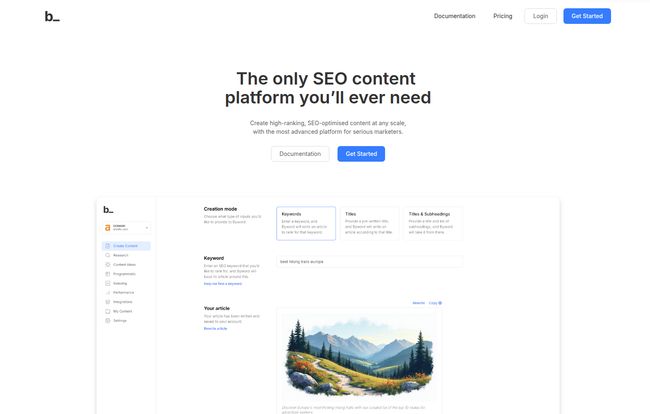
At its heart, Byword is an AI article writer. No surprises there. But calling it just an “article writer” is like calling a Bugatti just a “car.” It misses the point. Byword is engineered from the ground up for one specific purpose: generating high-quality, SEO-optimized articles at a scale that would make a content manager weep with joy.
This isn’t about asking an AI to write you a single blog post about the best dog food. This is about handing it a CSV file with 1,000 long-tail keywords—think “best hiking boots for wide feet in colorado” or “how to fix a leaky faucet under the kitchen sink”—and having it generate a thousand unique, structured, and search-friendly articles. It’s a content assembly line, but one that promises craftsmanship.
The Features That Genuinely Made Me Look Twice
A feature list is just a list until you see how it solves a real-world problem. Here’s what stood out to me from a pure, in-the-trenches SEO perspective.
Programmatic SEO Without the Migraine
Let’s be real, programmatic SEO (pSEO) is a dream for many of us. The idea of creating hundreds or thousands of landing pages from a single template and a dataset is powerful. Think of all the city/service pages, product comparisons, or specific query pages you could build. The reality? It’s often a technical nightmare involving developers, complex scripts, and a lot of things that can go wrong. I once tried a manual pSEO project for an e-commerce client and the amount of spreadsheet wrangling was… memorable. Not in a good way.
Byword aims to be the user-friendly front end for this powerful strategy. You can build customizable article templates and hook them up to your own datasets. This is how you can scale your content footprint to cover super-specific niches that your competitors wouldn’t even dream of targeting manually. It’s a huge competitive advantage if you can pull it off.
Google Search Console Integration is a Game Changer
This one really got my attention. Byword can connect directly to your Google Search Console account. Why does this matter? It means the AI isn’t just guessing what people are searching for; it’s working with real-time data from your own website. It can see which keywords you’re getting impressions for but not clicks (hello, content update opportunities!) and help you create content to fill those gaps. This turns the platform from a simple content generator into a more strategic content partner. It’s a feedback loop that could seriously accelerate your traffic growth.
Customization That Goes Beyond a ‘Tone of Voice’ Slider
Most AI writers give you basic options: friendly, professional, witty. It’s a bit of a gimmick. Byword goes deeper. The Knowledge Integration feature lets you feed the AI specific information—your company’s unique data, product specs, expert quotes, you name it. This helps solve the biggest problem with AI content: its tendency to be generic. By grounding the articles in your own proprietary information, you create something that other AIs (and your competitors) can’t easily replicate.
Add in custom prompting, automatic internal linking that actually makes sense, and intelligent meta content generation, and you have a suite of tools that gives you a surprising amount of control over the final output.
Let’s Talk Money: The Byword Pricing Structure
Okay, this is where the rubber meets the road. A great tool is only great if you can afford it. Byword is definitely positioned as a premium, professional-grade platform, and the pricing reflects that. No $29/month plan here. Here’s a quick breakdown:
| Plan | Price per Month | Key Features |
|---|---|---|
| Starter | $99 | 25 articles, 25 research reports |
| Standard | $299 | 80 articles, 80 research reports, Whitelabelling |
| Scale | $999 | 300 articles, 300 research reports, Whitelabelling |
| Unlimited / Self-Serve | $1,999 | Unlimited articles, dedicated server, BYO API key option |
| Managed | From $3,999 | They do all the work for you |
Frankly, the Starter plan at $99 for 25 articles feels a little steep. That’s about $4 per article, which might be tough for a solo blogger to swallow. But I don’t think that’s their target audience. The value really starts to appear with the Standard and Scale plans, especially for agencies or businesses with aggressive content goals. When you factor in the time saved on research, writing, editing, and internal linking, the ROI starts to make a lot of sense.
The Self-Serve plan is particularly intriguing for heavy users. Bringing your own OpenAI API key means you’re only paying Byword for the platform and infrastructure, while your content generation costs are directly with OpenAI, which can be much cheaper at scale. It’s a pro move for the pros.
The Good, The Bad, and The AI-Generated
No tool is perfect. After digging in, here’s my balanced take. What I love is the platform’s clear focus. It knows it’s for SEOs who need to scale. The programmatic features and GSC integration are brilliant. It’s a tool built to execute a specific, high-value strategy.
However, there are things to be cautious about. The price will certainly be a barrier for some. And this is not a magic wand. The quality of your output will always, always depend on the quality of your input. If you give it lazy keywords and zero custom knowledge, you’ll get lazy, generic content back. You still need a solid SEO strategy and a good understanding of your niche to make Byword truly sing. It’s a power tool, and like any power tool, it can make a big mess in untrained hands.
Frequently Asked Questions About Byword
Can I try Byword for free?
The website copy suggests you can get started quickly without payment, but there isn’t an explicitly stated “free trial” on the pricing page. It seems you can sign up and explore the platform, but to generate content, you’ll likely need to jump onto one of the paid plans. My advice? Sign up and see how far you get before it asks for a credit card.
Is Byword’s content actually good enough to rank on Google?
This is the million-dollar question, isn’t it? Based on its feature set, yes, it has the potential to be. Because it focuses on SEO structure, allows for knowledge integration, and can be guided by your own data, the content it produces is far more likely to be comprehensive and helpful than a generic AI writer. But remember, ranking depends on more than just content—authority, backlinks, and user experience still rule the day.
Who is Byword NOT for?
I wouldn’t recommend Byword to a hobby blogger or a small business that only needs one or two articles a month. It’s also not for people who want to be completely hands-off without paying for the managed service. It’s a tool for people who already have an SEO strategy and just need a way to execute it much, much faster.
Is this just a fancy wrapper for ChatGPT?
It’s easy to think that, but no. While it undoubtedly uses a powerful language model like GPT-4 on the backend, the value of Byword isn’t the AI model itself—it’s the entire workflow and infrastructure built around it. The custom templates, the programmatic SEO engine, the GSC integration, the automatic internal linking… that’s the secret sauce. You can’t replicate that entire system by just using a ChatGPT subscription.
My Final Verdict: Is Byword a Worthwhile Investment?
I came in skeptical, and I’m walking away… cautiously impressed. Byword isn’t trying to be everything to everyone. It has a laser focus on solving one of the biggest bottlenecks in modern SEO: creating high-quality, targeted content at scale.
If you’re an agency, an affiliate marketer with a portfolio of sites, or an in-house SEO manager with an ambitious content calendar, Byword could be a legitimate force multiplier. It’s an investment, for sure, but so is hiring a team of writers or a full-time developer for pSEO. Byword presents a compelling alternative that puts an immense amount of content power directly into the hands of the SEO strategist.
It won’t build your strategy for you, but it might just be the high-performance engine you need to finally bring that strategy to life. And in this incredibly competitive space, that might be all the edge you need.


