
Categories: AI Consulting, AI Marketing, AI Predictions, AI Report Generator, AI Script Writing, AI Summarizer, AI Writing Assistants
Callaia Review: Is AI Script Coverage Worth It?

If you’re a screenwriter, you know the waiting game. You pour your heart, soul, and way too much caffeine into a script, hit ‘send’ to a producer, reader, or competition, and then… silence. Crickets. You wait for weeks, sometimes months, for feedback that might come back as a single, soul-crushing paragraph. It’s a rite of passage in Hollywood, but man, it’s a painful one.
So, when a tool pops up on my radar promising “industry standard script coverage” in under a minute, my inner SEO-trend-watcher and my inner creative both sit up and pay attention. The tool is called Callaia, and it’s powered by AI. My first thought? Skepticism. My second? Intrigue. An AI that can read, understand, and critique a 110-page screenplay faster than I can make a cup of coffee? I had to see what this was all about.
What Exactly is Callaia? More Than Just a Robot Reader
At its core, Callaia is an AI-powered screenplay consultant. You upload your script, and it spits out a comprehensive analysis. But calling it just a “robot reader” feels a bit reductive. This isn’t some simple grammar checker. The platform is trusted by some absolute heavy-hitters—we’re talking Lionsgate, Warner Bros., and StudioCanal. These guys don’t just throw their logos on any new tech that comes along.
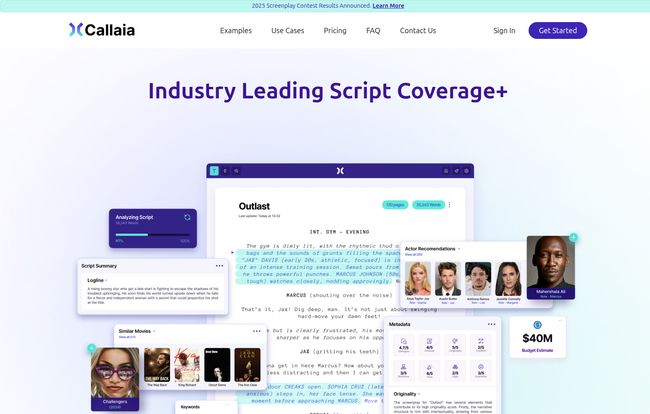
Callaia doesn’t just give you a few notes on your dialogue. It delivers a full suite of materials that are genuinely useful for taking a script to market. This includes:
- Loglines and synopses (because writing your own logline is a special kind of torture).
- Detailed grades on core story components like plot, pacing, and theme.
- In-depth character summaries and even casting suggestions.
- Comparable film and TV show recommendations (“comps”).
- A recommended release strategy.
Suddenly, it’s not just about feedback. It’s about positioning. It’s a go-to-market toolkit generated in less time than a commercial break.
Visit Callaia
The Need for Speed: Getting Script Feedback in 60 Seconds
I can’t overstate how much of a paradigm shift the speed is. The traditional script coverage process is a black box. You send your script into the void and hope for the best. Is the reader having a bad day? Did they just read five other scripts exactly like yours? Are they even the right person for your genre?
Callaia removes that agonizing wait. The promise of getting feedback in under a minute is, frankly, revolutionary. Think about the workflow. You finish a draft at 2 AM. Instead of having to wait to send it to your writing group, you can get an instant, objective first pass. You can identify major plot holes or character inconsistencies before it ever reaches human eyes. It’s the difference between sending a message by carrier pigeon and hitting ‘send’ on a text. You can iterate and redraft on the same day instead of the same month.
A Look Inside the Callaia Analysis
Okay, so it’s fast. But is the feedback any good? This is where my skepticism was highest. Story is about nuance, subtext, and emotion. Can an algorithm truly grasp that? Well, yes and no. Here’s a breakdown of what the analysis actually gives you.
Story Elements and Grading
Callaia gives your script a report card. It grades things like Plot, Character, Dialogue, Pacing, and Originality on a clear scale. For a writer, this is incredibly valuable. It provides an objective baseline. A human reader might just say “the pacing felt a bit off in the second act.” Callaia will show you a score, allowing you to see exactly where your script might be underperforming structurally. It removes the subjective “bad mood reader” variable and replaces it with data.
Character Breakdowns and Casting Ideas
This part is just plain cool. Callaia pulls out your main characters, summarizes their arcs, and analyzes their function in the story. Then, it suggests real actors who could play the part. Of course, this is a bit of fantasy casting, but it’s also a powerful tool. If the AI suggests an actor you’d never have imagined, it might make you re-evaluate how that character is coming across on the page. Is your gritty anti-hero reading more like a comedic sidekick? The casting suggestions can be an unexpected mirror.
Finding Your Comps and Market Strategy
Anyone who has ever had to pitch a project knows the dreaded question: “What are the comps?” Finding successful, recent, and relevant comparable films is a huge research headache. Callaia automates it. It analyzes your script’s DNA—its tone, genre, plot, and themes—and provides a list of comps. This alone is worth a good chunk of the price for me. It also suggests a release strategy, which is more geared towards producers but still gives writers fantastic insight into how their project might be positioned in the current market.
The Elephant in the Room: Can AI Really Understand a Story?
Here’s my honest take. No, Callaia is not going to replace your trusted mentor, your insightful director, or the brilliant notes you get from a seasoned producer. It’s an algorithm. It might miss the subtle genius of a script that breaks all the rules. It might not fully grasp a complex metaphor that underpins your entire theme. Its a tool for a specific job.
As Jesse Bordeau from Columbia Pictures puts it in his testimonial on their site, it’s “the most in depth and comprehensive script analysis tool I’ve used by human or AI, and extremely accurate.” The key here is to see Callaia not as a replacement, but as a supplement. It’s the best first reader you could ever ask for: unbelievably fast, totally objective, and incredibly thorough. It catches the structural problems and story gaps, so that when you do send it to a human, they can focus on the deeper, more nuanced elements of your work.
Security, Privacy, and Why It Matters A Lot
In the age of generative AI, every creator is rightfully terrified of their work being used to train some faceless model. Your script is your baby. It’s your intellectual property. The thought of it being absorbed into a machine is horrifying.
Callaia seems to get this. They make it very clear on their website: your script is safe. They state that they ensure total privacy and security, and most importantly, they do not use your scripts for AI training. For me, and for any writer I know, this is a non-negotiable feature. It builds a level of trust that is absolutely critical.
Let’s Talk Money: Callaia Pricing Breakdown
So, what’s the damage? Compared to traditional script coverage, the pricing is pretty competitive. A decent human reader can set you back anywhere from $100 to over $500, depending on their experience and the level of detail.
Here’s how Callaia’s pricing shakes out:
| Package | Price | Price Per Script |
|---|---|---|
| 1 Script | $79 | $79.00 |
| 5 Scripts | $349 | $69.80 |
| 10 Scripts | $649 | $64.90 |
As you can see, the bundles offer a nice little discount. For a writer who is constantly drafting and re-drafting, or a small production company that needs to get through a pile of submissions, the packages make a lot of financial sense. For less than the cost of one professional read, you could run ten drafts through the system.
Who is Callaia Actually For?
I see this tool having a few key audiences:
- The Developing Screenwriter: This is a godsend. You can affordably check your work, fix glaring issues, and build your confidence before sending your script out into the cold, cruel world.
- The Busy Producer or Executive: Facing a mountain of submissions? Callaia is your filter. It can help you quickly identify scripts that are structurally sound and have market potential, freeing up your time to focus on the top contenders.
- The Agent or Manager: It offers a fast, objective way to assess the work of a potential new client. It’s an efficient tool for due diligence.
My Final Verdict on Callaia
After digging in, I’ve moved from skeptical to genuinely impressed. Callaia is not a magic bullet that will get your script greenlit overnight. It’s not a sentient being that understands the human condition better than you do. But that’s not what it’s trying to be.
It’s an incredibly powerful, fast, and secure tool that provides objective, data-driven feedback on the mechanics of your story. It automates the tedious parts of the process, like researchings comps, and provides a clear, actionable report card on your script’s structure. It’s not here to write the script for you, but it might just be the best co-pilot a writer could ask for on the long road to “FADE OUT.” For the price and the speed, it’s a tool I believe will become a standard part of the development process.
Frequently Asked Questions About Callaia
- How long does Callaia take to analyze a script?
- Callaia’s main selling point is its speed. It provides a full, comprehensive script analysis in under one minute.
- Is my script safe with Callaia?
- Yes. Callaia emphasizes on its website that all scripts are analyzed securely and privately. They explicitly state they do not use your intellectual property to train their AI models, which is a crucial factor for creators.
- Does Callaia replace a human script reader?
- Not entirely. It’s best viewed as a powerful tool for a first pass. It excels at providing fast, objective, structural feedback, but it may not capture all the artistic nuance or subtext that an experienced human reader can. It’s a supplement, not a full replacement for human collaboration.
- What kind of feedback does Callaia provide?
- It provides a full coverage report, including a logline, synopsis, grades on story elements (plot, character, dialogue), character breakdowns, casting suggestions, comparable film/TV recommendations (comps), and a potential release strategy.
- Is Callaia worth the cost?
- Compared to traditional script readers, which can cost $100-$500+, Callaia is very cost-effective, starting at $79 per script with discounts for bundles. For writers looking for fast, iterative feedback, it offers significant value.
- Can Callaia help me get my script produced?
- Indirectly, yes. While it can’t pitch your script for you, it can help you polish it to a professional standard, identify its market potential with comps, and fix structural issues, all of which significantly increase your chances when you do submit it to producers or agents.


