
Categories: AI Marketing, AI Sales, AI Workflow
Cargo Review: The GTM AI Platform You Really Need?

If you’re in sales, marketing, or revenue ops, your tech stack probably looks like a chaotic spaghetti junction of SaaS tools. You’ve got your CRM over here, a data enrichment tool over there, a sequencing platform somewhere in the middle, and about fifteen different spreadsheets held together with Zapier automations and a prayer. I’ve been there. We’ve all been there.
Every so often, a tool comes along that promises to clean up the mess. To be the one hub to rule them all. Most of the time, it’s just more noise. But recently, I’ve been looking at a platform called Cargo, and I gotta say, my curiosity is piqued. It’s not just another app to add to the pile; it’s positioning itself as the orchestration layer, the AI-powered brain that makes your entire go-to-market (GTM) strategy actually work in harmony.
So, is it just another shiny object, or is it the GTM co-pilot we’ve been desperately needing? Let’s get into it.
So, What Exactly Is Cargo? Think Central Nervous System for Your Revenue Ops.
Okay, breaking it down. Cargo isn’t a CRM. It’s not an email tool. It’s the conductor of the orchestra. It connects to all the tools you already use—your Salesforce or HubSpot, your data providers like Clearbit, your outreach tools—and tells them how to work together. It uses AI and custom workflows to automate the stuff that makes your sales team want to tear their hair out.
Think about it like this: your GTM strategy has all these different limbs—marketing campaigns, inbound leads, sales outreach, customer data. But without a brain and a nervous system to coordinate them, they’re just flailing around. Cargo aims to be that central nervous system. It takes a signal (like a new lead) and instantly sends the right messages to the right places to create a coordinated, intelligent response. No more manual data entry, no more leads falling through the cracks, and no more sales and marketing teams pointing fingers at each other. At least, that’s teh promise.
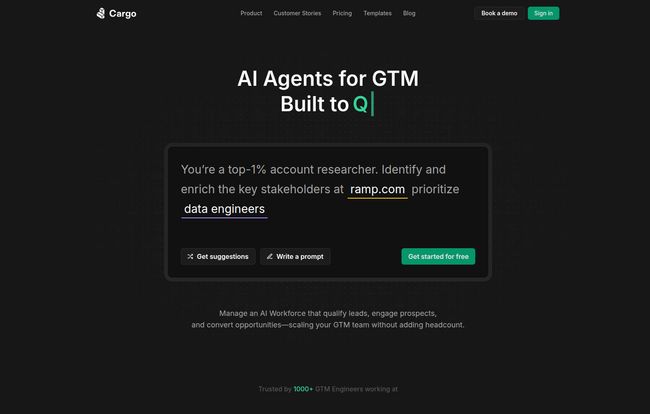
Visit Cargo
The Features That Actually Matter (And Why)
A feature list is just a feature list until you see how it solves a real problem. Here’s my take on the parts of Cargo that seem to have the biggest impact.
The AI Agents: Your New Automated SDRs?
This is probably the flashiest part of Cargo. They have these “AI Agents”—like an AI SDR Agent and an AI Inbox Agent—that can handle the top-of-funnel grunt work. They can qualify inbound leads, enrich their data, and even kick off initial outreach. The idea of an AI handling the first-touch qualification so my reps can focus on warm, qualified conversations… well, that’s pretty exciting. It’s a bold claim, but if it works even half as well as advertised, it could be a game-changer for sales efficiency.
Workflow Orchestration: The Real Magic
For me, this is the heart of Cargo. This is where you, the human, get to be the architect. The workflow builder lets you design the exact journey you want your data and leads to take. It’s more than a simple “if this, then that.”
For example, you can build a flow where:
- A new lead signs up for a webinar.
- Cargo immediately pulls that lead into its system.
- It enriches the lead’s profile with company size, industry, and job title from one of its 50+ integrated data providers.
- It runs the lead through your custom-built lead scoring model.
- If the score is over 85, it’s instantly assigned to the right account executive based on territory rules, and a high-priority notification is sent to them in Slack.
- If the score is below 85, it’s automatically added to a specific long-term nurturing campaign in your marketing automation platform.
See? That entire process, which would normally involve 3-4 different tools and a ton of manual steps, happens instantly and automatically. That’s powerful.
Saying Goodbye to Bad Data and “Who Gets This Lead?”
One of the oldest wars in business is the one between Sales and Marketing over lead quality. Marketing says, “We sent you 100 leads!” and Sales says, “Yeah, and 95 of them were garbage!” Cargo steps right into the middle of this fight with its lead enrichment, scoring, and routing capabilities. By automating the data gathering and applying a consistent, agreed-upon scoring model, you take the guesswork and emotion out of it. Leads are enriched and prioritized systematically. The hottest leads go straight to sales, while the cooler ones go to marketing for more nurturing. It fosters alignment because both teams are working from the same, clean, intelligent data set.
The Elephant in the Room: Let’s Talk Pricing
Alright, this is where things get serious. Cargo is not a cheap-and-cheerful plugin. It’s a serious platform for teams that are serious about scaling their revenue engine. The investment reflects that.
| Plan | Price (per month) | Who It’s For | Key Features |
|---|---|---|---|
| Starter | $900 | Growing teams ready to automate GTM processes. | 5,000 enrichment credits, 200,000 workflow steps, 2 AI models. |
| Pro | $1,500 | Established teams with more complex needs. | 15,000 enrichment credits, 1,000,000 workflow steps, Unlimited models, Territory Manager, White glove support. |
| Enterprise | Custom | Large organizations needing scale and customization. | Minimum 40k credits & 3m steps, SSO, custom integrations, dedicated professional services. |
My take? The price tag will be a barrier for some, no doubt. But you have to weigh it against the cost of not having it. How much time are your expensive sales reps wasting on manual tasks? How many high-value leads are you losing due to slow follow-up or poor routing? For a company with a solid GTM motion, the ROI from plugging those leaks could easily justify the cost. It’s an investment in infrastructure, not just another monthly software fee.
The Good, The Bad, and The Realistic
No tool is perfect. After looking at Cargo, here’s my honest breakdown.
The Upside: What I love is the centralization. Having one place to build, monitor, and tweak all your revenue-driving workflows is a dream for any ops person. The AI-powered efficiency boost for sales teams is undeniable, freeing them up to do what they do best: sell. And the improved alignment between sales and marketing isn’t just a soft benefit; it directly translates to a smoother funnel and more closed deals.
The Potential Hurdles: First off, the price. This isn’t for a two-person startup figuring out its business model. It’s for companies with a proven product and a need to scale operations efficiently. Second, this isn’t a magic wand you just wave. It requires thoughtful integration with your existing CRM and other tools. To get the most out of the custom workflows, someone on your team will need a bit of a technical or logical mindset. It’s not about writing code, but it is about architecting systems. You have to be ready to roll up your sleeves a bit.
So, Should You Get on Board with Cargo?
Here’s the bottom line. If your company is still running its GTM strategy on spreadsheets and a tangled web of manual processes, and you’re feeling the pain of that inefficiency, then Cargo is absolutely worth a serious look. It’s built for teams who have outgrown their basic setup and are ready to invest in a systematic, scalable, and intelligent way to grow revenue.
It’s not going to invent your GTM strategy for you. But if you have a strategy, Cargo looks like an incredibly powerful engine to execute it with precision and speed. In an era where everyone is armed with more data and more tools than ever, the real advantage comes from orchestration. Having a co-pilot like Cargo to manage the complexity might just be the edge you need.
Frequently Asked Questions
What are Cargo’s main integrations?
Cargo integrates with over 50 revenue-focused platforms. This includes major CRMs like Salesforce and HubSpot, data providers like Clearbit and Apollo, and communication tools like Slack and email platforms. The whole point is to connect the tools you’re already using.
Is Cargo just for sales teams?
No, it’s a go-to-market (GTM) platform. While sales teams see huge benefits from lead routing and automation, it’s designed to align sales, marketing, and revenue operations. Marketing uses it to ensure their leads are handled properly, and RevOps uses it to build and manage the entire system.
How does the AI work in Cargo?
Cargo uses AI in a few ways. Its AI Agents can automate tasks like lead qualification and initial outreach. It also uses machine learning for building custom lead scoring models, helping you prioritize your best opportunities based on your own data and criteria.
Is there a free trial for Cargo?
Based on their site, it looks like they offer a way to “Try Cargo” which seems to be a limited free trial or a sandbox environment where you can build and test workflows to see how it works before committing to a paid plan. It’s best to contact their team for the specifics.
What are ‘enrichment credits’ and ‘workflow steps’?
These are how Cargo measures usage. An ‘enrichment credit’ is typically used each time Cargo fetches data from a third-party provider to add information to a lead (like company size or location). A ‘workflow step’ is a single action within one of your automated workflows, like ‘update CRM field’ or ‘send a Slack alert’. The plans give you a monthly allowance for each.


