
Categories: Blockchain
Chainrel Review: Ditch the Blockchain Polling Nightmare

Let’s have a little heart-to-heart. If you’ve ever built anything on the blockchain that needs to react to something happening on-chain, you know the pain. The sheer, soul-crushing agony of setting up a reliable event listener. First, you’re wrestling with Web3.js or Ethers.js. Then you’re polling. Constantly. Ping, ping, ping… did anything happen yet? How about now? It’s like a needy toddler tugging at your server’s pant leg every five seconds.
And the infrastructure! You need a reliable node connection, you have to handle re-orgs, and if your listener script goes down for even a minute? You’ve got a blind spot. You could miss a critical mint, a vital transfer, or that one event your entire application logic depends on. I’ve been there. I’ve spent late nights debugging listeners that decided to take an unscheduled vacation. It’s not glamorous. It’s a resource drain, both for the server and for my sanity.
So when I stumbled across Chainrel, my inner cynic immediately piped up. “Another ‘game-changing’ web3 tool?” But I gave it a shot. And I’ve gotta say, I’m pleasantly surprised. It’s not trying to be everything to everyone. It’s a tool that does one thing—real-time blockchain event notifications—and it does it remarkably well. It’s the digital postman for the blockchain I never knew I needed; it just brings you the mail you actually care about, the second it’s sent.
What Exactly is Chainrel, and Who is it For?
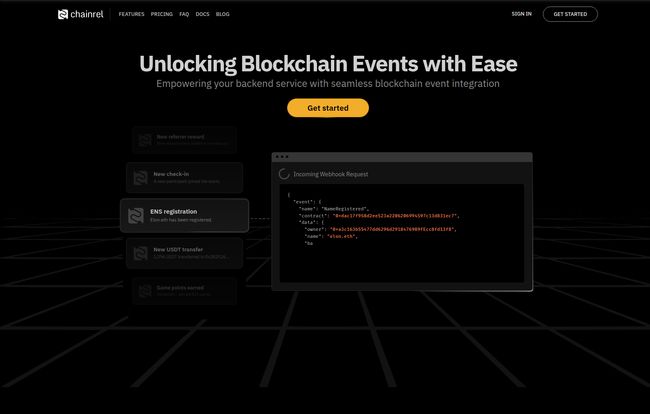
Okay, let’s break it down. At its core, Chainrel watches the blockchain for you. You tell it, “Hey, see this smart contract? Let me know whenever the ‘Transfer’ event happens.” And instead of you having to constantly ask the blockchain if it happened yet, Chainrel just… tells you. It sends a neat little package of data (a webhook) to your backend, or a message to your Slack or Discord, the moment the event is confirmed on-chain.
This is huge. It means your backend service can be blissfully ignorant of Solidity or the finer points of node management. It can be written in Python, Go, Rust, whatever you like. It just needs to be able to catch a webhook. This decouples your application from the raw, messy business of the chain itself.
Who is this for? Honestly? It’s for people like me. It’s for the backend developer who’s been tasked with a web3 integration and doesn’t want to spend the next month becoming a blockchain infrastructure expert. It’s for the fast-moving startup that needs to get an MVP out the door yesterday. It’s for anyone who values their time and would rather focus on building cool features than on reinventing the notification wheel.
My First Impressions: Getting Started with Chainrel
The sign-up was standard stuff. But the setup… it felt suspiciously easy. I was braced for a multi-step configuration nightmare, but within about three minutes, I had a listener pointed at a specific ERC-20 contract, ready to ping my test server.
You basically just give it a contract address, pick which event you want to listen for from a dropdown (it pulls them from the ABI automatically, which is a nice touch), and then tell it where to send the notification. That’s it. No code, no deployment pipeline, no headache. The UI is clean, dark, and gets straight to the point. No fluff.
Visit Chainrel
That first successful notification that hit my server felt like magic. It was the absence of pain that was so profound. All those hours I’d previously spent writing boilerplate listener code… just gone.
The Features That Actually Matter
A tool can look slick, but it’s the features under the hood that determine if it sticks around in my toolkit. Here’s what stood out to me.
The Magic of Real-Time Webhooks
This is the main event. Being able to push data to your system is so much more efficient than pulling it. Chainrel’s ability to send notifications to a generic Webhook URL is its most powerful feature for developers. But the direct integrations are also pretty cool. You can have it post new NFT mints directly to a community Discord channel, or alert your internal team on Slack when a treasury transaction occurs. They also list Zapier as “coming soon,” which could open up a wild world of possibilities, connecting on-chain events to thousands of other apps without writing a single line of code. I’m watching that one closely.
Multi-Chain Support (With a Caveat)
Right now, Chainrel has the big players covered: Ethereum, Polygon, Avalanche-C, and Binance Smart Chain. This is where most of the action is for a ton of projects. They also list Optimism and Linea as “coming soon.” This is both good and bad. It’s great that they’re expanding, but if you’re building on Linea today, you’ll have to wait. It’s an honest reflection of a growing platform, not a deal-breaker, but something to be aware of.
Granular Control Over What You’re Listening To
This is where I really started to fall for the platform. You can listen to any event on any verified contract. You can provide the contract address, upload an ABI file yourself, or just pick from predefined templates for common standards like ERC-20, ERC-721, and ERC-1155. This saves a ton of boring setup time.
But the real gem for me was the ‘Factory Contract Management’ feature. If you have a contract that creates other contracts (a common pattern), Chainrel can automatically start listening to all the new child contracts. Doing that manually is a genuine nightmare. This feature alone shows that the people behind Chainrel have actually built stuff in this space and understand the tricky edge cases.
A Nod to Security: Block Confirmations
Another small detail that reveals their expertise is the ability to set a block confirmation value. You can tell Chainrel to wait for 1, 5, or 10 blocks before it sends the notification. Why does this matter? Blockchain re-orgs. A transaction might appear in one block, only for the chain to reshuffle and have it disappear. Waiting for a few confirmations before you fire off your critical backend logic is just smart, and building this in as a simple option is a massive quality-of-life improvement.
Let’s Talk About Chainrel’s Pricing
This is often the make-or-break moment. A great tool with crazy pricing is a non-starter for most teams. I think Chainrel nailed it here. The pricing is straightforward and, frankly, very competitive.
| Plan | Price | Key Features |
|---|---|---|
| Starter | $0 / month | 500 notifications/month, 1 webhook, 3 event listeners. Perfect for testing and tiny projects. |
| Growth | $19.90 +VAT / month (paid annually) | 100,000 notifications/month, 10 webhooks, 50 contract addresses, team members. |
The free Starter plan is a proper free plan. It gives you 500 notifications, which is more than enough to build out your integration, test everything, and see if it’s the right fit. It’s not enough to run a popular dApp, but its perfect for development.
The Growth plan is, in my opinion, a steal. For about twenty bucks a month, you get 100,000 notifications. Stop and think about the cost of that. The developer hours to build a robust listener, the server costs to run it 24/7, the maintenance… it would cost you many multiples of $20. For an early-stage company, this pricing is a no-brainer.
The Not-So-Perfect Parts
No tool is perfect, and it’s important to be real about the downsides. The notification limits on the free plan are, well, limiting. It’s a free plan, so I can’t complain too much, but you’ll burn through 500 notifications fast on a busy contract. The other thing is the “coming soon” on some of the L2 chains. If your project is all-in on Optimism, you’re on the waiting list. It shows they’re growing, but it’s a limitation for now.
The Verdict: Is Chainrel Worth It?
For the vast majority of developers and teams building in web3 today? Yes, absolutely.
Chainrel is a perfect example of a new wave of developer tooling that abstracts away the unnecessary complexity of web3. It lets you focus on your unique value proposition, not on the plumbing. It’s for the indie dev building a cool notification bot, the dApp that needs to update its database based on on-chain actions, and the analytics platform that needs a reliable data firehose.
Who isn’t it for? Maybe a massive protocol like Uniswap, which has an entire team of world-class engineers dedicated to building bespoke, hyper-optimized infrastructure. But for the other 99% of us? This is a massive shortcut. I’m officially hanging up my custom listener hat for the foreseeable future. The peace of mind is worth it.
Closing Thoughts
Tools like Chainrel represent a maturation of the web3 development space. We’re moving past the era where every developer had to be a hardcore protocol engineer just to build a simple application. We’re getting a proper dev stack. By taking a notoriously painful problem and turning it into a simple, affordable service, Chainrel isn’t just offering a product; its offering developers their time back. And in this industry, time is everything.
Frequently Asked Questions
What is Chainrel?
Chainrel is a service that provides real-time notifications for blockchain events. It allows you to monitor smart contracts and send alerts via webhooks, Slack, or Discord when specific events occur, without you needing to run your own complex listening infrastructure.
How much does Chainrel cost?
Chainrel has a free Starter plan with 500 notifications per month for testing. The paid Growth plan starts at $19.90/month (paid annually) and includes 100,000 notifications, more webhooks, and team features.
What blockchains does Chainrel support?
Currently, Chainrel supports Ethereum, Polygon, Avalanche-C, and Binance Smart Chain (BSC). They have also announced upcoming support for L2s like Optimism and Linea.
Do I need to be a developer to use Chainrel?
For simple alerts to platforms like Slack or Discord, you don’t need coding skills. To use the Webhook feature to integrate with your own application’s backend, you will need some development knowledge to create an endpoint that can receive and process the data.
Is Chainrel secure for critical applications?
Chainrel includes important security-minded features, like the ability to set a block confirmation delay. This helps protect your application from reacting to blockchain re-organizations, making it more reliable for production use cases.
How is this better than running my own node and listener?
While running your own setup offers total control, it also comes with significant overhead in terms of cost, maintenance, and complexity. Chainrel abstracts all of that away. It’s a managed service that saves developer time, reduces infrastructure costs, and handles challenges like node uptime and event monitoring for you.


