
Categories: AI Agent, AI Assistant, AI Data Mining, AI For Data Analytics, AI Report Generator, AI Summarizer, Large Language Models (LLMs)
ChatGPT Deep Research: An SEO’s First Look

Okay, let’s have a real chat. As someone who lives and breathes data, trends, and the endless slog of research, my ears perk up anytime I hear about a tool that promises to make life easier. It’s a grind.
So when whispers of ChatGPT Deep Research started making the rounds, I was intrigued. Skeptical, but intrigued. The promise? An AI-powered research assistant, supposedly built on OpenAI’s next-gen o3 model, that doesn’t just fetch information but plans, analyzes, and reports on it. It sounds like the stuff of sci-fi, or at least the stuff of a very tired marketer’s daydreams.
But is it just another shiny object in the ever-expanding universe of AI tools, or is this the real deal? I took a look at what we know so far, and honestly, my feelings are a mixed bag of genuine excitement and healthy caution.
So, What Exactly is This ChatGPT Deep Research?
From what I’ve gathered, think of it less like a search engine and more like a junior research partner. One that’s incredibly fast and has read… well, pretty much everything. The idea is that you give it a complex research query—not just a keyword, but a whole topic or question—and it takes over from there.
It’s designed to automate the entire workflow:
- Planning: It breaks down your query into a multi-step research plan.
- Execution: It browses the web, accesses databases, and pulls in relevant data.
- Analysis: This is the cool part. It supposedly uses intelligent analysis to sift through the data, identify patterns, and synthesize findings.
- Reporting: Finally, it spits out a detailed report, complete with citations and even data visualizations. A full circle process.
Instead of just giving you a list of links (thanks, Google), it aims to deliver a synthesized answer with all the homework shown. For anyone in academia, market research, or content strategy, that’s a pretty compelling pitch.
The Core Features That Have Me Buzzing
Let’s get into the nitty-gritty. The feature set is where this tool either soars or falls flat. And from the looks of it, it’s aiming for the stratosphere.
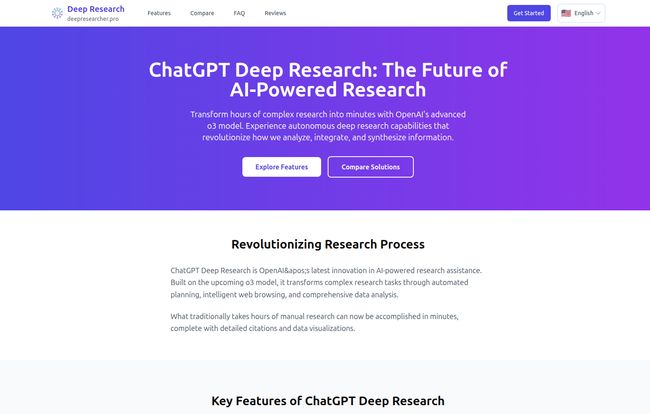
Visit ChatGPT Deep Research
A Research Process That Thinks for Itself
The “Multi-step Research Process” is probably the most significant departure from tools we use today. It doesn’t just react; it plans. This implies a level of reasoning that could save dozens of hours in project setup alone. It’s like telling your assistant to “research the impact of TikTok on consumer packaged goods sales among Gen Z” and having them come back with a structured outline and initial findings, not just a folder of random articles.
Pulling Data from All Corners of the Web
Advanced Data Integration sounds great on a feature list, but what does it mean? It means the tool isn’t just scraping headlines. It’s designed to integrate info from web pages, PDFs you upload, and potentially even databases. The ability to bring your own documents into the mix is huge, especially for proprietary research.
More Than Just Data, It’s Intelligent Analysis
This is where the magic (or the machine learning, I guess) happens. The tool claims to perform intelligent analysis and data classification. This could mean thematic analysis of text, sentiment analysis of reviews, or identifying trends in numerical data. Creating charts and graphs from raw data is a massive time-saver and makes insights immediately more accessible. No more fumbling with Excel pivot tables at 2 AM.
Keeping It Real with Verified Results
Okay, this is the one that really got my attention. In an age of AI hallucinations and made-up facts, the promise of “Verified Results” with full documentation and audit trails is everything. For SEOs, citing sources is crucial for E-E-A-T (Experience, Expertise, Authoritativeness, and Trustworthiness). For academics, it’s non-negotiable. If Deep Research can reliably provide accurate citations for every claim it makes, it’s not just a convenience; it’s a revolution in trust for AI-generated content.
Deep Research vs. The Old Way of Doing Things
The difference seems pretty stark when you lay it all out. Traditional research is a manual, often painfully slow process. You’re the project manager, the data collector, the analyst, and the report writer. It’s exhausting.
| Aspect | ChatGPT Deep Research | The Traditional Grind |
|---|---|---|
| Planning | Automated and strategic | Manual, often trial-and-error |
| Data Access | Broad and integrated | Siloed and limited by paywalls |
| Reporting | Detailed, with instant citations | Slow, manual compilation |
| Verification | Built-in with audit trails | A separate, time-sucking step |
It’s less about replacing the researcher and more about augmenting them. It handles the grunt work, freeing you up to do the one thing a machine can’t: think critically about what it all means.
Let’s Be Real: The Potential Downsides
Now for the reality check. I’ve been in this game long enough to know there’s no such thing as a perfect tool. And there are some red flags, or at least, yellow ones, to consider here.
My biggest concern? Over-reliance. If a tool does 90% of the work, it’s tempting to let it do 100% and switch your brain off. That’s dangerous. Critical thinking could atrophy, and we might start accepting synthesized reports without questioning the underlying assumptions. We have to be the final filter.
There’s also the question of depth. Will it deliver truly ‘deep’ insights, or will it just give us a very polished summary of abstracts and introductions? Real research often comes from reading the entire paper, catching a nuance in the methodology, or an aside in the conclusion. If the AI is just skimming, it might miss the gold. And then there’s the perennial problem of paywalls. Without institutional access, how will it handle closed-access journals? That remains a huge question mark.
What’s the Damage? A Look at Pricing
So, how much will this magic research assistant cost? I wish I could tell you. I went looking for a pricing page (`deepresearcher.pro/pricing` to be exact) and was met with a big fat 404 error. Classic.
This tells me a few things. It’s either not fully rolled out, the pricing isn’t public, or its availability is very limited for now. My gut tells me this will likely be bundled into a premium subscription, like ChatGPT Plus or a new, higher-tiered ‘Pro’ plan. Given the power it promises, I wouldn’t expect it to be cheap, but its value will ultimately depend on the quality and reliability of the output.
Who is This Tool Actually For?
Based on the features and the (admittedly glowing) user reviews plastered on its site, the audience is pretty clear.
- Academics and Students: The potential to speed up literature reviews is astronomical. We’re talking about saving weeks, maybe months.
- Market Researchers & Analysts: Quickly synthesizing market trends, competitor analysis, and consumer sentiment? Yes, please.
- Content Marketers & SEOs: For creating in-depth, data-backed pillar pages, whitepapers, and reports. The ability to generate cited, original content is a massive leg up.
- Product Managers: Doing user research or exploring a new feature idea could become radically more efficient.
Basically, if your job involves turning a mountain of information into a molehill of actionable insight, this tool is aimed directly at you.
Frequently Asked Questions
I’ve seen a few questions pop up repeatedly, so let’s tackle them head-on.
What makes Deep Research different from just using a search engine?
A search engine gives you a list of potential ingredients. Deep Research aims to give you a fully baked cake. It doesn’t just find sources; it synthesizes them into a structured, cited report, complete with analysis and visuals.
How does it handle different languages?
Impressively, from the looks of it. The documentation claims support for analysis and report generation in over 95 languages. This is a huge deal for global research teams.
Is the information reliable and how are sources cited?
This is the million-dollar question. It claims to have a robust verification process with confidence scores for all research and maintain a source certification for every piece of data. This audit trail is its biggest selling point for professional use.
How long does a complex query take to process?
Reports suggest it’s not instantaneous. For complex topics, it could take anywhere from 5 to 15 minutes. This makes sense, as it’s doing a lot more than a simple search. It’s a fair trade-off for a comprehensive report.
What about security and data privacy?
The platform states that all user data is encrypted and automatically deleted after 30 days. For anyone working with sensitive or proprietary information, this is a critical feature to watch.
Final Thoughts: A Cautiously Optimistic Future
So, where do I land on ChatGPT Deep Research? I’m cautiously, but genuinely, optimistic. It feels less like an incremental update and more like a potential step-change in how we approach knowledge work. The thought of automating the most tedious parts of research is enough to make any professional’s heart beat a little faster.
However, it all hinges on the execution. Can it live up to the promise of verified, deep insights without lulling us into intellectual complacency? We’ll have to wait and see. For now, it’s a tantalizing glimpse into a future where our best ideas are supported by an AI that does the heavy lifting. I, for one, will be keeping a very close eye on this one. It might just change everything.
Reference and Sources
Information and analysis in this article were based on publicly available information from the tool’s promotional website and general industry knowledge.
- Deep Researcher Pro Website: deepresearcher.pro
- OpenAI Official Blog (for general AI developments): openai.com/blog


