
Categories: AI Chatbot, AI Developer Tools, AI Face Recognition, AI Image Recognition, AI Medical Diagnosis, AI OCR, AI Search Engine, AI Speech Recognition, AI Transcription, AI Voice Assistants, Large Language Models (LLMs)
Clickworker Review: AI Data & Tasks by Real Humans?

In the world of SEO and AI, data is everything. It’s the fuel for our algorithms, the bedrock of our content strategies, and the secret sauce in pretty much every ‘next-gen’ tool that lands in our inbox. But getting good data? That’s the hard part. It’s often messy, time-consuming, and expensive to acquire, especially when you need a human touch.
I’ve been in this game for years, and I’ve seen countless projects stall because they couldn’t get the right datasets to train their AI models or couldn’t scale their content moderation. It’s a universal headache. So when a platform like clickworker comes along, promising a global workforce of over 7 million people ready to do your digital bidding, my ears perk up. But is it too good to be true? I decided to take a closer look.
So, What Exactly Is Clickworker?
Imagine you have a massive, almost unimaginable, digital task. Maybe you need thousands of images categorized for a new AI. Or you need product descriptions written for an e-commerce site with 50,000 items. Or you need to survey people in five different countries. Doing that in-house would be a logistical nightmare.
Clickworker is essentially a crowdsourcing platform that breaks down these huge projects into tiny ‘micro-tasks’. These tasks are then distributed to its enormous network of registered users—the ‘Clickworkers’—who get paid to complete them. Think of it as a giant, on-demand digital assembly line, powered by real people from all over the world. You submit the project, they chop it up, and their global team gets it done. It’s a simple concept with some seriously powerful applications.
Visit clickworker
The Main Event: AI Training Data
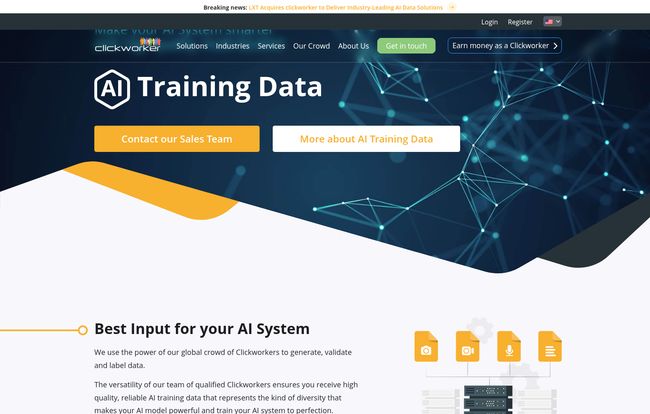
While Clickworker offers a bunch of services, their bread and butter these days is clearly AI training data. If you’ve ever wondered how a self-driving car learns to tell the difference between a pedestrian and a lamppost, or how your phone’s voice assistant understands your accent, the answer is data. Tons and tons of human-labeled data.
This is where Clickworker really flexes its muscles. They provide the human intelligence needed to teach artificial intelligence. Their main areas include:
- Computer Vision: This involves tasks like drawing boxes around objects in images (object detection), labeling pixels in a photo (semantic segmentation), and identifying faces or expressions. It’s the foundational work for everything from automated checkout systems to medical imaging analysis.
- Audio & NLP (Natural Language Processing): This is all about teaching machines to understand human language. It could be transcribing audio files, recording specific phrases to build a voice dataset, or analyzing the sentiment of customer reviews.
- Text Recognition & NLP: Similar to the above, but focused on written text. Think categorizing articles, extracting specific information from documents, or cleaning up messy text data for analysis.
How They Actually Create the Data
The process is surprisingly straightforward, which I appreciate. You typically provide the raw material—say, a folder of 100,000 street-view images. You then define the task very clearly: “Draw a box around every car.” Clickworker’s system pushes this task out to qualified Clickworkers, who get to work. They have quality control measures, like peer reviews and running the same task by multiple people, to ensure the final dataset isn’t a complete mess. The result, ideally, is a clean, labeled dataset you can feed directly to your hungry AI model.
But Wait, There’s More! Beyond the AI Hype
Okay, so not everyone is building a world-changing AI. What about us regular marketers and business owners? The good news is that the same workforce can be pointed at more traditional digital tasks. I find this part particularly interesting because it bridges the gap between high-tech AI development and everyday business needs.
You can use Clickworker for things like:
Content Creation and Editing: Need 1,000 unique product descriptions? Or maybe you need someone to proofread your blog posts. This is a classic use for a service like this. It’s about scaling content production without hiring a whole army of writers.
Surveys and Market Research: The platform’s global reach is a huge plus here. You can quickly get opinions from specific demographics in different countries, which is invaluable for international brands or anyone testing a new product idea.
Categorization and Tagging: This is an SEO’s secret weapon. Got a massive backlog of blog posts that need proper tagging? Or an e-commerce site where products need to be sorted into a dozen different categories? This is the kind of repetitive, rule-based work that’s perfect for crowdsourcing.
The Good, The Bad, and The Realistic
No platform is perfect, right? It’s always a trade-off. After digging through their site and reading up on user experiences, here’s my take on the pros and cons.
The Upsides of a 7-Million-Strong Workforce
The sheer scale is the most obvious advantage. With a workforce larger than the population of some countries, you can get things done fast. This scale also brings diversity—in language, culture, and location—which is critical for creating unbiased AI models and conducting global research. I was also impressed by their commitment to security. Being ISO 27001 certified and GDPR compliant isn’t just marketing fluff; it’s a serious indicator that they handle data responsibly. For any business dealing with sensitive information, this is a massive green flag.
Managing the Crowd: Potential Pitfalls
Here’s the flip side of crowdsourcing. You’re relying on a distributed, independent workforce. While Clickworker has quality checks, the skill level can vary from one worker to the next. The success of your project depends almost entirely on how well you design and explain your task. If your instructions are vague, you’re going to get vague results. It’s like trying to herd cats, but the cats are all over the world and speak different languages. This isn’t a flaw in Clickworker itself, but a reality of the model. It requires you, the client, to be incredibly precise and a good project manager. It’s not a ‘set it and forget it’ solution.
What’s the Damage? A Look at Clickworker’s Pricing
And now for the million-dollar question: how much does it cost? Well, you won’t find a neat little pricing table on their website, and there’s a reason for that. The cost is entirely dependent on what you need.
Think about it. The price for transcribing one hour of audio is going to be wildly different from the price of having 10,000 images annotated with complex polygons. The cost depends on the task’s difficulty, the required skill level of the Clickworker, the number of quality checks you want, and the volume of work. It’s a completely custom, quote-based model. My advice? If you have a serious project, your best bet is to contact their sales team with a detailed brief. They’ll work with you to scope it out and give you a concrete number.
Frequently Asked Questions about Clickworker
Is Clickworker legit?
Absolutely. They are a well-established German company (with a U.S. presence) founded in 2005. They work with large corporations and research institutions and are fully compliant with major data security standards like ISO 27001 and GDPR.
What kind of tasks can you outsource to Clickworker?
The range is huge. It covers everything from AI data services like image and video annotation, audio transcription, and text labeling, to more general business tasks like content creation, data entry, categorization, online research, and conducting surveys.
How does Clickworker ensure data quality?
They use a multi-layered approach. It starts with qualification tests for workers. During a project, they often use peer reviews, and a ‘majority rules’ system where multiple workers complete the same task to ensure consensus. The quality really hinges on good project setup from the client’s side, though.
Who is Clickworker best for?
It’s ideal for companies that need to process large volumes of data or content that requires a human touch. This includes AI and machine learning teams, large e-commerce platforms, market research firms, and any business looking to scale digital operations without a massive in-house team.
How much does Clickworker cost?
Pricing is project-based and not publicly listed. You’ll need to contact them for a custom quote based on the complexity, volume, and specific requirements of your task.
Can I become a Clickworker myself?
Yes, you can. They are always recruiting for their global workforce. You can sign up on their website to become a Clickworker and start earning money by completing micro-tasks from home.
So, What’s the Final Verdict?
After looking it all over, I’m genuinely optimistic about a platform like Clickworker. It’s not a magic wand. You can’t just throw a messy problem at it and expect a perfect solution to pop out. But if you have a well-defined task and are willing to put in the effort to create clear instructions, it offers incredible scale and power.
For AI developers, it’s a goldmine for creating the bespoke datasets that are so critical for success. For marketers and business owners, it’s a powerful tool for scaling the kind of tedious, time-sucking tasks that hold us back. It democratizes access to a global workforce, and in an increasingly digital world, that’s a pretty big deal. It’s a tool that, if wielded correctly, can genuinely move the needle on major projects.


