
Categories: AI Code Assistant, AI Code Generator, AI Copilot, AI Developer Tools
CodeComplete Review: An AI Coder for the Enterprise

Alright, let’s have a real chat. The AI coding assistant space has absolutely exploded. It feels like every other week there’s a new tool promising to make us 10x developers, cure our coding woes, and probably make us a decent cup of coffee. And honestly? Some of them are pretty darn good. I’ve been using tools like GitHub Copilot for a while, and the little productivity boosts are undeniable. It’s like having a junior dev on permanent call who never gets tired.
But. And it’s a big but.
If you work in a larger company, a proper enterprise, you know the conversation is different. The moment you mention piping your proprietary, super-secret, company-making codebase through a third-party cloud service, the security team starts getting hives. The legal department breaks out in a cold sweat. And your lead architect just sighs, knowing the generic suggestions won’t understand your company’s labyrinthine internal frameworks anyway. So, we’ve been in this weird limbo: incredible tools that aren’t quite right for the big leagues.
That’s why I’ve been keeping a close eye on a platform called CodeComplete. It’s been making some noise by tackling these enterprise-grade problems head-on. This isn’t just another AI coder; it’s a different beast altogether.
So What Exactly is CodeComplete?
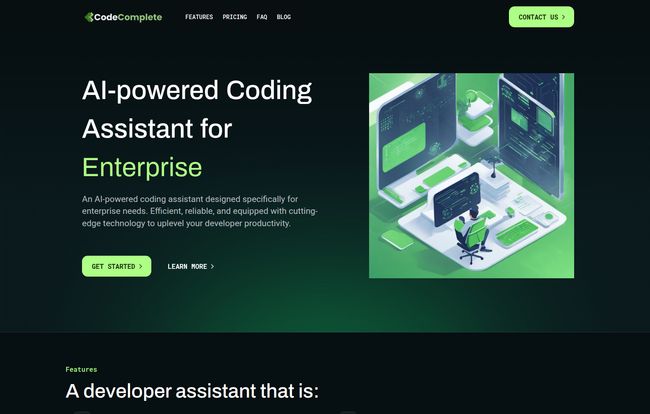
At its core, CodeComplete is an AI-powered coding assistant, but it’s built from the ground up for enterprise teams. The key difference isn’t just what it does, but how and where it does it. Forget the one-size-fits-all approach. This is about creating a coding partner that lives within your own walls and speaks your company’s unique dialect.
The Security Blanket: Self-Hosting is the Star of the Show
This is the big one. The absolute game-changer. CodeComplete offers self-hosting options. This means you can deploy it on-premises (on your own servers) or within your own private cloud environment (AWS, Azure, GCP, you name it).
Why does this matter so much? Because it means your code never leaves your control. It’s not being sent to some unknown server farm to be processed. For any company dealing with sensitive data, financial information, healthcare records (hello HIPAA), or just incredibly valuable intellectual property, this is non-negotiable. It’s the difference between keeping your secret family recipe locked in your own kitchen safe versus yelling it across a crowded food court and hoping nobody writes it down.
Fine-Tuning: An AI That Actually Gets You
The other major pain point with generic tools is their lack of context. They’re trained on a gazillion lines of public code from GitHub, which is great for common patterns but useless for your company’s internal `super-special-user-auth-v3` library.
CodeComplete attacks this with a two-pronged approach: fine-tuning and Retrieval Augmented Generation (RAG). That sounds techy, I know, but here’s the simple version:
- Fine-Tuning: They can train the model on your entire codebase. It learns your coding style, your architectural patterns, your variable naming conventions, and your internal APIs. It becomes a specialist in your software.
- RAG: This lets the AI pull in information from your documentation, wikis, and other resources in real-time to provide even more relevant suggestions.
The result? An assistant that doesn’t just suggest generic Python, it suggests code that looks like it was written by one of your own senior developers. That’s a huge leap in usefulness.
Visit CodeComplete
The All-in-One Developer Toolkit
Okay, so it’s secure and smart. But what can it actually do? The feature set is pretty comprehensive and covers the full development lifecycle, which is something I really appreciate. It’s not just a one-trick pony.
“We’re seeing a shift from simple autocomplete to comprehensive AI assistance. Tools need to do more than just finish a line of code; they need to help with the entire, often tedious, process of software development.”
CodeComplete’s platform seems to get this. It includes:
Code Generation & Chat: These are the table stakes now. You get intelligent code completions right in your IDE, and a chat interface (think ChatGPT for your code) where you can ask questions, get explanations, or brainstorm solutions.
Automated Unit Test Generation: I will be honest, writing unit tests is my least favorite part of the job. It’s the necessary chore, the eating of the vegetables. The idea of an AI that understands my new function and can generate meaningful tests for it… well, that’s just beautiful. It’s a massive potential time-saver and a huge boost for code quality.
Automated Documentation: Another classic developer pain point. This feature helps generate comments and documentation for your code, making it easier for the rest of the team (and your future self) to understand what’s going on. A well-documented codebase is a happy codebase.
Refactoring & Migrations: This is a higher-level function that gets really interesting. Need to update a bunch of code to a new API version or refactor a clunky module? An AI that is fine-tuned on your code is uniquely positioned to help with these complex, error-prone tasks. This could turn a week of painstaking work into a day of review.
Data, Analytics, and Pricing
One of the quieter but more important points on their site is about “High-quality training data.” This is a subtle nod to the legal gray areas that surround other models trained on the public internet. By focusing on a responsible training process (and fine-tuning on your data), they help mitigate legal and IP risks. It’s a very grown-up feature.
For the managers and team leads, there are also powerful analytics. You can see how the tool is being used, measure its impact on productivity, and identify areas where developers might need more support. It’s about proving the ROI, which is always part of the conversation with enterprise software.
What’s the Catch? The Pricing Model
Alright, let’s talk about the price. If you go to their pricing page, you’ll see two options: Individual and Enterprise. The Individual tier is just a waitlist right now, so it seems they’re focusing squarely on the big fish first.
The Enterprise tier? It’s the classic “Contact Us” button.
Now, don’t groan. This is standard for enterprise software. Pricing will depend on the number of users, the scale of your codebase for fine-tuning, the level of support you need, and your deployment choice (on-prem vs. cloud). It’s not a one-size-fits-all product, so it doesn’t have a one-size-fits-all price. It won’t be cheap, but for a large organization, the productivity gains and security assurances could easily justify the cost.
So, Who Is CodeComplete For?
This isn’t for the solo dev hacking on a side project in a coffee shop. At least, not yet.
CodeComplete is built for:
- CTOs and VPs of Engineering at mid-to-large companies who are losing sleep over data security and IP leakage.
- Development Teams in regulated industries like finance, healthcare, and government.
- Organizations with large, complex, and proprietary codebases where generic AI tools just don’t cut it.
- Managers who want to provide their teams with cutting-edge tools while maintaining control and measuring impact.
There might be a significant setup process, and its effectiveness is obviously tied to the quality of your existing code and documentation. It’s not a magic wand that fixes a messy house, it’s a super-powered tool for skilled craftspeople working in a well-organized workshop.
Frequently Asked Questions about CodeComplete
- How is CodeComplete different from GitHub Copilot?
- The two main differences are security and customization. CodeComplete can be self-hosted, so your code never leaves your private environment. It’s also fine-tuned on your specific codebase, so its suggestions are far more relevant to your internal projects than a general-purpose tool like Copilot.
- Is CodeComplete secure for my company’s sensitive code?
- Yes, that’s its primary selling point. The self-hosting option (on-premise or private cloud) is designed specifically to give companies maximum security and control over their intellectual property.
- What does “fine-tuning” actually mean?
- It means the AI model is specially trained on your company’s existing code. It learns your unique coding styles, frameworks, and APIs. This allows it to provide suggestions that are highly specific and useful within your organization, not just generic code snippets.
- What programming languages does CodeComplete support?
- The website doesn’t list specific languages, which is common for enterprise tools. Support is often broad and can be part of the customization process. It’s best to contact their sales team with your specific tech stack.
- Is there a free trial for CodeComplete?
- There isn’t a public free trial mentioned. Enterprise sales cycles typically involve a personalized demo and potentially a proof-of-concept (POC) project rather than a self-serve trial. You have to get in touch with them to start the process.
Final Thoughts: A Mature AI for a Mature Problem
I’m genuinely intrigued by CodeComplete. For the past couple of years, the AI coding conversation has been dominated by mass-market tools. They’re amazing, but they left a huge enterprise-sized hole in the market. It feels like CodeComplete isn’t just trying to fill that hole, but to build a custom-fit solution for it.
By prioritizing security, control, and deep customization, they’re addressing the exact reasons why so many large companies have been hesitant to adopt AI coding assistants. It’s a mature approach to a complex problem. While the lack of public pricing and a simple sign-up process means it’s not for everyone, it signals a clear focus. If you’re in a position where developer productivity is a top priority but security is an absolute mandate, then CodeComplete might just be the conversation you need to be having.


