
Categories: AI Copilot, AI Knowledge Management, AI Presentation Generator, AI Productivity Tools, Large Language Models (LLMs)
Context AI Review: The AI Office Suite We’ve Waited For?

How many browser tabs do you have open right now? If you’re anything like me, it’s a number you’re not proud of. Slack is pinging, the CRM is screaming for an update, your project data is in one spreadsheet, your team’s feedback is in a Google Doc, and the final presentation deck is… somewhere in Figma or Canva. It’s organized chaos. On a good day.
For years, we’ve been sold the dream of the “all-in-one” workspace. We’ve seen countless tools try and fail to be the one platform to rule them all. Most just end up becoming another siloed island in our ever-expanding archipelago of apps. But every so often, something new comes along that makes you sit up and pay attention. Something that doesn’t try to replace everything, but rather, connect everything.
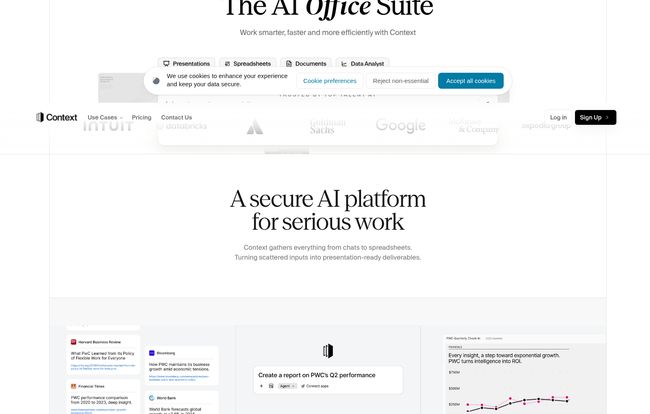
Enter Context. Their homepage calls it “The AI Office Suite” and, more poetically, a “hippocampus for LLMs.” I love that. A hippocampus. The part of the brain that organizes and retrieves memories. What a perfect metaphor for what we all desperately need at work: a brain for our scattered digital knowledge. But is it just clever marketing, or is there real substance here? I’ve been digging in, and what I’ve found is… promising.
What Exactly is Context and Why Should You Care?
At its core, Context isn’t just another document editor or spreadsheet tool with an AI chatbot stapled to the side. Thank goodness. We have enough of those. Instead, it’s designed to be a connective tissue, a smart layer that sits on top of the tools you already use. It aims to solve the “where did I put that file?” problem on a company-wide scale.
Think of it like this: your company’s collective knowledge is a giant library. But all the books have been thrown on the floor in random piles. You’ve got your Slack pile, your Notion pile, your Google Drive pile. Finding anything requires a frantic, manual search through each pile. Context is the AI librarian that comes in, reads every book, understands what’s inside, and then creates a single, searchable card catalog. But this catalog doesn’t just tell you where the book is; it can summarize chapters for you, compare information from different books, and even help you write a new one using all that existing knowledge.
That’s the vision. An AI that doesn’t just generate text, but understands the context of your work. It’s an ambitious goal, and one that could genuinely change how teams operate.
The Core Features That Actually Matter
The website throws around terms like “Presentations,” “Spreadsheets,” and “Documents.” But that’s selling it short. It’s not about the individual tools; it’s about how they work together.
From Scattered Data to Polished Deliverables
One of the most compelling use cases I see is the creation of client-facing materials. Imagine you need to build a quarterly performance report. Today, that means pulling sales numbers from your CRM, marketing stats from Google Analytics, project updates from Asana, and qualitative feedback from Slack. It’s a copy-paste nightmare.
Context’s approach is to connect to those sources directly. You can ask it, “Create a presentation on our Q3 performance,” and it will—in theory—pull the relevant data, visualize it in charts, and drop it into a slide deck. The real kicker? The images show it can learn your company’s branding. It promises to use your fonts, your colors, your logos. For any agency or in-house marketing team, that’s a massive time-saver. No more wrestling with rogue templates.
Visit Context
Spreadsheets and Data Analysis Without the Tears
I’ve spent more hours of my life than I care to admit cleaning up messy spreadsheets. VLOOKUPs that break, inconsistent formatting, data entry errors… it’s the tedious work that has to happen before the real work can begin. One of the screenshots for Context shows its “AI Spreadsheets” feature flagging an “invalid entry” and suggesting a fix. Yes. This. More of this, please.
This isn’t just about spreadsheets, though. It ties into their “Enterprise Search” and “Data Analyst” capabilities. This is the holy grail for so many businesses. Being able to ask a natural language question like, “What was our customer churn rate in Europe last quarter compared to the US?” and getting a direct answer, with sources cited from across your integrated apps, is a paradigm shift. It democratizes data analysis, taking it out of the hands of the few people who know how to write complex SQL queries.
The Magic Ingredient: Over 300 Integrations
This whole system lives or dies by its integrations. A brain is useless without sensory input. According to their site, Context connects with over 300 apps. The usual suspects are there: Slack, Notion, Figma, Airtable, Google Drive, and so on. This is what makes it different from a closed ecosystem. It’s not trying to be your new Notion; it’s trying to be the brain that makes your existing Notion, Slack, and other tools ten times more powerful.
“It’s a breakthrough for productivity.”
– Abdullah Anan, Solana Labs
Now, as a seasoned SEO and tech guy, I have to put my skeptical hat on for a moment. Relying on 300+ third-party APIs is both a strength and a potential vulnerability. What happens if a company like Slack makes a major change to its API access? It could break a key workflow. This is a risk inherent in any platform built on integrations, and it’s something potential users should be aware of. It requires a lot of trust in the Context team to maintain these connections. So far, it seems they have a strong foundation.
A Personal Take on the Good, the Bad, and the Murky
So, cutting through the marketing copy, what’s my take? I’m cautiously optimistic. I’ve seen a lot of tools make big promises, but the approach here feels right. It addresses a fundamental pain point—not a lack of tools, but a lack of connection between them.
The good is obvious: the potential to centralize your teams knowlege, automate tedious reporting, and uncover insights you didn’t even know you had. It’s a genuine force multiplier.
The potential bad? There will be a learning curve. This isn’t an app you download and master in an afternoon. To get real value, you’ll need to thoughtfully connect your data sources and train your team on a new way of working. It requires a bit of an investment in time and process change.
Let’s Talk About the Murky World of Pricing
And now, the elephant in the room. There’s no pricing page. Zero. Zilch. Nada.
This is a classic B2B SaaS strategy, and it tells us a few things. First, this is likely not a cheap, self-serve tool for individuals. It’s aimed at teams and enterprises. Second, the pricing is probably complex—perhaps based on the number of users, the number of integrations you use, or your data volume. By forcing you to “Contact Sales” or request a demo, they can tailor a pitch and a price to your specific organization.
Is it frustrating? As someone who likes to see prices upfront, yes. But it’s also understandable for a product this comprehensive. My gut says you’re looking at a significant monthly investment for a team, not a simple $10/user/month plan. I’d love to be proven wrong, though!
Who is This AI Office Suite Really For?
Based on its features and positioning, Context seems ideal for a few specific groups:
- Fast-Growing Tech Companies & Startups: Teams that are already living in a dozen different SaaS tools and are feeling the pain of information silos.
- Agencies (Marketing, Design, Consulting): The ability to generate branded, data-driven reports quickly is a massive value proposition. It could drastically cut down on non-billable administrative time.
- Data, Operations, and BI Teams: Professionals who need to synthesize information from multiple departments. The enterprise search and natural language querying could become their secret weapon.
Who is it not for? Probably the solo freelancer with a simple workflow or a very small team that’s perfectly happy with their current, minimal toolset. The power of Context scales with the complexity of your organization.
Frequently Asked Questions about Context
- How is Context different from tools like Notion or Coda?
- Notion and Coda are powerful all-in-one workspaces, but they primarily function as destinations for your information. You have to manually bring your work into them. Context works differently by integrating with your existing tools (including Notion!) to create a searchable, intelligent layer on top of them, rather than trying to replace them entirely.
- Do I need to be a developer to set it up?
- While the technology underneath is complex, the user experience seems designed for non-technical users. Connecting apps is typically done through secure, straightforward authentication (OAuth), similar to how you’d “Sign in with Google.” You shouldn’t need to write any code to get started.
- Is my data secure when I connect it to Context?
- This is a critical question for any AI tool. Context states they are a “Secure AI platform” and use industry-standard practices for data security and privacy. When you connect an app, you grant specific permissions. It’s always important to review the privacy policy and terms of any tool you give data access to, but established platforms in this space take security very seriously.
- Is there a free trial for Context?
- Since there’s no public pricing page, there’s no mention of a standard free trial. The main call-to-action is to contact sales or request a demo. It’s possible they offer pilot programs or extended trials for qualified enterprise teams after a sales consultation.
- Can this really replace Microsoft Office or Google Workspace?
- For some tasks, yes, but for others, its more of a powerful companion. It seems excellent for generating new documents, presentations, and analyses based on existing data. However, for real-time collaborative editing on a complex document, you might still find yourself in Google Docs. The idea isn’t necessarily to replace them but to make them more intelligent by feeding them the right information and pulling data from them seamlessly.
The Verdict: A Glimpse into the Future of Work?
So, is Context the answer to all our productivity prayers? Maybe not all of them, but it’s one of the most interesting answers I’ve seen in a while. It’s tackling the right problem: not a tool problem, but a connection problem. The “hippocampus” analogy is more than just a gimmick; it’s a mission statement.
The lack of transparent pricing is a hurdle, and the success of the platform will depend on the reliability of its hundreds of integrations. But the vision is powerful. A workspace that doesn’t create more work, but instead synthesizes, organizes, and contextualizes what you’re already doing. If they can pull it off, it won’t just be a breakthrough for productivity; it’ll be a profound shift in how we think about our digital offices.
Reference and Sources
- The official platform website: Context.ai
- An interesting take on enterprise knowledge management from Harvard Business Review: Is Your Company’s Knowledge Management Strategy Stuck in the Past?


