
Categories: AI Agent, AI Call Center, AI Chatbot, AI Developer Tools, AI Speech Recognition, AI Testing, AI Text-to-Speech, AI Voice Assistants
Coval Review: A Look at AI Agent Simulation

Let’s talk about something that gives every AI developer a nervous twitch: testing. Specifically, testing conversational AI. It’s a slog. A mind-numbing, repetitive, soul-crushing slog. You build this beautiful, complex conversational agent, and then you have to spend the next three weeks pretending to be a confused customer named ‘Bob’ to see if it breaks. You type the same questions in fifty different ways. You mumble into a microphone to test voice recognition. Fun times.
I’ve always felt that the gap between a ‘cool demo’ bot and a ‘production-ready’ agent is a chasm filled with manual testing and crossed fingers. So when I heard about a platform called Coval that claims to automate and scale this whole process, my ears perked up. Their whole pitch is about helping you build reliable voice and chat agents faster. But we’ve all heard promises like that before, right? So I decided to take a closer look.
So, What Exactly is Coval Supposed to Do?
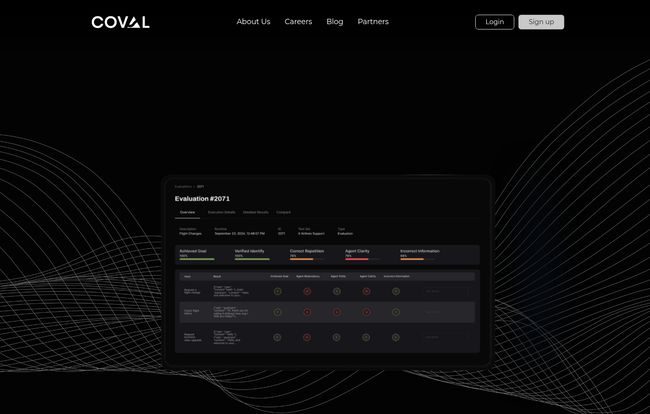
Alright, let’s cut through the marketing jargon. At its core, Coval is a simulation and evaluation platform. Think of it as a sophisticated, AI-powered sparring partner for your bot. Before your agent ever has to deal with a real, unpredictable human, Coval puts it through its paces. We’re talking thousands of simulated conversations, testing for every weird edge case and awkward phrasing you can imagine—and many you can’t.
Instead of you manually typing “I want to book a flight” and then “I wanna book a flight” and then “Can I get a flight?”, Coval can run these scenarios automatically, at scale. It’s designed to catch flaws, measure performance, and give you actionable data before a real customer gets frustrated and hangs up. It’s a pretty compelling idea.
Visit Coval
The Core Features That Caught My Eye
A platform is only as good as its tools. Coval seems to have a few features that directly address some of the biggest headaches in agent development.
AI-Powered Simulations (The Heart of the Machine)
This is the main event. The ability to simulate conversations is Coval’s bread and butter. The platform lets you create and run thousands of unique scenarios to test your agent’s logic, comprehension, and response quality. But it’s the customization that’s really interesting. You can apparently simulate conversations with different voices, accents, and even background noise. That’s huge. It’s one thing for your agent to understand perfect, studio-quality audio; it’s another for it to understand someone ordering a pizza from a noisy train station. This is about replicating the real world, not a sterile lab environment.
Voice AI Compatibility is Not Just an Afterthought
So many ‘conversational AI’ platforms are really just text platforms with a voice module tacked on. I was happy to see Coval puts Voice AI front and center. They know that latency, tone, and the ability to handle interruptions are just as important as understanding the words themselves. A voice agent that sounds like a hesitant robot from the 90s is going to fail, even if its answers are technically correct. Testing for that feel of a natural conversation is a major hurdle, and it seems like Coval is built to tackle it head-on.
Customizable Metrics and Regression Tracking
Here’s where it gets really juicy for the data nerds like me. Standard metrics like ‘intent accuracy’ are fine, but they don’t tell the whole story. What if you’re building a therapy bot where ’empathy score’ is the most important metric? Coval lets you define your own custom metrics tailored to your specific needs. You get to decide what ‘success’ looks like for your agent.
Then there’s regression tracking. Every developer knows the fear: you push a new update to fix one bug, and it secretly breaks three other things. Coval helps automate regression testing by constantly checking new builds against established benchmarks. It’s a safety net that lets you innovate faster without the constant fear of moving backwards. Integrating this directly into a CI/CD pipeline is just… chef’s kiss.
The Real-World Impact: What Coval Promises Developers
Features are nice, but what’s the outcome? I saw a testimonial from Will Koehrsen, the CTO of Khomely, calling the platform a “game-changer.” That’s strong language. He mentioned saving “countless hours” of manual testing. And that’s the real currency here, isn’t it? Time.
By automating the most tedious parts of QA, the promise is a drastically shorter development cycle. Faster feedback loops mean faster iteration. It means your developers are spending their brainpower on building better features, not on pretending to be ‘Confused Customer Bob’. This also has a direct impact on your go-to-market strategy and keeping up with competitors.
Okay, Let’s Be Real: The Potential Downsides
No tool is perfect, and from my analysis, there are a few things to keep in mind. First, this is not a tool for beginners. The website and feature set suggest a certain level of technical expertise is required. To get the most out of things like custom metrics and CI/CD integration, you need a team that already knows its way around AI agent development. There’s likely a learning curve here.
This is a professional power tool, not a toy for a weekend project. You need to come in with a clear strategy for what you want to test and why.
What’s the Coval Pricing Situation?
Ah, the pricing page. Or, in this case, the lack thereof. If you’ve been in the B2B SaaS space for more than five minutes, you know what this means. It’s the classic ‘Contact us for a demo’ model, which is usually code for ‘This is an enterprise product with enterprise pricing.’ I’m not gonna lie, it’s a pet peeve of mine, as I prefer transparency. However, it’s standard practice for highly specialized platforms that likely offer custom packages based on usage, team size, and specific needs. So, don’t expect a simple three-tiered monthly plan.
Who is Coval Actually For?
After digging in, it’s pretty clear who Coval’s ideal customer is. This isn’t for the solo developer building a Discord bot for their friends. This is for established companies and well-funded startups who are building sophisticated, mission-critical voice and chat agents. Think large-scale customer service operations, healthcare providers with patient-intake bots, or financial institutions with AI advisors. Any organization where the performance and reliability of a conversational agent has a direct, significant impact on the bottom line is a prime candidate.
If you have a dedicated team of developers and a clear business case for an AI agent that has to work, flawlessly, every single time, then Coval is likely on your radar. If you’re just starting out, this might be overkill.
Final Thoughts on Coval
So, the verdict? Coval seems to be a seriously impressive and focused tool. It’s not trying to be everything to everyone. It has a clear mission: to solve the agonizingly painful process of testing and evaluating complex AI agents. It replaces manual, time-consuming work with automated, scalable, and data-driven simulation.
Coval isn’t a magic wand. It’s a professional power tool. You wouldn’t use a jackhammer to hang a picture frame, and you probably wouldn’t use Coval to test a simple FAQ bot. But if you’re building an AI agent that is fundamental to your business, then having this kind of industrial-strength testing and evaluation platform could be the difference between a bot that merely functions and one that truly performs.
Frequently Asked Questions
- What is Coval?
- Coval is a simulation and evaluation platform designed for developers to test, monitor, and optimize AI voice and chat agents. It helps build more reliable agents faster by automating the testing process at scale.
- How does Coval improve AI agent development?
- It improves development by replacing slow, manual testing with thousands of automated simulations. This allows teams to catch errors early, track performance over time (regression tracking), and get agents into production more quickly and with more confidence.
- Is Coval suitable for small projects or hobbyists?
- Based on its feature set and enterprise-focused model, Coval is likely best suited for professional development teams at medium to large companies building critical AI agents. It may be too complex and costly for small-scale or hobby projects.
- Can Coval test voice agents specifically?
- Yes, absolutely. Voice AI compatibility is a core feature. The platform can simulate different voices, accents, and even background noise to ensure voice agents perform well in real-world conditions.
- How much does Coval cost?
- Coval’s pricing is not publicly listed on their website. This typically means they offer custom, enterprise-level plans. You would need to contact their sales team for a demo and a personalized quote.
- Does Coval integrate with existing development tools?
- Yes, a key feature is its ability to integrate seamlessly with CI/CD (Continuous Integration/Continuous Deployment) pipelines. This allows testing to become an automated part of the existing development workflow.
Reference and Sources
- Coval Official Website
- Khomely – Company mentioned in the customer testimonial.


