
Categories: AI Code Assistant, AI Interview Assistant, Undetectable AI
CrackCoder Review: The AI Tech Interview Cheat Code?

If you’ve ever been in the trenches of the tech world, you know the feeling. The clammy hands, the racing heart, the silent prayer that the interviewer doesn’t ask you to reverse a binary tree on a whiteboard. Tech interviews, especially the ones heavy on Data Structures and Algorithms (DSA), can feel less like a measure of your ability to build great software and more like a high-stakes, televised trivia show. It’s a grind. A painful, often demoralizing, LeetCode-fueled grind.
So, what happens when a tool comes along that promises to be your secret weapon? Your ghost in the machine that whispers the perfect, optimized solution right when you need it? Well, you get something like CrackCoder. And boy, does it make some bold promises.
So, What in the World is CrackCoder?
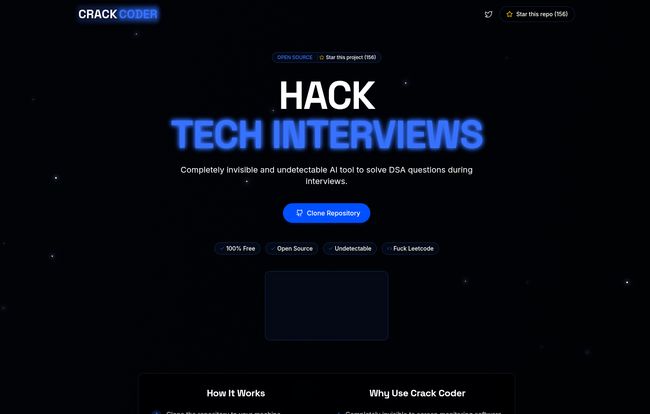
I stumbled upon this thing recently and my first reaction was a mix of “oh no” and “well, of course this exists.” CrackCoder bills itself as a “completely invisible and undetectable AI tool to solve DSA questions during Interviews.” The website is stark, dark-themed, and gets straight to the point with a headline that screams “HACK TECH INTERVIEWS.” No subtlety here, folks.
It’s an open-source project designed to run quietly in the background while you’re on a Google Meet, Zoom, or Amazon Chime call with a potential employer. The idea is, you get hit with a complex coding problem, and this AI swoops in and gives you the answer in seconds. It’s the digital equivalent of having the smartest kid in class slipping you notes during the final exam.
Visit CrackCoder
How It Claims to Work (The Four Easy Steps to… Trouble?)
According to their own homepage, the process is deceptively simple. It basically goes like this:
- Clone the repository to your machine.
- Run the invisible helper before your interview starts.
- Get undetectable DSA solutions during the interview.
- Land your tech job without grinding LeetCode.
Sounds easy, right? Maybe a little too easy. It’s presented as this simple, four-step path to glory, a magic wand that bypasses all the hard work. But as anyone who’s been around the block knows, magic wands often come with some gnarly side effects.
The Alluring Promise of Being ‘Undetectable’
This is the core selling point, the thing that makes CrackCoder so tempting and so terrifying. The claim is that it’s “Completely invisible to screen monitoring software.” That’s a huge claim. As someone who’s had to deal with remote proctoring tools and corporate monitoring software, I can tell you that the arms race between monitoring and evasion is constantly escalating.
Modern proctoring systems can do more than just watch your screen. They can monitor running processes, track keystroke patterns, and even use AI to analyze eye movement through your webcam. Is CrackCoder sophisticated enough to bypass all of that? Maybe. For now. But it feels like a risky bet. One suspicious glance away from the screen, one oddly-paced keystroke, and a sharp interviewer might get a feeling that something is… off. And trust me, that’s a bell you can’t un-ring.
Let’s Address the Elephant in the Room: The Ethics
Okay, we can’t ignore this. The whole premise is, let’s be blunt, cheating. The creators seem to know this, because they’ve slapped a little disclaimer at the bottom of the page:
“Disclaimer: This tool is intended for educational purposes only. We encourage ethical learning and do not promote or endorse cheating. Please use this resource responsibly and wisely.”
I had to chuckle at that one. It’s a classic case of plausible deniability. It’s like a company selling a battering ram with a note that says, “For opening your own doors when you’ve lost your keys.” Everyone knows what it’s really for.
I get the temptation, I really do. The tech interview process can feel arbitrary and broken. I once completely bombed an interview for a role I was perfect for because my brain froze on a simple recursion problem I’d solved a dozen times before. The pressure is immense. But using a tool like this to get a job feels like building a career on a foundation of sand. What happens when you’re hired? The interview might be over, but the actual work—the real problem-solving—is just beginning. There’s no CrackCoder for a production server that’s on fire at 3 AM.
Long-Term Consequences: A Crutch That Breaks Your Legs
Here’s my biggest issue with tools like this. They don’t just help you cheat an interview; they cheat you out of an opportunity to actually grow. The struggle of solving a difficult problem is where the learning happens. That ‘aha!’ moment when the logic finally clicks into place is what builds you into a competent, confident engineer.
Relying on an AI crutch means you never develop that problem-solving muscle. You might get the job, but you’ll walk in with a massive case of imposter syndrome and a genuine skill gap. That’s a recipe for misery, burnout, and eventually being found out. It’s a short-term shortcut that leads to a long-term dead end.
What’s the Damage? A Look at the Pricing
This is one area where there’s no catch. The tool is open-source and free. You just grab the code from the repository and run it yourself. When I went looking for a pricing page or a premium tier—because that’s just how my SEO brain works—I was greeted with a beautiful 404 ‘NOT_FOUND’ error. Poetic, isn’t it? The cost isn’t monetary. The price you pay is in skill, integrity, and the risk of getting caught.
My Final Take: Clever Tool, Dangerous Path
Look, I’m a tech guy. I can appreciate a clever piece of code. On a technical level, what CrackCoder is attempting to do is fascinating. It’s a testament to how powerful AI has become. But as a professional who values skill and integrity, I just can’t get behind it.
It’s a symptom of a larger problem in tech hiring, but it’s not the solution. It’s a tempting, shiny red button that promises an easy way out. But the real ‘hack’ to tech interviews isn’t a secret tool; it’s putting in the time, struggling through the problems, and building genuine, unshakeable competence. That’s a foundation that no interview, no matter how tough, can break.
Frequently Asked Questions about CrackCoder
Is using CrackCoder illegal?
Probably not ‘illegal’ in a criminal sense, but it’s almost certainly a violation of the terms of service of any company you’re interviewing with. If you’re caught, you can expect to be blacklisted immediately. If you’re hired and they find out later, it’s absolutely grounds for termination for fraudulent misrepresentation. It’s a high-risk, low-reward game.
Can companies really detect it?
It’s a cat-and-mouse game. While CrackCoder claims to be undetectable, companies are constantly improving their detection methods. It might work against a basic screen-share, but more advanced proctoring software or even an observant interviewer could potentially spot anomalies. Relying on it is a gamble.
What are some good alternatives to prepare for DSA interviews?
The old-fashioned way still works best! Grind problems on platforms like LeetCode and HackerRank to build muscle memory. Use mock interview platforms like Pramp to practice in a low-stakes environment. And most importantly, work on understanding the concepts behind the algorithms, not just memorizing solutions.
Why is the tool’s disclaimer so contradictory?
That’s a classic legal maneuver often called ‘CYA’ (Cover Your… Assets). The creators know exactly how their tool will be used, but the disclaimer gives them a thin veil of deniability. It shifts the responsibility entirely onto the user.
Is it safe to run open-source code like this from the internet?
That’s a fantastic question. You should always be cautious when cloning and running code from an unknown source, especially a tool designed for stealth. While open-source allows for community vetting, it’s not a guarantee against malware or security vulnerabilities. You’d be giving a random script access to your machine, which is always a risk.
Will this tool actually get you a job?
It might get you past a single coding screen. But the hiring process is more than one DSA question. There are system design rounds, behavioral questions, and follow-up technical discussions. This tool can’t help you there. It’s a very small key for a very big lock, and it probably doesn’t even work.
So, there you have it. A fascinating, ethically-dubious tool that speaks volumes about the state of tech hiring. My advice? Steer clear. The satisfaction of earning a job with your own skills is worth far more than the temporary relief of a shortcut.
Reference and Sources
- CrackCoder Official Website: As seen in the provided image (Note: The site appears to be just a landing page for the repository).
- Pramp: For peer-to-peer mock interviews.
- FreeCodeCamp: An article on approaching tech interviews ethically and effectively.


