
Categories: AI Design Generator, AI Healthcare, AI Models, AI Productivity Tools, AI Research Tool
Cradle AI Review: Faster Protein Engineering or Hype?

For years, I’ve seen countless tools promise to ‘revolutionize’ the R&D space. It’s a phrase that gets thrown around so much in SEO and tech circles that it’s almost lost all meaning. Most of the time, it’s just a slicker UI slapped on an old process. But every now and then, something comes along that makes me genuinely sit up and pay attention. Something that feels less like a fresh coat of paint and more like a whole new engine.
Lately, that something for me has been Cradle.
If you’re in biotech, pharma, or even cutting-edge food tech, you know the drill. Protein engineering is a slog. It’s a painstaking process of trial, error, and more error, stretching timelines from months into years. You tweak a sequence here, test an expression there, and hope you nudge a property in the right direction without breaking three others. It’s brilliant, necessary work, but wow, is it slow. So when a platform claims it can help you “engineer better proteins faster,” my inner skeptic and my inner optimist get into a fistfight. Today, the optimist is winning.
What on Earth is Cradle, Anyway?
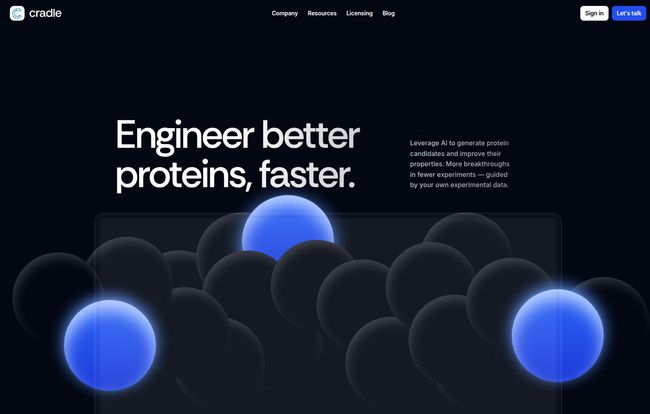
Strip away the marketing buzz, and Cradle is an AI-powered platform designed specifically for biologists who are deep in the trenches of protein engineering. Think of it less as a robot that does your job and more as an incredibly brilliant co-pilot. It uses generative AI and machine learning models to help you design and optimize proteins with specific properties—things like stability, activity, or binding affinity.
The company is already making waves, and you just have to look at the logos on their homepage to see they’re playing in the big leagues. We’re talking about scientific teams at Novozymes, Johnson & Johnson Innovation, and IFF. These aren’t garage startups; they’re industry giants. When they put their weight behind a tool, it’s a signal that something real is happening here.
The platform is built for a wide range of applications, from developing new therapeutics and antibodies to creating more efficient industrial enzymes or novel food ingredients. It’s not a one-trick pony.
How Cradle’s AI Actually Gets to Work
Alright, so how does it work? I’m not a machine learning engineer, and I’m guessing most of the biologists using this aren’t either. The beauty is, you don’t have to be. Cradle has broken down a ridiculously complex process into a logical workflow. I’d describe it as a feedback loop between your lab and their algorithms.
It’s like tuning a Formula 1 car. You have your base model (your protein), but you want to make it faster, more fuel-efficient, and have better tire grip—all at the same time. Doing that by hand is a nightmare of compromises. Cradle is like having a team of a thousand data engineers analyzing every bit of telemetry to suggest the perfect adjustments.
Visit Cradle
It Starts With Your Data
This isn’t magic, and it doesn’t work in a vacuum. The first step is to import your own experimental data—your sequences, your assay results, all that hard-won knowledge. The platform’s models then get to work learning the unique biophysics of your protein. This is a critical point. Its not some generic model; it learns from your specific project, getting smarter and more predictive with each round of data you feed it. The platform even helps you explore your data quality, because as we all know: garbage in, garbage out.
Generating and Optimizing New Candidates
Once the model is trained on your initial data, the fun begins. Cradle’s AI starts generating new protein sequence candidates—sometimes thousands of them—that are predicted to have improved properties. And this is the part that really gets me excited: the multi-property co-optimization. You can tell the AI, “I need to increase thermal stability by 15% and improve binding affinity, but without sacrificing expression levels.” The system then crunches the possibilities in silico to find designs that hit that sweet spot. This is something that is just brutally difficult to do manually.
From the Screen Back to the Lab
The platform provides detailed reports on its suggested candidates, giving you all the info you need to decide which ones to take forward. You then synthesize and test these new designs in the lab. Those results? They get fed right back into Cradle. This closes the loop. With each cycle, the AI gets a more refined understanding of your protein, and its next batch of suggestions gets even better. It’s a compounding effect that promises to slash the number of lab cycles needed to reach your goal.
The Good, The Bad, and The AI-Generated Peptide
No tool is perfect, right? After digging into Cradle, here’s my honest breakdown of where it shines and where you might hit a speed bump.
The Wins: Why I’m Genuinely Impressed
- Game-Changing Speed: The claim of turning months into hours for design is bold, but it’s the core of Cradle’s value. By front-loading the heavy lifting of design and prediction, it dramatically cuts down the ‘random walk’ of traditional protein engineering. For any company in a competitive market, that speed is currency.
- The Multi-Parameter Holy Grail: I mentioned this before, but it’s worth repeating. Simultaneously optimizing for multiple, often conflicting, properties is the holy grail. Cradle’s ability to tackle this is probably its most powerful feature.
- Security & Support: For the target audience (pharma, major biotech), data security is non-negotiable. Cradle emphasizes that your data is managed securely and privately. They also offer dedicated support from scientists and ML experts, which is a huge plus. You’re not just buying software; you’re getting a support team.
Potential Hurdles and Considerations
- It Needs to Be Fed: Cradle’s AI is powerful, but it needs a starting point. You must have existing experimental data to train the models. If you’re starting from absolute zero with no preliminary data, this tool can’t help you (yet). It accelerates research, it doesn’t invent it from thin air.
- There’s a Learning Curve: While it’s designed for biologists, let’s be real. Integrating an AI platform into a wet lab workflow requires a shift in thinking. It might take some expertise in both protein engineering and understanding the AI’s suggestions to get the most out of it. This isn’t a point-and-click solution for a total novice.
So, What’s the Price Tag on This Bio-Revolution?
Ah, the million-dollar question. Or is it a ten-million-dollar question? If you cruise over to Cradle’s website, you won’t find a neat little pricing page with three tiers. And that’s not surprising.
This is standard practice for high-end, specialized enterprise software. The cost is almost certainly customized based on a bunch of factors: the size of your research team, the scale of your projects, the level of dedicated support you need, and the amount of data you’ll be running through their models. It’s a “you have to call us” situation, which makes sense. They’re not selling a simple app; they’re selling a research partnership. My advice? If you’re a serious player in this space and the features resonate, don’t let the lack of a public price tag scare you. Just get in touch with them.
Frequently Asked Questions about Cradle
1. Is Cradle just for developing new drugs?
Absolutely not. While therapeutics is a major application, Cradle is built for any protein. The website specifically calls out industrial enzymes, antibodies, agricultural solutions, and food ingredients. If you’re engineering a protein, it’s relevant.
2. Do I need to be a machine learning expert to use Cradle?
It seems you don’t need to be a coder, but having a good grasp of the principles will help. The platform is designed for biologists, but it’s a powerful tool. Having someone on the team who can bridge the gap between the biology and the AI’s output is probably a good idea to maximize its value.
3. Is my proprietary sequence and assay data safe on the Cradle platform?
Cradle is very clear on this point. They highlight their secure and private platform for data management. For the kind of clients they work with, this is a top priority, so you can bet they’ve invested heavily in it.
4. How does Cradle actually learn and improve?
It learns directly from your experimental data. Each time you run a set of experiments on the candidates it suggested and feed those results back into the system, its predictive models get more accurate for your specific project. It’s a true design-build-test-learn cycle.
5. Can Cradle create a brand new protein from scratch for me?
No, that’s not its primary function. Cradle works by learning from existing proteins and their performance data to suggest improved variants. It’s an optimization and acceleration engine, not a from-scratch invention machine.
6. Just curious, where is the company based?
They’re a European company, with offices in Amsterdam and Zurich. A nice little detail that gives them a bit more personality than just another faceless Silicon Valley startup.
My Final Word on Cradle
So, is Cradle just more hype? I don’t think so. It feels different. It’s a tool that respects the scientific process and aims to augment, not replace, the brilliant work of researchers. It’s not a magic button that spits out perfect proteins. It’s a sophisticated, data-hungry co-pilot that can help you navigate the incredibly complex landscape of protein design faster and more efficiently than ever before.
For R&D teams with the data and the ambition, Cradle could genuinely be the difference between getting to a breakthrough in five years versus getting there in two. And in the world of science and business, that’s everything.
Reference and Sources
- Cradle Official Website: https://cradle.bio/


