
Categories: AI Agent, AI API, AI Developer Tools, AI Models, Large Language Models (LLMs)
Crosshatch API: Is This the Future of Personalization?

For years, the gold standard of ‘personalization’ online has been getting an email that says, “Hey, [First_Name]!” and then proceeds to show you ads for the exact pair of shoes you just bought. It’s clumsy. At its best, it’s slightly helpful; at its worst, it’s just plain creepy.
I’ve been in the SEO and traffic game for a long time, and I’ve seen the pendulum swing from ‘collect all the data!’ to ‘oh no, privacy!’ and back again. We’re in a weird spot. Users want experiences that feel like they were made just for them, but they’re (rightfully) more skeptical than ever about how their data is being used. It’s a real pickle for developers and marketers.
So when I stumbled upon a tool called Crosshatch, my curiosity was definitely piqued. Their headline is bold: “The internet’s first user-owned API.” That’s a big claim. But what does it actually mean, and can it live up to the hype? Let’s get into it.
What Exactly is Crosshatch? (Think of it as a Data Passport)
Okay, so ‘user-owned API’ sounds a bit jargon-y. Here’s my take on it. Imagine your user has a digital passport. This passport contains stamps of their recent activity—what music they love (from Spotify), where they like to travel (from Google Maps), what they’ve been buying (from Amazon).
Normally, for your app to know any of this, you’d have to build a bunch of separate, clunky integrations and ask your user to connect a dozen different accounts. It’s a nightmare for you, and it’s a huge ask for the user.
Crosshatch acts as the passport office. It’s an API that lets the user grant your application temporary, permissioned access to their passport. In a single tap, they can bring all that rich history and context into your app. They decide what to share, and they can revoke access at any time. You, the developer, get a firehose of real-time, relevant data to build something truly special, and the user keeps control. It’s a simple, yet pretty profound shift in how we think about app data.
Moving Beyond ‘Hello, Nicole!’ to Something Meaningful
The real magic here isn’t just about easier onboarding. It’s about the quality of the experiences you can create. The website gives a few examples that really get the wheels turning.
- Travel Itineraries: Instead of asking a user a 20-question survey about their travel style, what if your app could just know? With their permission, you could see they listen to lofi chill-hop on Spotify, frequently visit art museums via their Google Maps history, and recently bought hiking boots on Amazon. Instantly, you can suggest a trip to a city with a great art scene, quiet cafes, and nearby nature trails. That’s not just personalization; that’s intuition.
- Curated Shopping: Imagine an e-commerce store that doesn’t just show you more of what you’ve already bought. It could see you’re a new parent (based on purchase history) and also a coffee aficionado (based on local cafe check-ins) and suggest a high-quality, kid-safe, insulated coffee mug. That’s a level of connection most platforms can only dream of.
This is the kind of stuff that turns a functional app into a beloved one. It’s about anticipating needs, not just reacting to past behavior. It’s the difference between a tool and a companion.
Visit Crosshatch
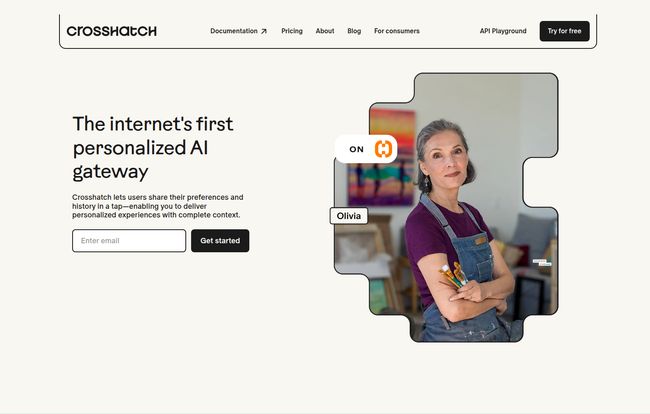
A Personalized Gateway to the AI Future
With every company on the planet scrambling to build their own AI features, the biggest bottleneck is data. AI is only as smart as the information you feed it. Garbage in, garbage out, as they say. Crosshatch positions itself as a ‘Personalized AI Gateway,’ and I think this is one of its most powerful angles. Instead of training your AI on generic, public data, you can power it with the real, consented, and deeply personal context of each individual user. The potential for creating truly helpful AI assistants, recommendation engines, and custom planners is immense.
A Dream for Developers? Less Compliance, More Code
Okay, let’s talk about the less glamorous side of things. If you’re a developer, the letters ‘GDPR’ or ‘CCPA’ probably give you a slight headache. Building amazing things is fun; navigating international data privacy law is… not.
One of the most appealing things on the Crosshatch site is the simple statement: “Crosshatch handles compliance.” Because the entire model is built around explicit user consent, it seems to sidestep many of the privacy nightmares that come with traditional data scraping or tracking. The user is the one providing the data, not you sneakily collecting it. This frees up developers to do what they do best: build cool stuff. That’s a value proposition you can’t really ignore.
The Big Question of Data Privacy and Trust
Now, some might argue that this is just another way to get users to hand over their data. And they’re not wrong. At the end of the day, the user is still sharing sensitive information. The key difference here is the agency. The entire framework is opt-in by design. It’s built on a foundation of user permission, which is a world away from the murky world of third-party cookies and data brokers. It’s a move towards what some in the industry call zero-party data—information a customer intentionally and proactively shares with a brand.
In my experience, users are willing to share data if there’s a clear and immediate benefit. If giving an app access to my Spotify history means I get amazing, tailored concert recommendations, that’s a trade I’m willing to make. The problem has always been the lack of transparency and control. Crosshatch seems to be tackling that problem head-on.
So, What’s the Price for This Magic?
Alright, this is the part of the review where I’d normally break down the pricing tiers. I clicked on the ‘View Pricing’ button on their site, full of optimism, ready to analyze the value… and was greeted by a shiny ‘404 Page Not Found’.
Look, it happens. Maybe they’re revamping it. Maybe they just launched and are still finalizing the details. It’s a minor stumble for what looks like a very polished platform otherwise. While I can’t give you concrete numbers, I can speculate. A tool like this will likely operate on a model based on API calls, monthly active users, or a tiered subscription for different levels of access and support. For now, your best bet is to hit up their documentation or contact them directly. A little bummer, but not a deal-breaker.
Who Should Be Looking at Crosshatch?
I see a few groups getting really excited about this.
- Indie Developers & Startups: If you’re building a new app from scratch, especially in travel, e-commerce, or lifestyle, this could be your secret weapon. It allows you to offer a level of personlization that would typically require a huge team and budget.
- Product Managers at Established Companies: Stuck with a generic user experience? This could be a way to inject new life into an existing product and dramatically improve engagement metrics without rebuilding your entire data infrastructure.
- Forward-Thinking Marketers: If you’re tired of basic segmentation, the rich context from Crosshatch could power marketing campaigns and user journeys that feel genuinely one-to-one.
Frequently Asked Questions About Crosshatch
- What is Crosshatch in simple terms?
- It’s an API that lets your users securely and instantly share data from their other accounts (like Spotify, Amazon, etc.) with your app. This gives you deep, real-time context to create hyper-personalized experiences.
- How does Crosshatch protect user privacy?
- The entire system is built on user consent. Users explicitly choose what data to share and with which application. They are in complete control and can revoke access anytime, which is a core part of the ‘user-owned’ philosophy.
- What kinds of data can be integrated through Crosshatch?
- Based on their site, it includes a wide range of data from services covering spending habits, travel history, music preferences, shopping carts, and more. This gives a holistic view of the user’s context.
- Is the Crosshatch API difficult to integrate?
- Any API integration has its complexities, but Crosshatch aims to simplify it by handling the compliance and security aspects. They provide documentation to guide developers, but the actual difficulty will depend on your existing tech stack.
- Is Crosshatch free to use?
- Currently, their pricing page is not available. It’s best to contact their team directly or check their documentation for the most up-to-date information on their pricing model.
- What makes Crosshatch different from other personalization software?
- The main difference is the ‘user-owned’ aspect. Instead of tracking users or buying third-party data, Crosshatch facilitates a direct, permission-based data share from the user to the application, ensuring better data quality and trust.
Final Thoughts
I’m genuinely optimistic about what Crosshatch represents. It feels like a step in the right direction—away from the covert surveillance model of the old web and towards a more transparent, consent-driven internet. It gives power to both the user and the developer.
Will it be the ultimate solution for everyone? Probably not. There will be challenges with user adoption and integration. But it’s a bold idea, and it’s tackling one of the biggest problems in the digital space today. In a world of copycat apps and generic experiences, a tool that helps you build something that feels truly unique and intuitive is worth paying attention to. I, for one, will be keeping a close eye on them.
Reference and Sources
- Crosshatch Official Website: https://www.crosshatch.io/
- Forbes Article on Zero-Party Data: https://www.forbes.com/sites/forbesbusinesscouncil/2022/01/24/zero-party-data-the-good-the-bad-and-the-ugly/


