
Categories: AI API, AI Beat Generator, AI Copilot, AI Instrumental Generator, AI Melody Generator, AI Music Generator, AI Song Generator, AI Text-to-Music
Delphos AI Music: A Virtual Composer That Learns Your Style

Okay, let’s have a real chat. You and me. As a content creator, I feel like I’m swimming in a sea of AI tools every single day. AI writers, AI image generators, AI video editors… it’s a lot. And honestly? Most of it feels a bit… soulless. Like a cheap copy of a copy.
So when another AI music tool lands on my radar, my first reaction is usually a skeptical eyebrow raise. We’ve all heard them—those generic, royalty-free tracks that sound like they were made for a corporate training video in 1998. But every now and then, something different comes along. Something that feels less like a content mill and more like a collaborator. That’s the vibe I got when I started looking into Delphos.
Instead of just asking for a prompt like “upbeat synthwave for a podcast intro,” Delphos claims to be a “virtual composer” that actually learns your style. Now THAT got my attention. It’s a bold claim. So, is it just clever marketing, or is this the AI music partner we’ve been waiting for?
So, What Exactly is Delphos?
At its core, Delphos is an AI-powered music generation platform. But the secret sauce, the thing that sets it apart, is this concept of a “soundworld.”
Think of it less like a vending machine for music and more like a highly-trained, lightning-fast studio apprentice. You don’t just give it a command; you train it. You feed it your existing music, your stems, your favorite loops, or even just musical elements you like. Delphos analyzes this input and creates a personalized sonic palette—your unique soundworld. From there, it can generate new, complete tracks that sound like… well, you.
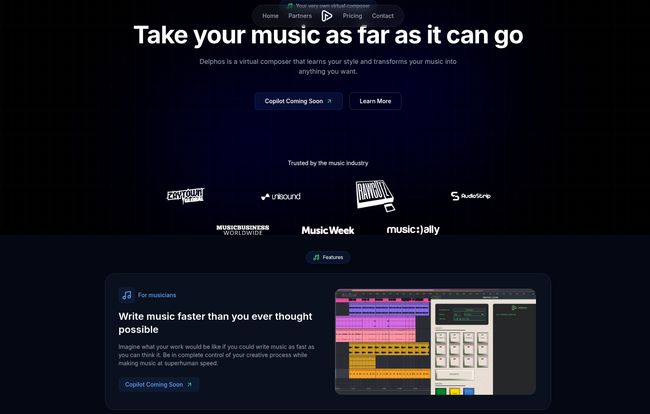
Visit Delphos
It’s designed to transform your musical DNA into an infinite stream of new ideas. Stuck on a bridge for your new song? Ask Delphos to generate a few options in your style. Need 20 background tracks for your YouTube channel that all feel cohesive? Train your soundworld once and generate them in minutes. This is a pretty significant shift from the one-off prompt-and-pray approach of other generators.
Who Is This Actually For?
Delphos seems to know its audience, and it’s not just one-size-fits-all. They’ve broken down their offerings for a few key groups, which I appreciate.
For the Solo Musician and Producer
This is the ground floor. The bedroom producer, the indie artist, the content creator. You’re looking for speed and inspiration. The idea here is that Delphos acts as your co-pilot, smashing through creative blocks. The landing page shows prompts like “Give me a funky bass line in the same style as my first album.” That’s powerful. It’s about augmenting your workflow, not replacing it. You can use it in their web app or integrate it with your DAW, which is a smart move for workflow continuity.
For the Scrappy Record Label
Okay, moving up a level. For a record label, especially an indie one, volume is often the name of the game. Building a big, diverse catalogue for sync licensing or streaming can be a monumental task. Delphos positions itself as a solution for scaling that production. Labels can train soundworlds based on their top artists or specific genres they want to push, and then generate vast amounts of new, on-brand material. It’s about expanding the catalogue without burning out your entire artist roster.
For the Big Tech Platforms
This is the enterprise-level play. Think of a video editing app, a social media platform, or a game development engine. They all need massive libraries of music. Delphos offers an API to build its music generation capabilities directly into another product. So, your users could generate a custom soundtrack for their video edit without ever leaving your app. It’s music creation as a feature, which is a whole other ballgame.
Let’s Talk Money: The Delphos Pricing Plans
Alright, the all-important question: what’s this going to cost? The pricing structure is… interesting. It’s not a simple monthly subscription for unlimited access, which might throw some people off.
| Plan | Price | Best For | Key Feature |
|---|---|---|---|
| Copilot | $10 / 1000 credits | Musicians & Individuals | Fast music generation for your own projects. |
| Record Label | $500 / month | Labels & Publishers | Ability to train your own custom soundworlds. |
| Enterprise | Contact Sales | Platforms & Large Companies | Full API integration and unlimited soundworlds. |
The “Copilot” plan uses a credit system, which I have mixed feelings about. On one hand, you only pay for what you use. On the other, it can be hard to predict costs and nobody loves watching a credit balance tick down. The big jump to the “Record Label” plan at $500 a month is substantial, but it unlocks the platform’s core promise: training your own soundworlds. The Enterprise plan is a classic “if you have to ask, you can’t afford it” situation, which is standard for API access.
My Honest Take: The Good and The Not-So-Good
No tool is perfect. After digging in, here’s my brutally honest breakdown of where Delphos shines and where it stumbles.
Let’s start with the good stuff. First off, the speed is undeniable. Generating ideas or full tracks in seconds is a game-changer for anyone on a deadline. The scalability for labels is also a massive plus. But for me, the single most important feature is this: you own the copyright on the compositions you generate. In the wild west of AI content, this is HUGE. The US Copyright Office is still figuring things out, so having a platform that gives you ownership is a major green flag. The ability to customize and train your soundworld is, of course, the headline feature and it’s genuinely innovative.
Now, for the reality check. There’s a definite reliance on AI for creative input, and that won’t sit right with everyone. If you’re a purist, this might feel like cheating. It’s a tool, but it’s a tool that does some of the creative heavy lifting. The cost is also a factor. While the Copilot plan is accessible, the real power is in the Record Label tier, and $500/month is a serious investment for smaller outfits. A huge limitation I noticed is that it seems to be instrumental music only. There’s no mention of vocal synthesis, so if you’re a songwriter looking for a topline, you’re out of luck. Finally, the need to train the soundworlds, while powerful, is also a hurdle. You need to have a body of work or a clear collection of sounds to feed it in the first place, so it might not be ideal for someone starting from absolute scratch.
Frequently Asked Questions about Delphos
- Do I really own the music I make with Delphos?
- According to their website, yes. They state that you own the copyright on the compositions generated with Delphos. This is a critical advantage over many other AI services.
- Can Delphos create songs with vocals?
- It appears not. All the examples and descriptions point towards instrumental music generation. You would need to produce and add your own vocals separately.
- Is using Delphos considered ethical?
- This is a big debate in the creative community. Delphos pitches itself as ethical by allowing you to train the AI on your own musical style. This avoids the thorny issue of AIs being trained on copyrighted music without permission, which is a major concern with some other platforms.
- How does the ‘soundworld’ training actually work?
- You provide Delphos with your musical inputs—this could be stems from your tracks, MIDI files, or audio loops. The AI analyzes the melodic, harmonic, and rhythmic patterns to create a model of your unique sound. You need the Record Label plan or higher to access this feature.
- Is Delphos good for beginners?
- Sort of. The ‘Copilot’ plan is great for generating quick ideas if you’re stuck. However, the true potential is unlocked when you have existing music to train a soundworld, so it might be even more powerful for intermediate to advanced producers who already have an established sound.
Final Thoughts: Your New AI Apprentice?
So, where do we land on Delphos? I walked in skeptical, but I’m walking away… intrigued. Very intrigued.
This doesn’t feel like another generic AI music generator. The focus on personalizing the output with ‘soundworlds’ and giving creators copyright ownership shows they understand the real-world needs of musicians and labels. It’s not trying to replace the artist. It’s trying to be the most talented, tireless, and technically proficient studio assistant you’ve ever had.
It’s not without its limitations—the lack of vocals and the price point for customization are real considerations. But for producers, content creators, and labels looking to scale their output without sacrificing their unique sonic identity, Delphos is one of the most interesting players in the game right now. It’s a tool that asks for your creativity as an input, not as a casualty.


