
Categories: AI For Data Analytics, AI Productivity Tools
DeviceHub.ai Review: The Future of IoT Device Management?

Shipping a hardware product is one part exhilarating, nine parts terrifying. You spend months, maybe years, perfecting the physical thing. The design, the components, the casing… it’s your baby. But the moment it leaves the factory and gets into the hands of a customer, a whole new kind of anxiety kicks in. What if it fails? What if a bug in the firmware turns a thousand of your shiny new gadgets into expensive paperweights? It’s the stuff of nightmares for any product manager or engineer.
For years, we’ve cobbled together solutions. Custom dashboards, messy logging systems, and a whole lot of praying. I’ve been in this game a long time, and I’ve seen it all. The frantic calls, the costly truck rolls to service a device that just needed a simple reboot. So, when a platform like DeviceHub.ai comes along, waving the banner of “Connected Hardware Intelligence,” my inner cynic immediately perks up. Another buzzword-laden solution? Or something that actually moves the needle?
I decided to take a closer look. And what I found was… well, it’s interesting. Very interesting.
So, What is DeviceHub.ai, Really?
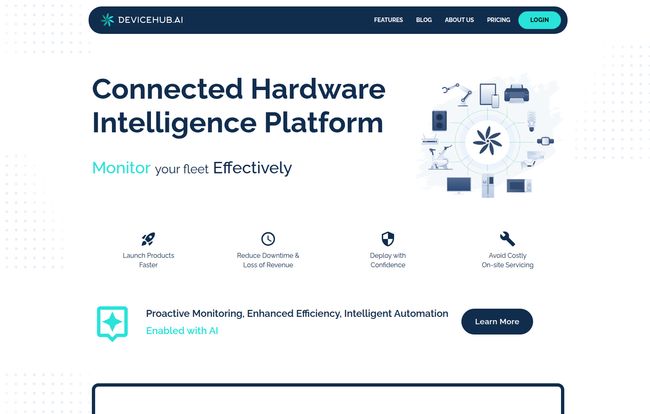
On the surface, DeviceHub.ai calls itself a “Connected Hardware Intelligence Platform.” Stripping away the marketing jargon, it’s a centralized command center for your entire fleet of deployed devices. Think of it less like a simple car dashboard that just shows your speed and fuel, and more like a full Formula 1 telemetry suite, monitoring hundreds of data points in real-time to predict when a tire is about to give out.
It’s built to help hardware companies do four things that are notoriously difficult:
- Launch products faster
- Reduce that dreaded downtime
- Deploy new updates with confidence
- Avoid expensive on-site service calls
It’s designed for the messy reality of managing hardware at scale, whether you’re dealing with a few hundred smart kiosks or hundreds of thousands of IoT sensors out in the wild. It handles everything from device monitoring and security to those gut-wrenching firmware updates. And the secret sauce? It’s all supposedly “enabled with AI.” We’ll get to that bit.
The Core Features That Actually Matter
A platform is only as good as its features. I’ve seen plenty of tools with a million options that nobody ever uses. DeviceHub.ai seems to focus on the things that cause the most headaches.
Beyond Simple Pings: Proactive Device Monitoring
Most basic monitoring tells you if a device is online or offline. That’s table stakes. It’s reactive. The real magic, and the real money-saver, is in proactive monitoring. This is about spotting the subtle signs that a device is about to fail. Is its memory usage slowly creeping up? Is a sensor reporting slightly weird data? This is where the AI part starts to make sense. It’s pattern recognition at a massive scale, flagging anomalies that a human would never catch until it’s too late. I once worked on a project involving thousands of remote payment terminals, and a tool like this would have saved us from a catastrophic, weekend-long outage. I still have teh scars from that one.
Firmware Updates Without the Heartache
Pushing out a firmware-over-the-air (FOTA) update is one of the most stressful things you can do in the hardware world. One bad line of code could brick your entire fleet. It’s like performing open-heart surgery on a patient who is a thousand miles away. DeviceHub.ai aims to be the steady-handed surgeon in this scenario. It provides the framework for managed rollouts—so you can update a small percentage of devices first, watch them closely, and then expand the deployment. This controlled approach turns a high-stakes gamble into a calculated, much safer, procedure.
Visit DeviceHub
Taking the Reins with Real-Time Control and IoT Security
Sometimes you just need to get your hands dirty. Real-time control means you can remotely access a device to run diagnostics, change configurations, or just give it a good old-fashioned reboot. But with great power comes great responsibility. The moment you open a remote connection to a device, you’ve created a potential security vulnerability. We all remember the Mirai botnet, right? A stark reminder of what happens when IoT security is an afterthought. DeviceHub.ai puts security front and center, which is non-negotiable in my book. Managing your fleet also means protecting it from the bad guys.
The Good, The Bad, and The Pricey
No platform is perfect. It’s always a matter of trade-offs. So let’s get into the nitty-gritty.
What I Like About DeviceHub.ai
What really appeals to me is the focus on scalability. The problems you have with 100 devices are completely different from the ones you have at 100,000. This platform is built for that growth. The comprehensive nature of it—combining monitoring, management, and AI-driven intelligence—is a huge plus. It prevents you from having to stitch together three or four different services, which is always a recipe for disaster. The promise of reducing downtime isn’t just a talking point; for a hardware business, uptime is directly tied to revenue and reputation.
The Potential Hiccups
Now, for a dose of reality. This isn’t some simple SaaS tool you sign up for and start using in five minutes. The first hurdle is that it requires integration with your existing hardware and software. You’ll need engineering resources to get this up and running. Secondly, some of the more advanced features, especially on the AI and analytics side, will probably require some technical expertise to get the most out of them. This isn’t a tool for a non-technical team. And then there’s the cost…
How Much Does DeviceHub.ai Cost?
The pricing is volume-based, which is standard for this kind of platform. Here’s a quick breakdown I pulled from their pricing page:
| Plan | Volume | Price per Device/Month |
|---|---|---|
| Launch | Under 10,000 devices | $3 |
| Expand | 10,000 – 100,000 devices | $2 |
| Custom | 100,000+ devices | Contact for quote |
At first glance, $3 per device per month might seem steep, especially for a startup. But you have to do the math. If a single service call costs you $300 in labor and travel, preventing just one of those calls for every 100 devices already pays for the platform. It’s an investment in operational efficiency, not just another line item on your expense report.
Final Thoughts: Is DeviceHub.ai Worth It?
So, we come back to the original question. Is DeviceHub.ai the IoT management platform we’ve all been waiting for? My take: for the right company, yes.
If you’re a hobbyist or a very small-scale operation, this is probably overkill. But if you’re a serious company building and shipping hardware products, especially complex ones running on Android or AOSP, a platform like this is not a luxury. It’s a necessity. You can’t afford to fly blind.
DeviceHub.ai appears to be a robust, well-thought-out solution to a very real, very expensive problem. It’s for businesses who understand that managing a fleet of devices is just as important as designing them in the first place. It’s for people who want to sleep at night without worrying about a thousand devices going dark simultaneously. It’s a serious tool for a serious job, and from what I’ve seen, it seems more than up to the task.
Frequently Asked Questions
- What kind of devices can I manage with DeviceHub.ai?
- It’s built for a wide range, from simple IoT sensors to more complex hardware like smart displays, kiosks, and custom handhelds, especially those running on Android or AOSP.
- Is DeviceHub.ai secure?
- Security is a core feature of the platform. However, remember that overall IoT security is a shared responsibility. The platform provides the tools, but your implementation is also critical.
- Do I need a developer to use DeviceHub.ai?
- For the initial setup and integration into your hardware’s software, you will almost certainly need an engineer or development team. For day-to-day monitoring and operations, it’s designed to be used by an operations or product team.
- How does the AI actually help reduce downtime?
- The AI works by constantly analyzing streams of data from all your devices to find subtle patterns and anomalies. This allows it to predict potential failures before they happen, so you can perform maintenance proactively instead of reacting to an outage.
- Can I get a trial or demo of DeviceHub.ai?
- For enterprise-level platforms like this, the typical route is to contact their sales team through their website to schedule a personalized demo. They’ll want to understand your specific use case.
- Is the pricing per month or a one-time fee?
- The pricing is a recurring subscription, charged on a per-device, per-month basis.
Reference and Sources
- DeviceHub.ai Official Website
- DeviceHub.ai Pricing Page
- CISA Alert on the Mirai Botnet – A good primer on why IoT security is so important.


