
Categories: AI Assistant, AI Chatbot, AI Dream Interpreter
AI Dream Interpretation: Unlocking Your Subconscious?

The other night, I dreamt I was trying to parallel park a canoe in a crowded supermarket. Everyone was watching. And judging. The canoe, for some reason, was full of lukewarm soup. I woke up feeling… confused. And a little sticky.
My first thought, like any perpetually-online person, wasn’t to ponder the deep pyschological implications myself. No, it was: I wonder what the internet thinks this means? For ages, we’ve had dream dictionaries, Freudian analysis, and that one friend who’s really into Jungian archetypes. But now, in the age of AI everything, we have a new oracle: the AI dream interpreter.
As an SEO guy, I’m swimming in AI tools daily. They write content, they analyze data, they predict trends. But an AI that claims to understand the soup-filled canoe of my subconscious? That I had to see. So I stumbled upon a site called the Dream Interpretation Guide, and decided to let a machine take a crack at my nightly nonsense.
First Impressions of the Dream Interpretation Guide
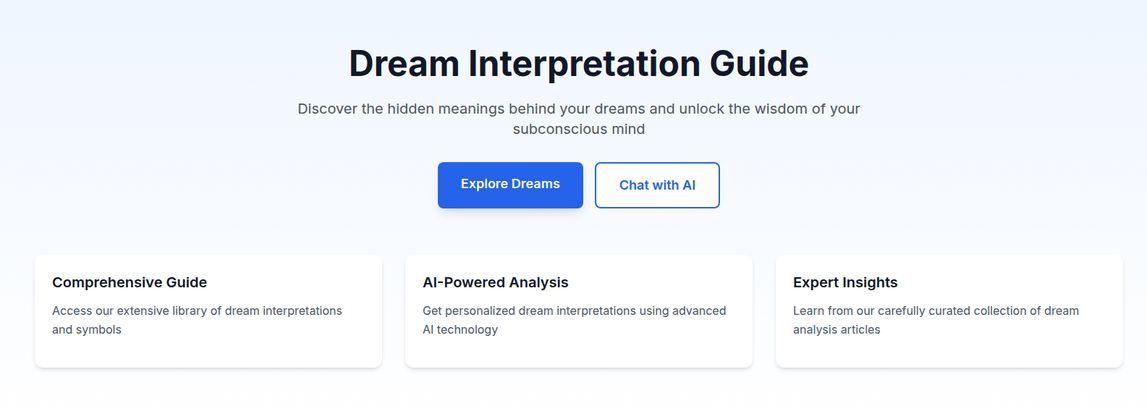
Landing on the homepage, it’s all very clean and straightforward. No mystical, star-dusted nonsense. Just a simple, clear proposition: “Discover the hidden meanings behind your dreams and unlock the wisdom of your subconscious mind.” Okay, ambitious. I like it.
The site immediately presents you with its three core pillars:
- Comprehensive Guide: This is basically your classic dream dictionary, an extensive library of symbols and their supposed meanings. A digital version of the dusty book you’d find in a secondhand shop.
- AI-Powered Analysis: This is the main event. You feed the machine your dream, and it spits back a personalized interpretation. The secret sauce.
- Expert Insights: A collection of articles on dream analysis, probably written by actual humans, which is a comforting thought.
Visit Dream Interpreter
You’ve got two big buttons staring you in the face: “Explore Dreams” and “Chat with AI.” It’s a simple fork in the road. Do you want to browse the library yourself, or do you want to talk to the robot therapist? I, of course, went straight for the robot.
Putting the AI Dream Analyst to the Test
So, I typed in my dream. “I was in a busy supermarket, trying to parallel park a canoe full of lukewarm soup. Everyone was staring at me and I felt very anxious.” I hit enter and waited for the algorithmic wisdom to descend.
The response came back pretty quick. It broke down the symbols individually first. The supermarket, it suggested, could represent choices and the things we need to sustain ourselves in life. The canoe, a symbol of a personal journey, often an emotional one. And the soup? Nourishment, but the fact that it was lukewarm suggested dissatisfaction or a lack of fulfillment. Nailed that part, at least. Lukewarm soup is definately dissatisfying.
Then it pieced it all together. The AI’s conclusion was that I might be feeling judged (the staring people) about the unconventional path (parking a canoe) I’m navigating in my life, and that I’m worried my efforts aren’t providing me with the emotional fulfillment (the lukewarm soup) I need.
Honestly? It wasn’t bad. It was… surprisingly coherent. It felt like a really good horoscope—specific enough to feel personal, but general enough to apply to almost any modern professional’s low-grade anxiety. It reminds me a little of those early chatbots, like SmarterChild on AOL Instant Messenger. You’d ask it the meaning of life, and it would give you some canned, philosophical-sounding response. This is that, but it’s been reading Carl Jung’s Wikipedia page.
The Good, The Bad, and The Vaguely Psychological
The Bright Side of AI Dream Analysis
What I genuinely appreciate about a tool like this is its immediacy and accessibility. There’s zero barrier to entry. You have a weird dream at 3 AM, you can roll over, grab your phone, and get an instant take. There’s no need to schedule an appointment or even put on pants. That’s a huge win.
The extensive library of symbols is also a pretty solid resource. It’s fun to just browse and see what different things supposedly mean. A crow, a key, a ladder—it’s like a glossary for the weird movie your brain produces every night. For anyone who journals or is just into self-reflection, it’s a fantastic starting point for digging a little deeper into your own thoughts. It’s like a creative prompt generator for your own psyche.
Where The Dream Gets a Bit Muddy
Now, for the reality check. Is this AI actually understanding my dream? No. Of course not. It’s a large language model that’s been trained on a massive dataset of psychological texts, dream dictionaries, and probably thousands of forum posts from people asking what it means to dream about their teeth falling out. It’s a pattern-matching machine, not a conscious entity.
The biggest risk here is a lack of personal context. The AI didn’t know that I recently watched a documentary about arctic explorers, which might explain the canoe. It didn’t know I had a terrible bowl of soup for lunch, hence the soupy anxiety. A human therapist would ask those questions. The AI just takes the raw symbols and runs its algorithm. This can lead to interpretations that are generic or, worse, flat-out wrong and anxiety-inducing. Accuracy is… let’s say, variable.
Is This a Replacement for Therapy? (Spoiler: Absolutely Not)
Let’s be crystal clear about something. This tool, and others like it, are not therapy. Not even close. It’s a fun, engaging tool for introspection. It’s a novelty. It’s a digital toy for the curious mind.
Thinking of it as a diagnostic tool is like using WebMD to perform your own surgery. It’s a terrible idea. If your dreams are causing you genuine distress, or if they’re part of a larger pattern of anxiety, depression, or trauma, the person you need to talk to is a licensed mental health professional. An AI can’t provide empathy, a tailored treatment plan, or the genuine human connection that is essential for real psychological support.
Think of this tool as a helpful first step. It might help you organize your thoughts before you talk to a real person. It’s a conversation starter with yourself. Nothing more.
What’s the Price of Unlocking Your Subconscious?
So, what does this digital dream oracle cost? Well, that’s a bit of a mystery. I clicked around looking for a pricing page, but was met with a 404 error—the classic internet sign for “oops, we forgot a page.”
Based on the open-access feel of the site, my guess is that it’s operating on a freemium model. Perhaps you get a few free interpretations before being asked to subscribe, or maybe the chat feature has some premium-tier functionality. For now, it seems you can jump right in and get your dreams analyzed without pulling out a credit card, which is always nice.
So, Who Is This Dream Interpreter Really For?
After playing around with it for a while, I have a pretty good idea of the ideal user. This is for the curious and the creative. It’s for the person who keeps a journal by their bed. It’s for someone who enjoys personality quizzes and horoscopes and is looking for another fun lens through which to view themselves. It’s for writers looking for a spark of inspiration.
It is not for someone in the midst of a mental health crisis or anyone seeking a serious diagnosis. Please, please, please talk to a human for that. But if you wake up from a dream about parking a soup-filled canoe and just want a plausible-sounding, entertaining explanation, this is a pretty great way to spend five minutes.
My Final Takeaway
The AI Dream Interpretation Guide is a fascinating little product of our time. It sits at the weird intersection of advanced technology and the most ancient, mysterious part of human experience. It’s a clever application of AI, but we shouldn’t mistake cleverness for consciousness.
Will I use it again? Yeah, probably. The next time I dream I’m arm-wrestling a badger for the last slice of pizza, I’ll definately be curious to hear the AI’s take. But I’ll take it with a huge grain of salt. And maybe a side of lukewarm soup.
Frequently Asked Questions
Is the AI dream interpretation accurate?
Accuracy is subjective and varies greatly. The AI is good at identifying common symbols and themes based on psychological texts and data, but it lacks personal context, which is critical for a truly accurate interpretation. It’s best used as a starting point for your own reflection.
Can this tool replace a psychologist or therapist?
No, absolutely not. This is an entertainment and self-exploration tool, not a medical or therapeutic one. For serious mental health concerns, recurring nightmares, or distressing thoughts, always consult a licensed mental health professional.
How does the AI dream analysis actually work?
It uses a form of artificial intelligence called Natural Language Processing (NLP). You input the text of your dream, and the AI analyzes the language to identify key objects, actions, and emotions. It then cross-references these with a vast database of dream symbols and psychological theories to construct a plausible interpretation.
Is it free to use this dream interpretation website?
Currently, the website appears to be free to use. While I couldn’t find a dedicated pricing page (it was broken), the main features were accessible without payment. It’s possible they have a freemium model or may introduce pricing later.
What’s the difference between the ‘Explore Dreams’ and ‘Chat with AI’ features?
‘Explore Dreams’ likely takes you to their library of dream symbols, allowing you to look up meanings yourself, like a traditional dream dictionary. ‘Chat with AI’ is the interactive feature where you describe your specific dream and receive a personalized, synthesized interpretation from the AI chatbot.
Reference and Sources
- For anyone seeking professional mental health support, resources like the National Alliance on Mental Illness (NAMI) or Mental Health America (MHA) are excellent places to start.


