
Categories: AI Agent, AI App Builder, No-Code&Low-Code
Durable AI: Your Idea to Software Without Writing Code?

Let’s have a little chat. How many times have you been sitting on a killer idea for an app or a piece of software? You know, the one that would solve that super specific, annoying problem for your business. Or maybe it’s a million-dollar concept scribbled on a napkin. And then reality hits. You’re not a developer. You can’t write a line of code to save your life, and the quotes you get from agencies make your wallet cry.
We’ve all been there. It’s the great chasm between idea and execution. For years, the bridge across that chasm has been built with two things: time and money. Lots of both. But what if it wasn’t? What if the bridge was just… your words?
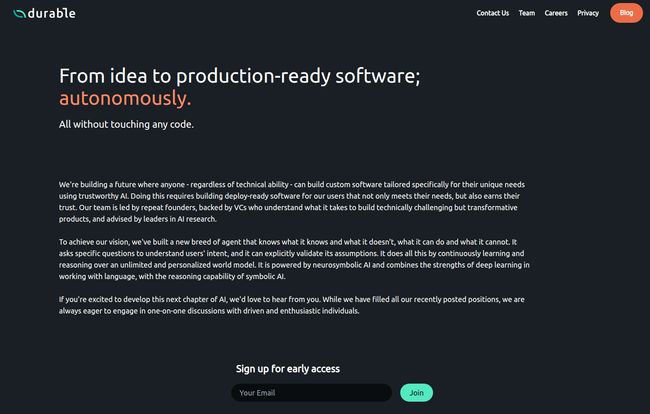
I’ve been in the SEO and digital trends space for a while, and I’ve seen my fair share of “game-changers.” Some are flashes in the pan, others genuinely shift the ground beneath our feet. I’m starting to get the feeling that Durable, a platform I’ve been keeping an eye on, might just be one of the latter. It’s making a bold, almost audacious promise: to take your idea and turn it into production-ready software, autonomously. All without you touching a single line of code.
Yeah, I was skeptical too. So let’s get into it.
What in the World is Durable AI, Really?
So, what are we talking about here? At its core, Durable is an AI platform designed to generate custom software from natural language instructions. You describe what you want, and it builds it. Simple, right? But the devil, as always, is in the details, and the key word on their homepage is autonomously.
This isn’t just another AI code-completion tool like GitHub Copilot, which is fantastic for assisting developers. Think of Copilot as an incredibly smart pair-programmer whispering suggestions in your ear. Durable is aiming to be the entire development team. It’s the project manager that asks clarifying questions, the architect that designs the system, and the engineer that writes, tests, and deploys the code. It’s a whole different ballgame.
The vision is to completely democratize software creation. To put the power of a full-stack developer into the hands of anyone with a clear idea and the ability to explain it. It’s a lofty goal, one that could fundamentally alter the startup landscape and how small businesses operate.
Visit Durable
The Magic Ingredient: Neurosymbolic AI
Alright, time to put on our nerd hats for a second. How does it work? Durable’s big bet is on a type of AI called neurosymbolic AI. It sounds complicated, but the concept is actually pretty intuitive when you break it down.
For the last decade, the AI world has been dominated by neural networks (the “neuro” part). This is the tech behind things like ChatGPT and Midjourney. They are phenomenal at learning from massive datasets, understanding context, recognizing patterns, and generating human-like text or images. Their weakness? They don’t really ‘understand’ logic or reason in a structured way. They’re amazing improvisers, but not always great with hard rules.
On the other hand, you have symbolic AI (the “symbolic” part). This is old-school, “good old-fashioned AI.” It’s based on logic, rules, and reason. Think of a chess-playing computer from the 90s. It can’t write a poem, but it can execute a flawless logical strategy based on a set of unbreakable rules. It can also explain why it made a certain move.
Durable is smashing these two worlds together. It uses the neural part to understand the nuance of what you’re asking for—your human language—and the symbolic part to reason about it, structure it, validate assumptions, and build a functional, reliable piece of software. It’s like having a creative, free-thinking artist paired with a meticulous, logical engineer. That combo is pretty darn powerful.
This system continuously learns and reasons over what they call a “personalized world model,” which is just a fancy way of saying it builds a mental map of your specific needs and project goals. It’s not just spitting out generic code; it’s trying to build your world.
How This Could Genuinely Change Things
Okay, so the tech is cool. But what does it mean for you and me? The most obvious benefit is the democratization of software. A local coffee shop owner could describe a custom loyalty app, and get one. A non-profit could design a bespoke donor management system without a massive grant. The gatekeepers—coding knowledge and big budgets—could start to crumble.
This goes a step beyond the no-code and low-code builders we’ve grown to love, like Bubble or Webflow. Those tools are amazing, but they primarily give you a set of pre-built blocks and a visual canvas to arrange them on. You’re still limited by the blocks they provide. Durable isn’t giving you the blocks; it’s creating the blocks for you based on your description. It’s a generative approach, not an assembly-line one. The potential for true customization is just on another level.
Imagine the speed. Prototyping an idea could go from weeks or months to hours or days. You could test a hypothesis for a new software feature by simply describing it to the AI and seeing what it builds. The iteration cycle could become ridiculously fast.
Let’s Be Honest: The Potential Roadblocks
Now, I wouldn’t be doing my job if I didn’t pour a little cold water on the hype train. As exciting as this is, there are some very real hurdles to consider.
First, there’s the classic “garbage in, garbage out” problem. The AI might be smart, but it can’t read your mind. Users will need to be incredibly clear and articulate about what they want. If your instructions are vague or contradictory, the software it produces will likely be a mess. This puts a huge emphasis on the user’s ability to define their own requirements, which is a skill in itself.
Second is the black box issue. What happens when something goes wrong? When the AI-generated software has a bug, how do you fix it? Troubleshooting a system you didn’t build and can’t read is a nightmare scenario. Durable says its AI is “explainable,” which is a nod to this problem, but how that works in practice for a non-technical user remains a huge question mark.
Finally, there’s the matter of control. By handing over the entire development process to an AI, you’re giving up a significant amount of control. For highly complex, mission-critical systems, or for projects that require a very specific, unconventional architecture, seasoned developers will probably still be the go-to. At least for the foreseeable future.
Who Is This For, and How Much Will It Cost?
So who is the ideal user? I see a few key groups.
- Solo Founders and Entrepreneurs: The ability to build an MVP without a technical co-founder is, frankly, a superpower.
- Small to Medium Businesses: Think custom inventory systems, internal dashboards, bespoke CRM features—all the things they need but can’t afford to custom-build.
- Product Managers & Agencies: For rapid prototyping and building proof-of-concepts at lightning speed to show clients or stakeholders.
Now for the big question: the price tag. As of right now, Durable is in a private, early-access phase. There is no public pricing information available. They are carefully curating a small group of users, likely to fine-tune the AI and learn from real-world use cases. You can sign up for early access on their website, which I would recommend if this piques your interest. They seem to be in it for the long haul, backed by some serious VCs and actively hiring for key machine learning and engineering roles.
My Final Take on Durable AI
So, is Durable the future? In my opinion, it’s a very strong glimpse of it. The ambition is massive, but they seem to be approaching it with the right technology (neurosymbolic AI) and a clear-eyed view of the challenges. They’re not just building a product; they’re tackling a fundamental computer science problem.
I am cautiously optimistic. This won’t replace all developers overnight—complex problem-solving and true architectural genius are still deeply human skills. But for a massive slice of the software world, it could lower the barrier to entry to almost zero. And that’s incredibly exciting.
Remember that black box problem we talked about? That’s the billion-dollar question. If they can crack the code on making the AI’s output truly trustworthy, debuggable, and maintainable, then they haven’t just built a cool tool. They’ve built a new industrial revolution for software.
Frequently Asked Questions about Durable
- 1. What is Durable AI in simple terms?
- Durable AI is a platform that aims to build custom, ready-to-use software based on your written or spoken descriptions. Instead of you writing code or hiring a developer, you tell the AI what you want, and it builds the software for you.
- 2. Do I need to know how to code to use Durable?
- No. The entire premise of Durable is to eliminate the need for coding knowledge. The goal is for anyone to be able to create software simply by describing their needs in natural language.
- 3. How is this different from AI assistants like GitHub Copilot?
- GitHub Copilot is a tool for developers that suggests code snippets and helps them write code faster. Durable is designed to handle the entire process autonomously—from understanding the idea to designing, building, and deploying the final software—for non-developers.
- 4. Is Durable just another no-code website builder?
- It’s different. No-code builders like Webflow or Bubble provide a set of pre-made components that you can arrange visually. Durable is a generative platform; it creates the components and the software structure from scratch based on your unique instructions, allowing for much deeper customization.
- 5. Is Durable AI available to the public right now?
- Not yet. Durable is currently in an early-access phase with a limited number of users. You can visit their website to sign up for a chance to join their early access program.
- 6. How much does Durable cost?
- Pricing information has not been made public yet. Since the platform is still in development and early access, they have not announced their pricing model.
Conclusion
The gap between a brilliant idea and a tangible product has always been the hardest to cross. Tools like Durable represent a fascinating and potentially powerful new bridge. While it’s still early days, the promise of turning clear thoughts into functional software is no longer science fiction. It’s a technical challenge being actively worked on by some very smart people. And I, for one, will be watching very, very closely.
Reference and Sources
- Durable Official Website – For early access sign-up and company information.
- Durable LinkedIn Page – For company updates and team information.
- IBM Research Blog on Neuro-Symbolic AI – For a more technical overview of the underlying AI concepts.


