
Categories: AI Developer Tools, AI Testing, AI Transcription, AI Voice Assistants, Large Language Models (LLMs)
Elixir AI Review: The QA Tool Your Voice Agent Needs?

Building a voice agent is one thing. Making sure it doesn’t completely fall on its face in front of a real, live customer is another thing entirely. I’ve been in the trenches, man. I’ve seen beautifully designed conversational flows crumble into a mess of, “I’m sorry, I didn’t get that,” faster than you can say ‘production bug’. It’s the cold sweat moment for anyone in this space. You push to production, cross your fingers, and just pray.
For years, the testing process has been a patchwork of manual calls, spreadsheets, and sheer hope. It’s tedious. It’s expensive. And honestly, it’s not very effective. You can’t possibly anticipate every weird thing a user might say, or every bit of latency that might throw your agent for a loop.
So when I stumbled upon a platform called Elixir, my inner, battle-scarred SEO-and-dev-nerd sat up a little straighter. They call themselves an “AI Ops & QA platform for multimodal, audio-first experiences.” That’s a mouthful, but the promise is simple: make sure your voice agent works as expected. Always. A bold claim, right? Let’s see if they can back it up.
So, What Exactly is Elixir? (And Why Should I Care?)
Think of Elixir as a dedicated pit crew and diagnostics team for your AI race car. Your voice agent is the car—sleek, fast, and full of complex tech. But without a team to run tests, check the engine (the LLM), and analyze performance after every lap, it’s destined to break down. Elixir is that team. It’s built to hammer your agent with realistic tests, watch it like a hawk in the wild, and give you the tools to fix it when it inevitably wobbles.
It’s not just about finding bugs. It’s about building confidence. The whole point is to move away from that “launch and pray” model to a more systematic “launch and know” approach. For anyone who has lost sleep over a go-live, that’s a pretty compelling idea.
The Core Features That Actually Matter
A features page can be a list of empty promises. I’m more interested in what a tool actually does to solve a problem. From what I can see, Elixir’s approach is refreshingly practical.
Automated Testing That Isn’t a Total Nightmare
Manually testing a voice agent is soul-crushing. You put on a headset, call your own bot, and pretend to be an angry customer from Ohio. You do this a few dozen times, jot down notes, and then a developer has to try and replicate it. It’s a mess.
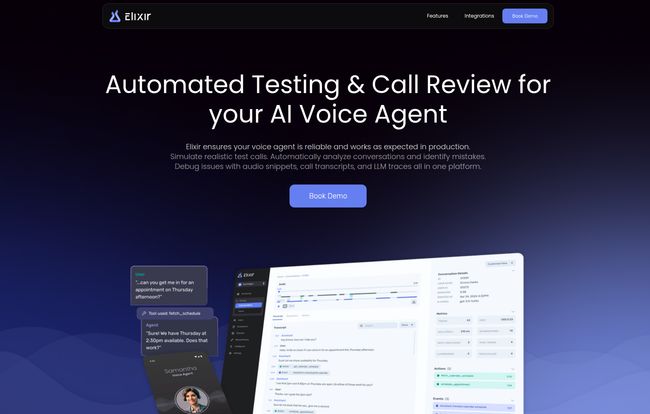
Elixir’s big play is automating this. It can simulate hundreds, if not thousands, of calls to pressure-test the system. It checks for everything—did the agent understand? Did it respond correctly? Was there an awkward silence? It even has an auto-grading feature to streamline the review process, which sounds like an absolute gift. This means you can find those edge-case failures before a customer does.
Debugging Tools That Don’t Make You Want to Cry
Okay, so a test fails. Now what? The typical debugging process for a voice AI is a special kind of hell. The audio is in one system, the transcription in another, the LLM logs are somewhere else… it’s a nightmare to piece together the story of what went wrong. I’ve wasted days on this stuff.
This is where Elixir looks really slick. It pulls everything into one unified view. You get the actual audio snippet, the call transcript, and the LLM traces all side-by-side. You can see the entire conversation flow and pinpoint the exact moment things went south. This isn’t just a nice-to-have; it’s a fundamental improvement to the developer workflow. No more hunting through five different browser tabs.
Visit Elixir
Analytics and Monitoring for the Data-Obsessed
Once you’re live, you need to know how things are going. Elixir provides a dashboard for tracking key metrics at scale. You can monitor stuff like latency, how well the agent is performing against its goals, and find patterns in conversations. Are a lot of people hanging up after a specific prompt? Is teh agent suddenly taking longer to respond? These are the early warning signs of a bigger problem, and catching them early is everything.
Who Is This For, Really?
Let’s be clear, this probably isn’t for the person hooking up a simple voice-to-text API for a weekend project. Based on the feature set and the language on their site, Elixir is aimed squarely at professional teams. We’re talking AI engineers, developers, and product managers at companies where the voice agent is a critical piece of the business.
The biggest clue? The integrations. Elixir is designed to play nice with the tools you’re already using. It connects with major LLM Providers (think OpenAI, Anthropic), Vector DBs, popular frameworks like Vapi, telephony systems, and transcription services. This isn’t a walled garden; it’s a tool meant to slot into an existing, professional AI stack. If you’re building serious, audio-first applications, you’re their target audience.
The Elephant in the Room: Elixir’s Pricing
Alright, so how much does all this goodness cost? I wish I could tell you. I went looking for a pricing page, and… well, I was greeted with a classic “Page Not Found” 404 error.
This isn’t a huge surprise, to be honest. The platform is currently in a private beta called ‘Luna’. This is a pretty standard playbook for a B2B SaaS tool finding its footing. It means they’re likely working closely with early customers to refine the product and figure out a pricing structure. My guess? It won’t be a $20/month plan. This feels like enterprise-grade software, so expect custom quotes, demos, and tiered pricing based on usage. You’ll have to book a demo to get the numbers, which is a bit of a dance but typical for this kind of platform.
My Honest Take: The Good, The Bad, and The Beta
So, where do I land on Elixir? I’m cautiously optimistic. Here’s the breakdown as I see it.
- The Good: The focus on reliability is spot-on. The automated, large-scale testing is a potential game-changer for QA teams. And that unified debugging view with audio, transcripts, and LLM traces? That alone could save dev teams countless hours of frustration. It solves a real, painful problem.
- The Not-So-Good: The biggest drawback is that it’s in private beta. You can’t just sign up and start playing; you have to get on the list. The website also hints that it might require a bit of technical know-how to get everything set up, so it might not be a plug-and-play solution for non-technical users. And of course, the mystery pricing is always a bit of a hurdle.
Also Read: EDITH: Is Decentralized SuperAI the Future?
Is Elixir the Potion for Your AI Woes?
Look, no tool is a magic bullet. But Elixir seems less like a magic potion and more like a set of professional-grade diagnostic equipment. It won’t build your voice agent for you, but it promises to make the one you did build more dependable, easier to fix, and less likely to cause a PR disaster.
For teams that are serious about deploying reliable voice AI and are tired of the old way of testing, Elixir is definitely one to watch. Getting in on the beta might be a smart move to get ahead of the curve. It seems to be addressing a major growing pain in the AI world, and from what I’ve seen, it’s doing it with a thoughtful, developer-first approach. And in this industry, that’s a refreshing change of pace.
Your Questions About Elixir, Answered
What is Elixir used for?
Elixir is an AI Operations and Quality Assurance (QA) platform specifically designed for audio-first AI applications, like voice assistants and smart call center agents. Its main purpose is to automate testing, monitor performance, and provide powerful debugging tools to ensure these voice agents are reliable.
Is Elixir easy to use?
It depends on your background. For AI engineers and developers, it seems designed to fit right into their workflow. However, because it deals with complex systems like LLM traces and telephony integrations, it will likely require some technical expertise to set up and use to its full potential. It’s not really a no-code tool for beginners.
How much does Elixir cost?
The pricing for Elixir is not publicly available on their website. The platform is currently in a private beta, which usually means they work directly with early customers to create custom plans. You’ll need to contact their team and likely book a demo to get specific pricing information.
What can Elixir integrate with?
Elixir is built to be compatible with a modern AI stack. It integrates with various services including LLM Providers (like OpenAI), Vector Databases, development frameworks, Telephony & WebRTC systems, and Transcription & Voice services.
Can I use Elixir for a text-based chatbot?
While the underlying principles of QA could apply, Elixir is explicitly marketed as a platform for “multimodal, audio-first experiences.” Its key features, like analyzing audio snippets and telephony issues, are tailored for voice. You’d likely be better off with a different tool for a purely text-based chatbot.
Who are the people behind the testimonials on the site?
The testimonials feature individuals like Josh Singer, Ralph Ma, and Sean Creannon. While their specific companies aren’t listed in the screenshots, their presence suggests that Elixir is being tested or used by people actively working in the AI and voice technology space.


