
Categories: AI Developer Tools, AI Models
EmbedAPI Review: One API to Rule All AI Models?

If you’ve spent any time building with AI in the last couple of years, you know the feeling. It’s like being a roadie for a rock band with ten different lead singers, all demanding a different brand of sparkling water and their own special microphone. You’ve got your OpenAI key in one file, your Anthropic key in another, a totally separate billing dashboard for Google’s Gemini, and don’t even get me started on Mistral. It’s a mess. A glorious, innovative mess, but a mess nonetheless.
For a while, I just accepted this as the cost of doing business on the cutting edge. This API spaghetti was just part of the deal. Then I stumbled across a tool that promised to be the universal adapter for this mess. It’s called EmbedAPI, and the premise is so simple it’s almost infuriating: what if you only needed one API key to talk to all of them?
Yeah, I was skeptical too. But after digging in, I think they might actually be onto something big.
So, What Exactly is EmbedAPI?
In the simplest terms, EmbedAPI is an AI integration platform. Think of it as a master translator or a universal remote for the world’s best AI models. Instead of you having to learn the specific language (API structure) of OpenAI, then Anthropic, then Cohere, you just talk to EmbedAPI. It takes your request and handles the messy business of routing it to the correct model provider, translating the call, and getting the response back to you.
It’s an abstraction layer. A single, unified gateway that lets you access a whole suite of powerful models—from OpenAI’s GPT-4o to Anthropic’s Claude 3 Sonnet and Google’s Gemini Pro—all through one consistent interface. It’s designed to let you focus on what you’re actually trying to build, not on the plumbing required to get there.
The Features That Actually Matter to Developers
A lot of platforms throw a kitchen sink of features at you. But a few of EmbedAPI’s promises really caught my eye because they solve real, tangible problems.
A Single, Unified API (The Holy Grail)
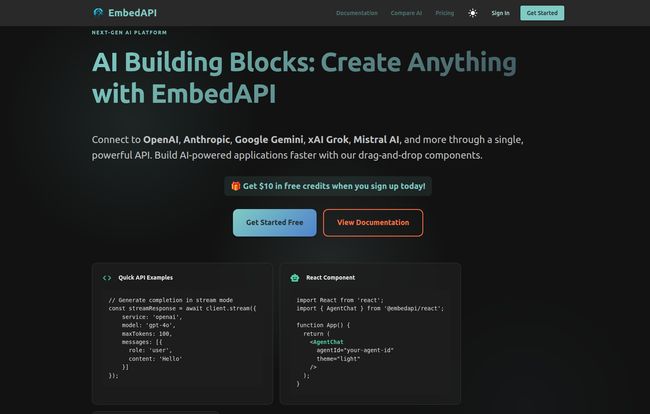
This is the main event. The biggest headache in a multi-model world is the context switching. Different SDKs, different documentation, different error handling… it slows you down. EmbedAPI claims a 5-minute setup, and for a basic API call, that feels about right. The idea of writing a single piece of code and being able to swap `model: ‘openai/gpt-4o’` for `model: ‘anthropic/claude-3-haiku’` without a major rewrite is… well, it’s the dream, isn’t it? It turns model selection from a heavy engineering decision into a simple configuration change. Now you can A/B test which of your ten lead singers actually hits the high notes without rewiring the entire stage.
Transparent Pricing That Doesn’t Require a PhD
AI pricing can be maddeningly opaque. You have tokens, credits, per-character charges, and a dozen other metrics that make budgeting a nightmare. What I genuinely appreciate about EmbedAPI is the clarity. Their pricing page is one of the most straightforward I’ve seen. They list the cost per 1,000 tokens for input and output, for every single model they offer, with what they claim is zero markup. You pay what the providers charge, and you pay EmbedAPI for the convenience and the unified access. It’s clean. It’s honest. And it makes forecasting costs way easier.
Just look at how they break it down. Its’ a breath of fresh air.
Visit EmbedAPI
Access to the “Who’s Who” of AI Models
The platform isn’t just about OpenAI and Anthropic. They’ve integrated a fantastic range of models, including those from Mistral AI, Meta AI (like Llama 3), and even specialized ones like Grok. This is huge for developers who want to find the right tool for the right job. Maybe you need Mistral’s efficiency for a simple classification task but want Claude’s nuance for long-form content generation. With this setup, you can do that from the same codebase.
Let’s Talk Money: A Look at EmbedAPI’s Pricing Tiers
Okay, so how much does this universal translator cost? The pricing model is refreshingly simple and broken into three tiers, which I’ve summarized below. It basically caters to everyone from a weekend hobbyist to a massive corporation.
| Plan | Cost | Who It’s For | Key Features |
|---|---|---|---|
| Free | $0 | Hobbyists & Testers | $10 in free credits, 10k tokens/month, access to basic models, rate limits. Perfect for a test drive. |
| Pro (Pay-as-you-go) | Pay for what you use | Professionals & Startups | Unlimited tokens, access to all models, no rate limits, priority routing, and an analytics dashboard. This is the sweet spot. |
| Enterprise | Custom | High-Volume Businesses | Volume discounts, dedicated infrastructure, SLA guarantees, and a dedicated account manager. The “call us” plan. |
The Free tier is genuinely useful. That $10 in credits is more than enough to kick the tires and see if the workflow suits you. The Pro plan is where most serious developers will live. The pay-as-you-go model is fair, and the access to all models without rate limiting is the core value proposition. The Enterprise plan is standard fare for big companies needing security guarantees and custom contracts.
My Honest Take: The Good, The Bad, and The Unpredictable
No tool is perfect, and I’ve learned to look at new, shiny platforms with a healthy dose of professional cynicism. So, here’s my unfiltered take.
The Good is undeniable. The simplicity is a 10/10. It saves time, reduces complexity, and genuinely makes it easier to experiment and innovate. For startups, indie hackers, or agencies juggling multiple client projects, EmbedAPI feels like a no-brainer. It solves a real, frustrating problem elegantly.
The not-so-good? Well, it comes down to two things for me: predictability and dependency. While the pay-as-you-go model is transparent, it can also be a bit scary. A runaway script or an unexpected spike in usage could lead to a surprising bill. You’re trading a fixed cost for a variable one. To their credit, they offer usage alerts and monitoring on the Pro plan, which is an absolute must-use feature in my book.
The other point is dependency. You are placing a third-party service between you and your AI provider. This introduces another potential point of failure. Some might argue against this, but in my experience, if that third party is solid, it’s a worthwhile trade-off. EmbedAPI seems to know this is a concern, which is why they highlight their enterprise-grade infrastructure and SOC 2 compliance—signals that they take reliability seriously.
Who is EmbedAPI Actually For?
After playing around and analyzing the offer, I see a few key groups who would fall in love with this:
- Startups and Indie Devs: The ability to move fast and test different models without getting bogged down in API management is priceless. This is a perfect match.
- Agencies and Freelancers: Imagine spinning up AI features for different clients, each with unique needs, all using a single, familiar workflow. Yes, please.
- Prototyping Teams: For teams inside larger companies tasked with building proofs-of-concept, EmbedAPI allows them to quickly compare models for performance and cost before committing to a full-scale native integration.
Larger enterprises might be a bit slower to adopt, as they often prefer direct relationships with providers like OpenAI or Google. However, the Enterprise plan with its SLAs and dedicated infrastructure shows that EmbedAPI is serious about courting them too.
Frequently Asked Questions about EmbedAPI
How does the pay-as-you-go pricing work?
It’s simple: you only pay for the tokens you use. At the end of the billing cycle, EmbedAPI totals your usage across all the different models and bills you accordingly. There are no monthly subscription fees on the Pro plan.
What are tokens, really?
Think of tokens as pieces of words. For most AI models, 1,000 tokens is roughly equivalent to 750 words. Both your input (the prompt) and the output (the AI’s response) consume tokens.
Can I use this for a simple AI chatbot?
Absolutely. That’s one of the primary use cases. You can build a chatbot and easily experiment with whether GPT-3.5, Claude Haiku, or Llama 3 gives you the best conversational results, all without changing your core code.
Is it secure to put my API calls through EmbedAPI?
Security is always a valid concern. EmbedAPI states they are SOC 2 compliant, which is a key industry standard for data security and privacy. For their Enterprise clients, they even offer private endpoints for maximum security.
Do my free credits expire?
According to their FAQ, the free credits never expire. This is a nice little perk, allowing you to come back and test new models as they’re added.
How does this compare to just using the OpenAI API directly?
If you only ever plan to use one model from one provider (like OpenAI), going direct might be simpler. But the moment you think, “I wonder if Claude would be better for this?” you’ll have to build a whole new integration. EmbedAPI is for those who want flexibility and don’t want to be locked into a single AI ecosystem.
The Final Verdict
So, is EmbedAPI the magic bullet for all AI development? Of course not. No tool is. But it’s a damn good solution to a very real problem. It’s a powerful abstraction layer that simplifies the increasingly fragmented AI landscape. It trades a little bit of direct control for a massive gain in flexibility, speed, and simplicity.
In a world where new, groundbreaking AI models seem to drop every other Tuesday, being able to test and deploy them without a massive engineering overhaul isn’t just a convenience—it’s a competitive advantage. And for that reason alone, I think EmbedAPI is a tool every AI developer should have on their radar.


