
Categories: AI Agent, AI App Builder, AI ERP, AI Knowledge Graph, AI Workflow, No-Code&Low-Code
ERP.AI Review: The AI Your ERP System is Missing

You’re staring at your company’s ERP system. It’s the digital backbone of the entire operation, a powerful, expensive piece of software that holds everything from financials to inventory. But sometimes… it feels less like a central nervous system and more like a dusty old file cabinet. It holds the data, sure, but it doesn’t really think. Getting different departments to talk to each other through it can feel like playing telephone with bad reception.
For years, we’ve been promised an AI revolution. And frankly, a lot of it has been smoke and mirrors. Another dashboard, another chatbot. So when I came across ERP.AI, claiming to be an “AI-Native Platform Powering the Future of Work,” my inner cynic sat up and took notice. Is this just another layer of complexity, or is it the missing brain our business systems have been crying out for? I decided to dig in.
What Exactly is ERP.AI? (And Why Should You Care?)
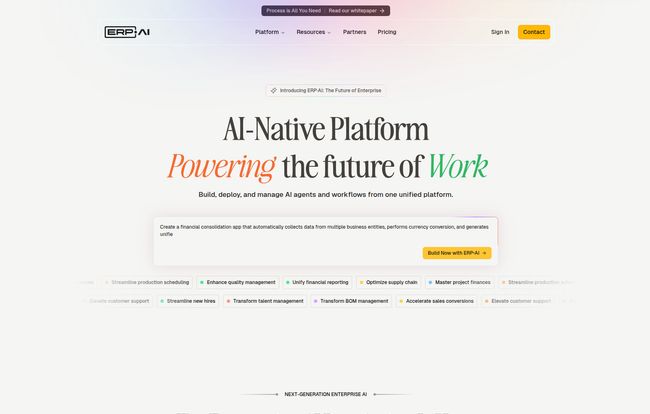
Okay, so what is this thing? In the simplest terms, ERP.AI isn’t trying to replace your existing ERP. Thank goodness. Nobody wants to go through that migration process again. Instead, it bolts on top of it, acting like an intelligence layer. Think of your ERP as the car’s chassis and engine—solid, reliable, essential. ERP.AI is the advanced navigation, the predictive maintenance alerts, and the autonomous driving features all rolled into one.
It’s designed to transform your existing system into an “intelligent powerhouse.” That’s their marketing speak, but the idea behind it is solid. It focuses on improving data governance (knowing who can see and do what) and automating workflows that are currently sucking up your team’s precious time. From smart approvals that don’t need a manager to click a button for the tenth time that day to full-blown financial automation, the goal is to streamline things. To make the whole operation just… smarter.
Visit ERP.AI
The Three Pillars of the ERP.AI Transformation
From what I’ve gathered, their approach isn’t a single magic bullet. It’s built on three core ideas that, together, create a pretty compelling picture of a more efficient future.
Build AI-Powered Apps on the Fly
This one got my attention. “AI-Powered Applications on Demand.” What does that even mean? It means giving your teams—the people who actually do the work—the ability to quickly build small, specific applications for their needs. Think about the HR department needing a better way to track onboarding tasks, or the finance team wanting to automate expense report validation. Instead of filing a ticket with IT and waiting six months, ERP.AI provides a platform to build these department-specific tools right on top of your existing data. The promise of “seamless integration with your existing systems” is huge here. No more data exports to messy spreadsheets. A real game-changer if it works as advertised.
Let the Autonomous Agents Do the Heavy Lifting
Here’s where it gets a little sci-fi. “Autonomous AI Agents.” These aren’t robots walking around your office. They’re smart, automated workflows that can execute tasks independently. You can deploy an agent to monitor your supply chain for disruptions and automatically re-route shipments. Or one that performs currency conversion and generates financial consolidation reports without a human touching it. It’s about taking automation to the next level—moving from simple “if this, then that” rules to processes that can analyze information and make decisions based on the policies you set. It’s the kind of thing that frees up your best people to work on strategy instead of drudgery.
Finally, a Single Source of Truth
Every business with more than ten people knows the pain of data silos. Marketing has their numbers, Sales has theirs, and Finance is working off a report from last Tuesday. It’s a mess. ERP.AI’s concept of “Unified Enterprise Knowledge” aims to fix this. By connecting to data from multiple business entities, it creates a single, connected pool of knowledge. It’s like giving your entire company a shared brain that everyone can query. Imagine being able to ask a complex question that involves data from three different departments and getting a single, coherent answer. That’s the dream, isn’t it?
The Big Question: Data Security and Control
Alright, let’s talk about the elephant in the room. AI is great, but the moment you mention connecting your sensitive financial and operational data to an AI, every CISO in a five-mile radius gets a nervous twitch. This, in my experience, is where ERP.AI has its most compelling argument.
They are laser-focused on Data Sovereignty. This means your data remains your data. It is not shared with external AI providers to train their next big public model. This is a massive departure from many other AI tools that are essentially renting you access to their brain, which is learning from your information. With ERP.AI, you have complete control.
How? A huge part of this is the option for a 100% on-premises deployment. For companies in finance, healthcare, or government, this is often a non-negotiable requirement. You can run the entire platform within your own firewalls. Now, this comes with a catch—you’ll need the IT resources to manage it—but for maximum security, it’s the gold standard. Paired with what they call “enterprise-grade security with fine-grained access controls,” it’s clear they built this for serious businesses who can’t afford to play fast and loose with data privacy.
A Look at the ERP.AI Pricing Tiers
So, what’s this going to cost? The pricing page is refreshingly straightforward. It’s not one of those “call us for a quote and prepare your wallet” situations, at least not entirely. It looks like they also have a free starting point, which is great for seeing what’s what before you commit.
| Plan | Price | Best For | Key Features |
|---|---|---|---|
| Starter | $19 /month | Teams building apps and collaborating on workflows. | Unlimited Users & Apps, 5k Agent Credits, 50k Records. |
| Business | $49 /month | Departments needing advanced automation and features. | Everything in Starter, plus more credits & records, Custom Branding, APIs & Sandbox. |
| Enterprise | Custom | Large organizations with complex, scalable needs. | Everything in Business, plus custom integrations, offline/private cloud, and dedicated support. |
The “agent credits” likely correspond to how many tasks or operations your autonomous agents can perform each month, which is a common way to meter usage in these platforms. The Business plan, at $49/month, seems like teh sweet spot for a lot of companies looking to get serious without going for a full custom enterprise build.
The Not-So-Shiny Bits: A Realistic Look
Okay, it’s not all sunshine and autonomous rainbows. No platform is perfect, and it’s important to go in with your eyes open. Based on the information, there are a few things to consider.
First, this requires integration with your existing ERP. That sounds obvious, but it means this isn’t a plug-and-play solution you can set up in an afternoon. There will be an implementation project, and you’ll need people who understand both your ERP and the new platform to make them talk nicely to each other.
Second, if you opt for that wonderful on-premises deployment for security, you’ll need the IT infrastructure and personnel to support it. It’s a trade-off: complete control in exchange for more responsibility. Finally, those “customizable AI guardrails” are a double-edged sword. It’s fantastic that you can set the rules, but it also means you have to. This requires careful thought and planning to align the AI’s behavior with your actual business policies. A misconfigured agent could be just as bad as a lazy employee.
Who is ERP.AI Really For?
After looking it all over, I have a pretty clear picture. This isn’t for the solo blogger or the small retail shop. ERP.AI is aimed squarely at two groups:
- Growing Businesses: Companies that are feeling the pain of manual processes and data silos. They’ve invested in a proper ERP, but they’ve hit a ceiling of efficiency. The Starter and Business plans seem perfectly suited for them.
- Large Enterprises: Big corporations, especially those in regulated industries like finance or healthcare, who are desperate for AI-driven automation but are terrified of the data privacy implications of public cloud AI. The on-premises option and enterprise-grade security are built for them.
If your biggest operational headache is an inefficient workflow that everyone complains about but no one has time to fix, this might be a tool to watch.
Your ERP.AI Questions Answered
Can ERP.AI replace my current ERP system?
No, and that’s one of its strengths. ERP.AI is designed to integrate with and enhance your existing ERP system (like those from SAP, Oracle, etc.), not replace it. It adds an intelligence layer on top of the system you already have.
Is my company’s data safe with ERP.AI?
Security seems to be a top priority. They emphasize data sovereignty, meaning you maintain control over your data. Crucially, they offer an on-premises deployment option, allowing you to host the entire platform within your own secure infrastructure, which is a major plus for data-sensitive industries.
Do I need a team of developers to use ERP.AI?
It’s a mix. The “AI-Powered Applications on Demand” feature suggests a low-code or no-code environment where business users can build their own solutions. However, the initial integration with your core ERP system will almost certainly require technical expertise from your IT team or a consultant.
What are “agent credits” in the pricing plans?
While not explicitly defined, in platforms like this, “agent credits” are typically a form of usage-based currency. Each task, operation, or decision made by an autonomous AI agent consumes a certain number of credits. The more you automate, the more credits you’ll use.
Is there a free trial for ERP.AI?
Yes, it appears so. While the main pricing grid starts with the ‘Starter’ plan, the company states you can start using ERP.AI for free and then upgrade. This freemium model is a great way to test the platform’s basic capabilities.
My Final Thoughts on the Enterprise AI Revolution
So, is ERP.AI the real deal? It’s certainly one of the most interesting and well-thought-out approaches I’ve seen to enterprise AI. They aren’t just throwing a generic LLM at a business problem. They’ve clearly thought about the real-world barriers to adoption—namely, integration complexity and data security.
The focus on data sovereignty and on-premises deployment is, for me, the killer feature. It shows they understand their target audience isn’t just looking for cool tech; they’re looking for a secure, compliant, and powerful solution to very real operational bottlenecks. It’s an ambitious platform, but it’s trying to solve an ambitious problem. If they can deliver on these promises, this might just be the start of that enterprise AI revolution we’ve been hearing about for so long.


