
Categories: AI Course, AI Developer Tools, AI Research Tool, Large Language Models (LLMs), Open Source AI Models
fast.ai Review: Is It The Best Way to Learn AI?

The AI world is noisy. It’s a chaotic mess of hype cycles, six-figure ‘prompt engineer’ salaries that feel more like lottery tickets, and a constant, low-grade anxiety that if you’re not building a GPT wrapper for something, you’re basically a dinosaur. Every other day there’s a new “groundbreaking” model, and trying to keep up feels like drinking from a firehose. A very, very expensive firehose.
Amidst all this noise, I keep coming back to a place that zigs where everyone else zags. A place with the delightfully contrarian motto: “Making neural nets uncool again.”
That place is fast.ai. And honestly, thank goodness for it.
I’ve been in the SEO and traffic game for years, and I’ve seen countless platforms promise to teach you the next big thing. Most are slick, expensive, and, frankly, a little shallow. But fast.ai is different. It’s less of a product and more of a philosophy. So, if you’re tired of the hype and just want to learn how to build cool stuff with AI, pull up a chair. Let’s talk about it.
What Exactly is fast.ai? (Hint: It’s More Than Just a Course)
First off, fast.ai isn’t some slick, VC-backed ed-tech startup trying to hit a billion-dollar valuation. It’s a non-profit research group founded by two absolute legends in the field, Jeremy Howard and Rachel Thomas. Their goal isn’t to sell you something; it’s to make deep learning as accessible as possible. They’re trying to tear down the ivory tower, brick by brick.
Their entire ecosystem is built on three core pillars:
- The Courses: World-class, practical deep learning education that’s… wait for it… completely free.
- The fastai Library: A powerful software library that makes coding in PyTorch simpler and faster.
- The Blog & Community: A hub for thoughtful discussion on everything from technical breakthroughs to the thorny ethics of artificial intelligence.
It’s a philosophy, a community, and a suite of tools all rolled into one awesome, slightly nerdy burrito.
Diving Into the ‘Practical Deep Learning for Coders’ Course
This course is the crown jewel. If you’ve ever tried to learn AI from a traditional university textbook, you know the drill. You start with weeks of linear algebra, then calculus, then probability theory… and maybe, six months later, you get to write your first line of code. It’s soul-crushing.
fast.ai flips that entire model on its head. They use a “top-down” approach. On day one, you’ll be training a state-of-the-art image classifier. I’m not kidding. You get to drive the car before you learn how to build the engine. You get the win, you see the magic, and that motivates you to peel back the layers and understand what’s happening underneath.
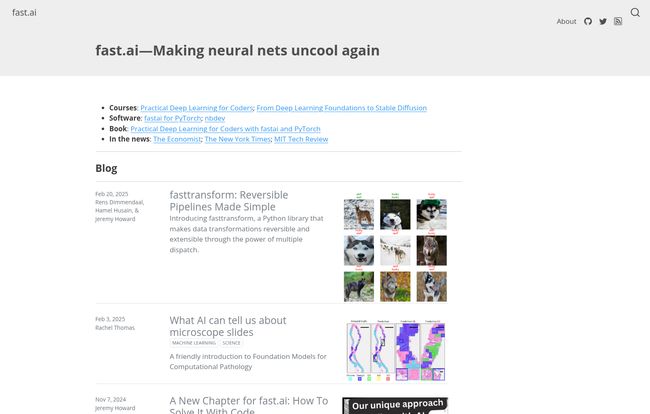
Visit fast.ai
This method is, in my opinion, revolutionary for self-learners. It builds confidence and practical skills simultaneously. You learn the theory in the context of a real problem you’ve already solved. It just clicks in a way that abstract math equations never did for me.
Who is this course for, really?
Now, while it’s incredibly accessible, it’s not for a total programming novice. The course assumes you have at least a year of coding experience, preferably with Python. You don’t need to be a Python guru, but you should be comfortable with concepts like loops, functions, and variables. You definitely don’t need a Ph.D. in math. That’s the whole point.
The fastai Library: Your PyTorch Swiss Army Knife
If you’ve ever worked with a low-level machine learning framework like PyTorch, you know it can be incredibly powerful but also ridiculously verbose. You end up writing the same boilerplate code over and over again. It’s like trying to cook a gourmet meal but having to forge your own pots and pans first.
The fastai library is the solution. It sits on top of PyTorch and gives you high-level components to get things done quickly. It automates the boring stuff and lets you focus on the interesting parts of your model. Using best practices from the get-go is baked right in. It’s an opinionated library, and its opinions are usually right because they’re born from years of Jeremy and Rachel winning Kaggle competitions and publishing papers.
It’s the perfect companion to the course because you’re not just learning theory; you’re learning to use a tool that professionals use to get results, fast.
The Blog and The Philosophy: Making AI Human
This might be my favorite part. The fast.ai blog isn’t your typical corporate blog churning out SEO-optimized listicles. It’s a place for deep, nuanced thinking. You’ll find a post about a cutting-edge technique like “fasttransform” right next to a powerful essay on why “AI Harms are Societal, Not just ‘Biases’”.
This commitment to ethics is so desperately needed. In an industry rushing to deploy models at all costs, fast.ai constantly reminds its students and the community to stop and think about the consequences. To ask why we’re building something, not just if we can. This human-centric view is woven into the fabric of their courses and writings, and it’s a massive differentiator.
The Good, The Bad, and The Honest Truth
No platform is perfect, and I believe in giving an honest take. So here’s my breakdown.
What’s to Love
The biggest pro is obvious: the core courses are 100% free. This isn’t a freemium model; it’s just free. The value you get is astronomical. The practical, top-down teaching method is a game-changer for anyone who has struggled with traditional learning. And the serious, integrated focus on AI ethics isn’t just a footnote; it’s a core part of the curriculum.
The Potential Downsides
It does require a bit of a programming background. If you’ve never written code before, you’ll need to learn the basics of Python first. Also, because fast.ai is run by a small, research-focused team, not a massive corporation, sometimes things can be a little… rough around the edges. Every so often, you might click a link on the site and hit a 404 error page. It happens. Some of the older forum posts or supplementary materials might be slightly out of date as the field moves so quickly. But to me, these are minor quibbles for the insane amount of value provided.
So, What’s the Price Tag?
I feel like I’m repeating myself, but it’s important. The cost is the best part. It’s zero. Zilch. Nada.
| Offering | Price |
|---|---|
| Practical Deep Learning for Coders Course | Free |
| From Deep Learning Foundations to Stable Diffusion Course | Free |
| fastai Software Library | Free (Open Source) |
| The Book (Deep Learning for Coders with fastai and PyTorch) | Paid (Supports their work) |
They do have a fantastic book that you can buy, which I highly recommend as it’s a great reference and a way to support their non-profit work.
Frequently Asked Questions about fast.ai
- Is fast.ai really free?
- Yes, the courses and the software library are completely free. The only paid product is the optional companion book, which is a great way to support their mission.
- Do I need a math degree to take the course?
- Absolutely not. This is one of the main problems fast.ai solves. It teaches the necessary math concepts in a practical, as-needed context after you’ve already seen the code work.
- Is fast.ai good for complete beginners?
- It’s great for beginners to AI, but not for beginners to programming. You should have about a year of coding experience under your belt, ideally with some Python, to get the most out of it.
- What’s the difference between the fastai library and PyTorch?
- PyTorch is a powerful, low-level deep learning framework. The fastai library is a high-level wrapper that sits on top of PyTorch, making it much easier and faster to build common types of models by simplifying code and incorporating best practices by default.
- How is fast.ai different from a Coursera or Udacity course?
- Besides being free, fast.ai’s main difference is its top-down teaching philosophy (build first, understand theory later) and its tight integration with its own powerful library. It feels less like a traditional academic course and more like a hands-on apprenticeship.
Final Thoughts: A Breath of Fresh, Uncool Air
In a field obsessed with being cool, fast.ai’s mission to make neural nets “uncool” is the most refreshing thing I’ve seen in years. It’s a return to first principles: sharing knowledge, building practical skills, and fostering a community that cares about the impact of its work.
If you’re a developer looking to skill up, a student frustrated with theory-first approaches, or just an AI-curious person who wants to get their hands dirty, I can’t recommend it enough. It’s not just a course or a library; it’s an invitation to a different kind of conversation about AI. And it’s one we desperately need to be having.


