
Categories: AI For Data Analytics, AI Instagram, AI Marketing, AI Social Media
Feelsy: A Look at the Instagram Sentiment Tool

As someone who’s been swimming in the digital marketing pool for years, I’m always on the hunt for the next shiny tool. You know the drill. Anything that promises to give us an edge, a deeper insight, or just make our lives a little easier. We’re constantly chasing metrics—engagement rates, CPC, follower counts. It’s a numbers game.
But lately, I’ve been thinking we’re missing the point. We’re so obsessed with the quantity of engagement that we often forget the quality. A comment isn’t just a +1 to a post’s score; it’s a person taking the time to type out a thought. An emotion. And understanding that emotion? That’s the real gold.
So, when I first heard about a tool called Feelsy, my interest was definitely piqued. A platform dedicated to sentiment analysis for Instagram comments. Simple, focused, and potentially powerful. I decided to dig in, see what it was all about, and maybe write a review. But what I found was… well, not what I expected.
What Was the Big Idea Behind Feelsy?
The promise of Feelsy was pretty straightforward. It was designed to be a microscope for your Instagram comment section. Instead of you, the frazzled social media manager or brand owner, manually scrolling through hundreds of comments trying to get a ‘vibe check’ on your audience, Feelsy was supposed to do the heavy lifting.
It claimed to analyze the emotional tone of the comments on your posts, telling you if the overall reaction was joyful, appreciative, angry, or something else entirely. Think of it as less of a metrics dashboard and more of an emotional barometer for your content. The core idea was to help you stop guessing and start knowing what truly connects with your audience on an emotional level.
Visit Feelsy
The platform was built on a few key features:
- Real-Time Sentiment Analysis: The ability to see the emotional tide turn as the comments roll in. This could be huge for reacting quickly to a post that’s either taking off or, you know, blowing up in your face.
- Detailed Post-Level Insights: Breaking down the sentiment for each individual post, so you can finally prove to your boss that pictures of the office dog really do generate more joy than his corporate updates.
- Multi-Profile Support: A must-have for agencies like mine or anyone managing a portfolio of brands. Hopping between accounts is a pain we all know too well.
The essense of it was to move beyond vanity metrics and into the realm of genuine audience understanding. A noble goal, for sure.
Why Bother with Sentiment Analysis Anyway?
Some people might roll their eyes at this. “Feelings? I need leads, not feelings!” I get it. But the two are more connected than you think. In my experience, understanding audience sentiment is one of the most underrated strategies in the game. It’s the difference between shouting into the void and having a real conversation.
Standard metrics tell you that people are reacting; sentiment analysis tells you how they are reacting. That distinction is everything. A post with 500 comments could be a viral success or a PR nightmare. A simple comment count won’t tell you which. This kind of insight is critical for:
- Brand Health Monitoring: Are people generally happy with your brand, or is there a low-key current of frustration you’re missing?
- Content Strategy Refinement: If you know posts about topic X generate ‘joyful’ and ‘excited’ comments, while posts about topic Y are met with ‘neutral’ or ‘confused’ ones, where are you going to put your energy? You double down on what works. It’s that simple.
- Proactive Community Management: Spotting a wave of negative sentiment early allows you to jump in, address concerns, and manage a potential crisis before it gets out of control.
The Potential and The Pitfalls
Every tool has its angels and its demons, and from the information I gathered, Feelsy was no different. It had some genuinely smart ideas, but also a few things that made me raise an eyebrow.
The Bright Side
The ability to get real-time, emotionally-charged feedback is a dream for any creative. It’s like having a direct line to your audience’s collective consciousness. For content creators, this means crafting posts that are more likely to be shared and loved. For advertisers, it means understanding the emotional triggers that can be used to build more effective campaigns. It’s a powerful feedback loop that goes way beyond a simple like count.
The Red Flags
Now, for the catches. The first one was a biggie for me: it required a Facebook login. Ugh. In an age where people are increasingly wary of Meta’s data practices and are trying to compartmentalize their digital lives, forcing a Facebook login feels a bit dated. It’s an immediate barrier to entry for privacy-conscious users or teams that don’t want to link personal Facebook accounts to business tools.
Another point of friction was its singular focus on Instagram. Now, you could argue this is a strength. Specialization can lead to a deeper, more refined tool. And I’d agree, to a point. But the market trend is towards consolidation. Most social media pros I know would rather pay a bit more for one tool that handles Instagram, TikTok, and X, rather than having three different specialist tools with three different bills. It’s a tough balancing act for any new SaaS.
So… Where Did Feelsy Go?
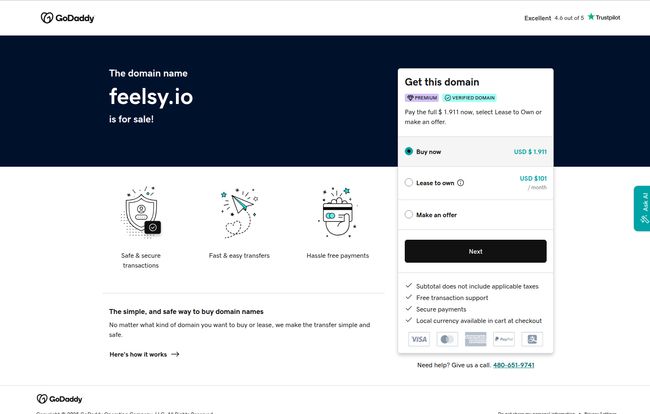
This is where my little research project took a sharp left turn. I had my notes, my opinions, and I was ready to try and find a pricing page or a sign-up link. I typed `feelsy.io` into my browser, hit enter, and was greeted not by a slick landing page, but by a GoDaddy auction block.
That’s right. The domain is for sale. For a cool $1,911, or a lease-to-own option. You can see it for yourself.
This, in the world of tech startups, is usually the digital equivalent of a “Closed for Business” sign hanging on the door. It means the project has likely been abandoned. The lights are off. It’s a ghost town. It’s a cautionary tale I’ve seen play out dozens of times. A brilliant idea that, for one reason or another, didn’t get the traction it needed to survive. Maybe the monetization strategy was off. Maybe it was too difficult to compete with the big all-in-one platforms like Sprout Social or Brand24, which are increasingly incorporating sentiment analysis into their broader offerings.
Whatever the reason, Feelsy appears to be a thing of the past. A great idea that just didn’t make it. And honestly, it’s a bit of a shame.
So What Are Your Options Now?
Just because Feelsy is gone doesn’t mean the need for sentiment analysis has disappeared. If you’re sold on the idea of listening more closely to your audience’s emotions (and you should be), here are a few stable, well-regarded platforms that can get the job done:
- Brand24: A powerful social listening tool that goes beyond just Instagram. It tracks mentions across the web and provides robust sentiment analysis. Great for a holistic view of your brand’s reputation.
- Sprout Social: One of the big players in social media management. Its listening tools are top-notch and include sentiment analysis as part of a much larger suite of features for publishing, reporting, and engagement.
- Mention: Similar to Brand24, Mention is another media monitoring tool that helps you track conversations about your brand, competitors, or industry, with sentiment analysis built right in.
These are more comprehensive (and generally more expensive) solutions, but they are reliable and well-supported. The dream of a cheap, simple, Instagram-only sentiment tool might have died with Feelsy, but the strategic advantage it offered is still very much alive and accessible.
Frequently Asked Questions
- What exactly is sentiment analysis?
- It’s the process of using natural language processing (NLP) to analyze a piece of text—like a comment or a review—to determine if its emotional tone is positive, negative, or neutral. It’s about understanding the feeling behind the words.
- Is Feelsy still an active tool I can use?
- No, it appears not. The tool’s domain name, feelsy.io, is currently up for sale on GoDaddy, which is a strong indication that the service is no longer operational.
- Why is it important to analyze Instagram comments?
- Comments are a direct line of communication from your audience. Analyzing them helps you understand what content resonates, manage your brand’s reputation, identify customer service issues, and build a stronger community by engaging more thoughtfully.
- What are the risks of using a new, niche SaaS tool?
- The primary risk, as demonstrated by Feelsy, is that they can disappear. New tools often lack the funding and market share of established players, making them more volatile. You might invest time integrating a tool into your workflow only to have it shut down.
- Does Instagram have its own built-in sentiment analysis feature?
- Not directly. Instagram’s professional dashboard provides metrics on reach, engagement, and audience demographics, but it doesn’t offer a feature that automatically analyzes the emotional sentiment of your comments. This is why third-party tools are necessary for this function.
- Are there any free tools for basic sentiment analysis?
- There are some open-source libraries and basic web-based tools where you can paste text to get a sentiment score, but they aren’t integrated with social media. For automated, ongoing analysis of your Instagram account, you’ll almost always need a paid subscription service.
A Final Thought
The story of Feelsy is a perfect snapshot of the marketing tech world. Full of brilliant ideas, boundless potential, and brutal realities. It’s a reminder that a great concept isn’t always enough. But it’s also a powerful reminder of where our focus should be. The tools will come and go, some will fizzle out and their domains will end up on GoDaddy. But the underlying principle—the need to genuinely listen to and understand the people we’re trying to connect with—that’s timeless. Don’t ever lose sight of that.


