
Categories: AI Agent, AI Consulting, AI For Data Analytics, AI Predictions, Large Language Models (LLMs)
Findly Review: Is This AI Chatbot Your Data Guru?

We’re all drowning in data. As an SEO guy, I’ve spent more hours than I’d care to admit trying to wrestle insights out of Google Analytics 4, staring at spreadsheets until my eyes cross, and sending “just one more quick question” to the dev team. It’s the classic bottleneck. We’re told to be data-driven, but the data is often locked away in a fortress, and only the people who speak SQL or Python hold the keys.
It’s frustrating. You know the answer to your campaign’s performance is in there somewhere, but getting to it feels like a monumental task. What if you could just… ask? What if you could type, “What was our organic traffic to the blog last month compared to the month before?” and get an answer, with a chart, in seconds? This isn’t science fiction anymore. This is the promise of AI data assistants, and a platform called Findly has been making some serious waves in this space.
I’ve been watching these tools for a while, and Findly caught my eye. It claims to be an AI-powered chatbot that simplifies data for everyone. No code, no complex dashboards, just answers. But does it live up to the hype? Let’s find out.
So, What on Earth is Findly?
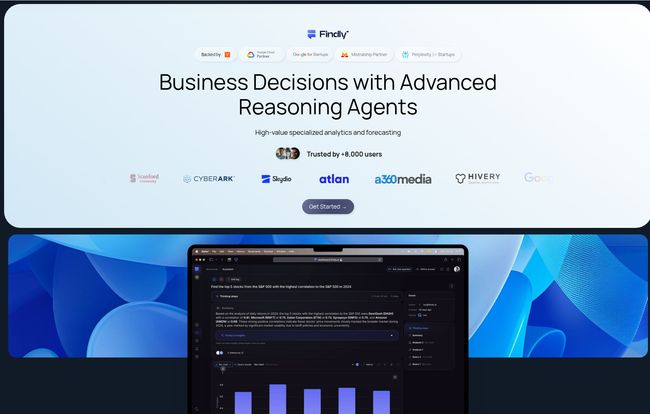
At its core, Findly is an AI-powered chatbot designed to connect directly to your business’s databases. Think of it less as a piece of software and more like a new team member—a junior data analyst who is incredibly fast, works 24/7, and never asks for a day off. You interact with it through a simple chat interface, asking questions in plain English. Findly’s AI then translates your question, queries the database, and presents the information back to you in an easy-to-digest format, often with visuals.
Visit Findly
The whole point is to break down the barrier between you and your data. You don’t need to know the difference between PostgreSQL and BigQuery. You just need to know what you want to ask. This democratizes data access, moving it from the sole domain of the data team to the hands of marketers, project managers, sales leaders, and founders. It’s about making decisions based on real-time information, not on a report that was already a week old by the time it landed in your inbox.
The Core Features That Actually Matter
Any new platform can throw a list of features at you. But after years in this industry, I’ve learned to cut through the noise and focus on what genuinely moves the needle. Here’s what stood out to me about Findly.
The Magic of the Semantic Layer
This sounds technical, but it’s probably Findly’s most important feature. The semantic layer is like a custom dictionary for your business that you teach to the AI. It learns what you mean by terms like “active user,” “qualified lead (MQL),” or “customer lifetime value.” Why is this a big deal? Because without it, an AI might just pull raw data that doesn’t account for your specific business logic. The semantic layer ensures the AI understands the context of your questions, which leads to far more accurate and reliable answers. It’s the difference between getting a random number and getting a true business insight.
Seamless Database and Platform Integrations
A data tool is useless if it can’t connect to where your data lives. Findly does pretty well here. Out of the box, it connects to the big ones for marketing and sales teams: Google Analytics, Facebook Ads, Shopify, Google Search Console, and Google BigQuery. For bigger companies on their Enterprise plan, they can hook it up to pretty much any SQL database, like PostgreSQL, Snowflake, or Amazon Redshift. This flexibility means it can grow with you, from a small team just looking at ad spend to a large organization with a complex data warehouse.
Real-Time Analytics Without the Wait
The ability to get answers on the fly is a game-changer. Imagine you’re in a meeting and someone asks about the performance of a recent product launch. Instead of saying, “I’ll get back to you,” you can literally ask Findly and have the answer in 30 seconds. This fosters a culture of curiosity and allows for much more agile decision-making. You can spot trends, identify problems, and double down on what’s working, today, not next Tuesday.
Chatting with Your Data in Slack
I’ve always felt that the best tools are the ones that fit into your existing workflow, not the ones that force you to adopt a new one. Findly’s Slack integration is a prime example. The conversation about campaign performance is already happening in your #marketing channel. With the integration, you can pull the data right into that conversation. No more switching tabs, logging into another platform, and copy-pasting screenshots. It’s a small thing that has a huge impact on team efficiency.
A Look at the Findly Pricing Tiers
Alright, let’s talk money. Pricing can make or break a tool’s adoption, and Findly uses a tiered model that seems pretty standard for SaaS platforms. It’s important to see where you might fit in.
| Plan | Price | Key Features |
|---|---|---|
| Free | Free | Up to 3 users, connects to Google Analytics & Facebook Ads, basic reporting and templates. A great starting point. |
| Standard | $149 /month | Up to 10 users, adds Shopify, GSC & BigQuery integrations, better AI models, scheduled reports. The sweet spot for most businesses. |
| Enterprise | Contact Sales | Unlimited users, connects to any SQL database, white-labeling, embedded assistant, dedicated support. The whole shebang. |
The Free plan is genuinely useful for getting a feel for the platform, especially for a solo marketer or a very small team. The Standard plan at $149/month feels like the main offering, aimed at growing teams and agencies. Honestly, when you compare that cost to the salary of a data analyst or the hours wasted trying to do it manually, the price starts to look pretty reasonable. For more information, you can always check their official pricing page.
The Good, The Bad, and The AI-Powered
No tool is perfect. A good review isn’t just about cheerleading; it’s about giving a balanced view. So here’s my honest take on the pros and cons.
What I Like (The Pros)
The biggest win for Findly is its sheer simplicity. It genuinely lowers the technical barrier to data analysis. It’s like having Google Translate for your database. The accuracy provided by the semantic layer model is another massive plus; it shows they’ve thought about the practical challenges of getting meaningful results from an AI. The real-time nature of the analytics and the range of integrations make it a truly powerful and flexible tool for a modern marketing team.
What Gives Me Pause (The Cons)
On the flip side, that $149/month for the Standard plan could be a barrier for some freelancers or very early-stage startups. You have to be sure you’ll get the value out of it. There’s also the initial setup. While it’s easier than a traditional BI tool, it’s not exactly a one-click process. You still need to connect your data sources and help train the semantic layer, which requires some upfront effort. Finally, while the AI is impressive, it’s not infallible. You still need a human with some domain expertise to sense-check the results. You can’t completely abdicate your critical thinking; you have to treat it as a powerful assistant, not an all-knowing oracle.
Who is Findly Actually For?
So, who should be rushing to sign up? In my opinion, Findly is a near-perfect fit for a few specific groups:
- Scrappy Marketing Teams: Teams of 2-10 people who need quick answers on campaign performance, CPC trends, and conversion rates without having to file a ticket with the dev team.
- E-commerce Managers: Anyone running a Shopify store who wants to easily connect their sales data with their ad spend from Google and Facebook to get a true picture of profitability.
- Agency Owners: The ability to quickly generate reports and answer client questions across multiple accounts is a massive time-saver. The enterprise plan’s white-labeling could be a huge value-add here.
Who is it not for? Probably not for the hardcore data science team that lives in Python notebooks and builds custom machine learning models from scratch. They have their own toolsets. Findly isn’t trying to replace them; it’s trying to empower everyone else.
My Final Verdict on Findly
After digging in, I’m genuinely optimistic about tools like Findly. It represents a significant shift in how we approach business intelligence. It’s moving from a world of complex, static dashboards to one of dynamic, conversational data exploration. It’s not a magic wand that will instantly solve all your problems, but it is an incredibly powerful lever.
Findly succeeds in its mission to make data more accessible. It’s a well-designed platform that addresses a very real and persistent pain point for so many businesses. If you’ve ever felt that your company’s data was just out of reach, Findly might just be the key you’ve been looking for.
Frequently Asked Questions About Findly
- 1. Does Findly completely replace the need for a data analyst?
- Not at all. It empowers them. Findly handles the repetitive, time-consuming queries, freeing up analysts to focus on deeper strategic work, like building more complex models or interpreting the ‘why’ behind the data. It makes your data team more efficient, it doesn’t make them obsolete.
- 2. Is my company’s data secure with Findly?
- Security is a major concern, and Findly addresses this by integrating with secure, established databases like Google BigQuery, Snowflake, and Amazon Redshift. The platform itself is built with security in mind, but as with any cloud service, you should review their security protocols. The architecture is designed to ensure maximum privacy.
- 3. What kinds of questions can I actually ask Findly?
- You can get pretty specific. For example: “Show me our top 10 landing pages by organic conversions last month,” “What was our average CPC on Facebook Ads for the ‘Summer Sale’ campaign?” or “Compare revenue from Shopify for Q1 versus Q2 this year.” The more you train the semantic layer, the more complex your questions can be.
- 4. How long does it really take to set up Findly?
- This will vary. A simple setup connecting Google Analytics and Facebook Ads could be done in under an hour. A more complex Enterprise setup with a custom SQL database will naturally take more time and collaboration with their support team. However, it’s designed to be significantly faster than implementing a traditional BI tool from scratch.
- 5. Is there a free trial to test it out?
- Even better! Findly offers a permanent Free plan for up to 3 users. It has some limitations on data sources, but it’s more than enough to test the core functionality and see if it’s a good fit for your team before committing to a paid plan.


