
Categories: AI Assistant, AI Newsletter
Firefinder: What Happened to the AI Business Idea Tool?

I get excited about new tools for indie hackers. Genuinely. In a world cluttered with yet another to-do list app or a ‘revolutionary’ project management platform, finding something that tackles a real, gritty problem… well, it feels like striking a tiny bit of gold. The problem? Coming up with a business idea that doesn’t suck.
That’s the itch Firefinder was built to scratch. I stumbled upon it a while back, an AI-powered Chrome extension designed to be a sort of digital prospector’s pan. You’d sift through the endless streams of Reddit, X (still feels weird saying that), and Facebook, and it would help you spot the glittering nuggets of business potential. Sounds amazing, right?
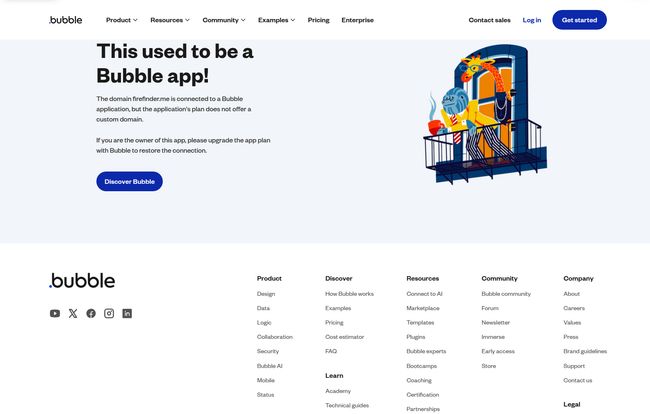
So, naturally, I went to check it out again recently, ready to give it a proper spin for a review. And I was greeted by… this.
Visit Firefinder
A digital ghost town. A message from Bubble, the popular no-code platform, explaining that the app’s plan had lapsed. Oof. As an SEO guy and a perennial bootstrapper, I felt that in my bones. It’s a story we see all too often in the startup world. A brilliant spark that, for whatever reason, seems to have fizzled out.
But does a dead landing page mean the idea is dead? Not at all. Let’s do a little digital archaeology and look at what Firefinder promised, because the concept itself is still incredibly relevant.
The Brilliant Spark Behind Firefinder
Let’s be real for a second. The hardest part of starting a business isn’t always the building. It’s the knowing what to build. We can all get lost in a sea of our own terrible ideas. We build things nobody wants, we solve problems that don’t exist. It’s a rite of passage for entrepreneurs, but a painful one.
Firefinder was designed to be the antidote to that. It wasn’t just another random ‘AI business idea generator’ that spits out nonsense like “Uber for hamsters.” No, its approach was grounded in reality. It worked by analyzing actual conversations happening on the web. The idea was to plug directly into the source of customer pain: forums, social media, and comment sections.
How It Was Meant to Work
The workflow was simple and elegant. You’d install the Chrome extension and just go about your day, browsing the web. When Firefinder’s AI detected a potential business opportunity within a webpage’s content—a complaint, a wish, a problem someone was trying to solve—it would flag it for you. It was meant to give you insights into not just the idea, but also its potential revenue and the difficulty of bringing it to life. This is the part that really got my attention. Idea validation is everything, and getting even a rough, AI-driven estimate of difficulty and potential return is a huge leg up.
You could then save these personalized ideas, creating a private list of validated concepts to explore later. It’s the kind of tool you’d leave running in the background, letting it do the heavy lifting of discovery while you focus on other things. A silent partner, hunting for opportunities.
The Promise and the Pitfalls of AI Idea Generation
Now, I’m a huge proponent of using AI to augment our workflows, but I’m also a realist. Tools like Firefinder live and die by the quality of their AI and the data they analyze. The pros are obvious. It helps you break out of your own echo chamber and forces you to look at problems other people are actually having. It can save you dozens, if not hundreds, of hours that might otherwise be spent on a dead-end project.
“The goal is to ensure you’re building something real and valuable.
That was the core mission, and it’s a noble one. But there’s a flip side. An over-reliance on any AI tool can be a crutch. An AI might spot a complaint, but it can’t always grasp the nuance, the sarcasm, or the context. Is this a genuine, burning problem for a whole market, or just one person having a bad day? The ideas it generates would inevitably need a ton of human refinement and good old-fashioned market research. You still have to get out there and, you know, talk to potential customers. A revolutionary concept, I know.
The tools effectiveness is also completely dependent on the quality of the content its analyzing. A well-moderated subreddit with insightful discussions is one thing; the comment section on a controversial news article is quite another.
So What Happened to Firefinder? A Coder’s Elegy
Which brings us back to that lonely Bubble page. For those not in the know, Bubble is a fantastic no-code platform that allows people to build complex web applications without writing a line of code. It’s a favorite in the indie hacker and MVP (Minimum Viable Product) scene. It lets you get an idea out the door fast.
But it’s not free, at least not for custom domains and serious apps. That error message, “the application’s plan does not offer a custom domain,” is the digital equivalent of an eviction notice. It means the subscription wasn’t paid. The irony here is almost poetic—a tool designed to find profitable business ideas seemingly couldn’t sustain its own operational costs. It’s a stark lesson for every single one of us in this game. Building a product is one thing; building a business is another entirely.
Is this the end, or just a pivot? It’s impossible to say for sure. The project might be undergoing a rewrite, the founder could have taken a full-time job, or maybe they just moved on to the next idea. That’s the beauty and the terror of the indie life. It’s a journey of trial and error.
Alternatives to Fill the Void
So, Firefinder is MIA. What’s a budding entrepreneur to do? Don’t despair. The principle behind the tool is something you can replicate manually, albeit with more elbow grease.
- Manual Prospecting: Spend an hour a day on Reddit, Indie Hackers, or specific industry forums. But don’t just scroll. Search for keywords like “I wish there was an app for,” “how do you solve,” or “I hate it when.” Look for the pain.
- Use Search Modifiers: Get good at Google. Searching `site:reddit.com/r/smallbusiness “problem with”` can unearth some absolute gems.
- Check Out Other Tools: There are other players in this space. Tools like GummySearch are specifically designed to help you find customer problems on Reddit. They carry the torch that Firefinder lit.
At the end of the day, a tool is just a tool. The real magic is in the mindset—the ability to listen, to spot patterns, and to connect problems with solutions.
Frequently Asked Questions about Firefinder
- What was Firefinder?
- Firefinder was an AI-powered Chrome extension designed to help entrepreneurs and indie hackers discover and validate business ideas by analyzing content on websites like Reddit, X, and Facebook for user-expressed problems and needs.
- How did Firefinder generate business ideas?
- It used AI to scan the text of webpages you visited, identifying phrases that indicated a problem or a need. It would then present these as potential business opportunities, complete with an assessment of potential revenue and difficulty.
- Is Firefinder still available?
- As of late 2024, the Firefinder website (firefinder.me) is inactive. It displays an error message indicating that its hosting plan on the Bubble platform has lapsed, so the tool is currently unavailable.
- Why is the Firefinder website down?
- The site is hosted on Bubble, a no-code platform. The error message suggests the subscription for the app was not renewed, which is often due to a project being paused, abandoned, or running out of funding.
- Are there good alternatives to Firefinder?
- Yes. While Firefinder itself is down, you can use other tools like GummySearch for Reddit-based research, or adopt a manual approach by actively searching forums and social media for customer pain points.
- Was Firefinder a free tool?
- The pricing structure was never fully publicized, but given it was built on a paid Bubble plan, it likely operated on a freemium or paid subscription model to cover its own costs.
Also Read: What Happened to Xembly AI? A Post-Mortem
A Final Thought on Finding Fire
The story of Firefinder is a perfect microcosm of the indie hacker experience. It’s about a brilliant idea, the clever application of new technology, and the harsh realities of the market. It’s a reminder that even the tools meant to help us find success are subject to the same pressures we are.
So, while we might not be able to install the Firefinder extension today, we can absolutely carry its spirit with us. Keep your eyes open. Listen for the problems. And never stop searching for that spark. Because the next great idea isn’t going to come from an AI, not really. It’s going to come from you.
Reference and Sources
- Bubble.io – The no-code platform used to build Firefinder.
- GummySearch – An alternative tool for finding business ideas on Reddit.


