
Categories: AI API, AI Code Generator, AI Developer Tools, AI Testing, AI Workflow, Large Language Models (LLMs), No-Code&Low-Code, Open Source AI Models
FlowTestAI Review: AI-Powered API Testing for Humans

Let’s have a frank chat. For years, I’ve been neck-deep in the worlds of traffic, trends, and tech. And if there’s one universal truth I’ve found among development and QA teams, it’s this: almost nobody enjoys writing API tests. It’s the digital equivalent of doing the dishes after a magnificent feast. Necessary, sure. But tedious, repetitive, and often, a soul-crushing bottleneck.
We’ve all been there, right? Staring at endless lines of boilerplate code, trying to simulate every possible user interaction, and then having to maintain that fragile house of cards every time a tiny endpoint changes. It’s a chore. So when a tool comes along promising to use Generative AI to shoulder that burden, my ears perk up. I’m skeptical, of course—I’ve seen a lot of ‘game-changers’ that were anything but. But with FlowTestAI, my skepticism is turning into genuine curiosity, and maybe even a little bit of excitement.
So, What’s the Big Deal with FlowTestAI?
At its core, FlowTestAI is a GenAI-powered platform designed to take the sting out of end-to-end API testing. Think of it less as a rigid testing framework and more as a brilliant interpreter. You give it your OpenAPI specification—the blueprint for your API—and then you tell it, in plain, simple English, what you want to test.
For example, you could say something like, “Create a new user, have them log in, add two items to their cart, and then check out.” Instead of you having to manually script each of those API calls and chain them together, FlowTestAI’s AI engine does the heavy lifting. It understands your intent, maps it to the right API endpoints from your spec, and generates the entire test flow. Its a pretty slick concept.
Visit FlowTestAI
It’s a low/no-code approach that aims to bridge the gap between technical specs and real-world user behavior. And frankly, this is a gap that has caused more than a few headaches in my career.
The Magic Under the Hood
This isn’t just smoke and mirrors; there’s some serious tech making this happen. The tool leverages leading Large Language Models (LLMs) like those from OpenAI and AWS Bedrock to understand both your natural language prompts and the structure of your API documentation.
From Plain English to Flawless API Calls
The secret sauce seems to be its ‘Function Calling’ capability. The AI doesn’t just guess what you mean; it intelligently interprets your OpenAPI spec to understand the available functions, their parameters, and how they connect. This contextual awareness is what separates it from a simple script generator. It builds a logical sequence, passing data from one step to the next, just like a real user session would.
Seeing Is Believing with Visual Workflows
One of my favorite things I saw on their site is the visual representation of these test flows. Instead of a wall of code, you get a clean, graphical flowchart showing each API call, the data being passed, and the dependencies between them. This is huge. Not only does it make debugging a thousand times easier, but it also makes the tests accessible to non-developers. Product managers, UX designers, even stakeholders can look at a flow and say, “Yep, that’s the customer experience we designed.” That kind of shared understanding is priceless.
The Good, The Not-So-Bad, and The ‘Coming Soon’
No tool is perfect, and I’m always wary of overly glowing reviews. So let’s get real about what FlowTestAI brings to the table right now.
What I’m Genuinely Excited About
The automation is the obvious win. Slashing the time it takes to create comprehensive end-to-end tests is a massive productivity boost. The integration with existing CI/CD pipelines is also a non-negotiable for any modern dev team, and they’ve ticked that box. But for me, the most significant promise is privacy and security. By designing the tool to run locally, you’re not sending your sensitive API schemas and test data to some random third-party cloud. They’re also working on a fully local AI integration, which means total air-gapped privacy. In an age of constant data breaches, that’s a huge sigh of relief.
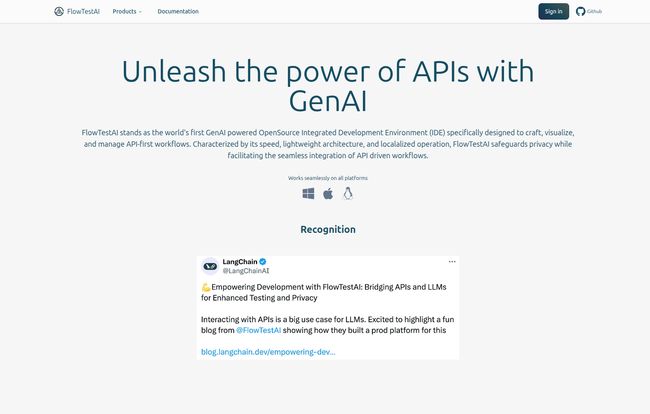
I also saw they got a nod from the folks at LangChain, which is a big deal in the AI dev community. It adds a layer of credibility that you dont always see with new tools.
“AI will probably be the thing that leads to the end of big programming teams at companies.”
– Sam Altman, as quoted on the FlowTestAI site
That quote feels… intense. But it points to a future where tools like this empower smaller teams to do much more.
A Few Things to Keep in Mind
On the flip side, let’s be realistic. The system’s intelligence is tied to the quality of the LLM it’s using. This means you might need to do some fine-tuning or be very specific with your prompts to get the exact test you need. It’s not magic; it’s a powerful assistant that still needs good direction. Also, if your team isn’t already using OpenAPI (or Swagger) specifications, there will be a learning curve. You need that structured documentation for FlowTestAI to work its magic. This is less a flaw of the tool and more a prerequisite for this kind of advanced automation.
A Peek Inside the Toolkit
FlowTestAI isn’t a single product but a suite of tools designed to fit into your workflow, whether you’re a GUI person or a command-line warrior.
- The FlowTestAI IDE: This is your mission control. It’s where you can write your natural language prompts, see the visual flows get created, manage your tests, and inspect the results. The clear traceability feature here is key for debugging when things go wrong.
- The FlowTestAI CLI: For the automators and power users. This is how you’ll integrate your AI-generated tests directly into your GitHub Actions, Jenkins, or other CI/CD pipelines. Set it and forget it.
- FlowTestAI Analytics: This is where you turn test results into strategy. The dashboard gives you an overview of your API health, tracks performance over time, and helps you pinpoint the exact cause of failures. Less guesswork, more data-driven fixes.
What’s the Damage? A Look at Pricing
This is the big question, isn’t it? As of my writing this, FlowTestAI has not published its pricing information publicly. This is pretty common for B2B and developer tools that might have custom or enterprise-level plans. My advice? If this sounds like a fit for your team, head over to their site and request access or book a demo. That’s the best way to get a clear picture of the cost for your specific use case.
So, Is FlowTestAI the Future?
Look, I’ve been around long enough to know there’s no silver bullet. But FlowTestAI feels different. It’s not just trying to make an old process faster; it’s fundamentally changing the process itself. It’s making API testing more intuitive, more collaborative, and dare I say it, a little more human.
It’s a tool built for the way modern teams work: API-first, fast-moving, and security-conscious. It won’t replace skilled QA engineers, but it will give them superpowers, freeing them from the mundane to focus on more complex, exploratory testing. And for that reason alone, I’m keeping a very close eye on FlowTestAI. It might just be the thing that finally lets us enjoy the feast and have the dishes do themselves.
Frequently Asked Questions
- What exactly is FlowTestAI?
- FlowTestAI is an AI-powered tool that simplifies API testing. It uses Generative AI to automatically create end-to-end tests from an OpenAPI specification based on natural language commands you provide.
- How does the AI part actually work?
- It utilizes powerful Large Language Models (LLMs) from providers like OpenAI and AWS Bedrock. The AI interprets your plain English instructions and your API’s blueprint (the OpenAPI spec) to generate a visual, executable test workflow.
- Is FlowTestAI secure to use with my company’s private APIs?
- Security is a core feature. The platform is designed to operate locally, meaning your sensitive API data and specifications don’t have to be sent to a third-party server. They are also developing a fully local AI model for maximum privacy.
- What LLMs does FlowTestAI support?
- Currently, it integrates with leading models from OpenAI and AWS Bedrock. They have also announced that a private, local AI option is in development and will be available soon.
- Can I integrate FlowTestAI into my existing development process?
- Yes. It comes with a Command Line Interface (CLI) that is specifically designed for easy integration with popular CI/CD pipelines like GitHub Actions, Jenkins, CircleCI, and others.
- How much does FlowTestAI cost?
- Pricing information is not currently public. The best way to find out is to visit their website and contact their team for a demo or a personalized quote based on your team’s needs.


