
Categories: AI Models, Large Language Models (LLMs)
Frontier Model Forum: AI’s Safety Net or PR Stunt?

I remember the first time I saw a truly powerful AI model in action. It wasn’t even one of the flashy new ones. It was an earlier version of GPT, and it spit out a piece of code that would have taken me hours to write, flawlessly, in seconds. My first thought was, “Wow, this changes everything.” My second thought, hot on its heels, was a slightly more nervous, “…this changes everything.”
If you’re in the tech, SEO, or marketing space, you’ve felt it too. This weird mix of excitement and low-grade anxiety about where this is all heading. We’re in the middle of an AI gold rush, a digital Wild West, and everyone’s building bigger, faster, more powerful models. But who’s making sure the whole thing doesn’t, you know, go off the rails?
Enter the Frontier Model Forum. On the surface, it sounds like exactly what we need. A big, serious-sounding group dedicated to “advancing frontier AI safety and security.” But I’ve been in this industry long enough to know that high-minded mission statements can sometimes be a smokescreen. So, let’s pull back the curtain and see what’s really going on. Is this a genuine effort to build guardrails, or is it just the industry’s biggest players trying to look responsible while they continue to race ahead?
So What Exactly Is the Frontier Model Forum?
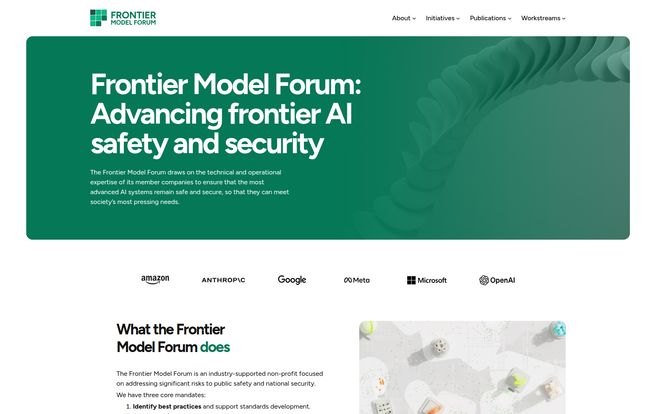
At its core, the Frontier Model Forum is an industry-led, non-profit body. Think of it less like a government regulator and more like a high-stakes working group. The stated goal is to ensure the most powerful AI systems—what they call “frontier models”—are developed safely and responsibly. They want to pool their collective brainpower to tackle the biggest risks, from national security threats to other, more sci-fi-sounding dangers.
Who’s in this exclusive club? It’s a roster of the companies you’d expect: Anthropic, Google, Microsoft, and OpenAI. They’ve since expanded to include other heavyweights like Amazon and Meta. These are the organizations with the keys to the kingdom—the ones building the very models that have us all talking.
Their existence is predicated on a simple, and I think, valid idea: the companies creating this tech are uniquely positioned to understand its risks. They have the technical expertise and operational insights that academics and politicians might lack. The Forum is meant to be the place where they share that knowledge.
The Four Pillars of AI Safety (According to the Forum)
The Forum’s website lays out four core objectives. It’s not just a mission statement; it’s a proposed plan of action. Let’s break it down beyond the corporate-speak.
1. Advancing AI Safety Research
This is the big one. How do you even test a system that’s smarter than its creators in specific domains? The Forum is focused on developing and promoting research into AI safety, from creating better evaluation techniques to figuring out how to stop models from doing things they shouldn’t. It’s about building the science of AI safety from the ground up, because frankly, we’re all flying a bit blind right now.
2. Identifying Best Practices
What does a “safe” AI development process look like? No one really knows yet. The Forum aims to identify and share best practices for everything from internal red teaming (where you actively try to “break” your own models to find flaws) to security protocols that prevent models from being stolen or misused. This is less about hard-and-fast rules and more about creating a shared playbook that can evolve as the tech does.
Visit Frontier Model Forum
3. Collaborating Across Sectors
This is crucial. The Forum says it wants to work with people outside its own bubble—academics, civil society groups, and governments. I’m glad they put this in writing. An echo chamber of tech giants won’t solve this problem. True progress will only happen if researchers, ethicists, and policymakers have a seat at the table. We’ll see how this plays out in practice, but it’s the right sentiment.
4. Sharing Information
This might be the most challenging pillar. The members are fierce competitors. Asking them to share information about safety incidents or vulnerabilities is like asking Coke and Pepsi to swap secret formulas. Yet, the Forum is designed to be a trusted channel for exactly that. They’re focused on sharing insights about unique challenges and risks that frontier models present, something that a single company might not spot on its own.
The Good, The Concerning, and The Complicated
Alright, so the mission sounds noble. But let’s get real. Does it hold up to scrutiny? I see it as a mixed bag, and honestly, that’s probably the best we can hope for at this stage.
What I Genuinely Like
In my book, any collaboration is better than none. Before the Forum, these companies were largely tackling safety in their own silos. Getting them in the same room to talk about catastrophic risks is a monumental step. Their first technical report on capability assessments—which discussed testing models for scary stuff like helping create biological weapons or launching cyberattacks—shows they are at least thinking about the worst-case scenarios. That’s a conversation we need to be having, and they’ve started it.
The Elephant in the Room
Now for the skepticism. The most obvious critique is the whole “fox guarding the henhouse” situation. Can a body funded and run by the very companies it’s meant to hold accountable ever be truly objective? It’s a fair question. They are essentially grading their own homework. While they might be brilliant, there’s an inherent conflict of interest. They’re incentivized to innovate at breakneck speed, and safety can sometimes feel like a speed bump.
My other major hang-up is its narrow focus. The Forum is all about frontier models—the biggest, most expensive ones. But what about the proliferation of powerful open-source models? A significant portion of AI development is happening in the open, decentralized and accessible to anyone. The Forum’s work, while important, might miss a huge part of the picture, potentially overlooking risks from smaller, more widely available AI systems. It feels a bit elitist, if I’m being honest.
Is This Just a Fancy Lobbying Group?
It’s the question on every cynic’s mind. And it’s not entirely unfair. The creation of the Forum could be seen as a preemptive move to show governments, “Hey, we’ve got this, no need for heavy-handed regulation.” A self-regulation play to keep the real regulators at bay.
I don’t think it’s just that, though. I think the people inside these companies are genuinely grappling with the power of what they’ve built. But we can’t take their word for it. The Forum can be a fantastic venue for technical safety alignment, for hashing out the nitty-gritty of red-teaming and vulnerability standards. What it can’t be is the sole arbiter of what’s good for society. That requires independent oversight, robust government involvement, and a much, much wider public conversation.
The Forum should be seen as one piece of a much larger puzzle. A very important, very powerful piece, but a piece nonetheless.
What’s the Price to Join this AI Safety Club?
This is a quick one. There is no pricing. The Frontier Model Forum is not a product or a service you can buy. It’s a non-profit industry consortium. The “price of admission” is being one of the handful of companies with the resources to build a frontier AI model and a willingness to commit to the Forum’s objectives. The funding comes from the deep pockets of its member companies, not from subscriptions.
Also Read: FreshFeed Review: A Cure for Outdated AI?
Frequently Asked Questions About The Frontier Model Forum
Who are the members of the Frontier Model Forum?
The founding members are Anthropic, Google, Microsoft, and OpenAI. They have since been joined by other major players like Amazon and Meta.
Is the Frontier Model Forum a government agency?
No, it’s not. It is an industry-led, non-profit organization created and funded by its member companies. It aims to collaborate with governments but is not part of any government body.
What is a “frontier AI model”?
A frontier model is a term for a large-scale AI model that has capabilities at the leading edge of what’s currently possible. These are the most powerful and complex models, like Google’s Gemini or OpenAI’s GPT-4 series.
How does the Forum actually promote safety?
It focuses on four main activities: advancing AI safety research, identifying and sharing best practices among developers, sharing information about risks and vulnerabilities, and collaborating with external groups like academia and government.
Can smaller AI companies or startups join the Forum?
As of now, membership seems to be focused on the companies developing the largest-scale frontier models. The website has a contact form for getting in touch, but it’s not an open-door organization. Its exclusivity is one of the common points of criticism.
Where can I read the Forum’s research and reports?
The Forum publishes its findings and reports on its official website, under the “Publications” section. Their first major technical report on capability assessments is available there for anyone to read.
My Final Takeaway
So, where do we land on the Frontier Model Forum? Is it our savior or just a PR play?
The truth, as it so often is, is somewhere in the messy middle. It’s an imperfect, perhaps even flawed, but ultimately necessary initiative. I’m glad it exists. The alternative—a world where these giants don’t talk to each other about existential risks—is far scarier. It’s a step in the right direction.
But we, as an industry and as a society, cannot afford to be complacent. We can’t outsource our future’s safety to a small handful of corporations, no matter how well-intentioned they claim to be. The Forum is a starting line, not a finish line. The real work of building a safe and equitable AI future is just beginning, and it’s going to take all of us.


