
Categories: AI For Data Analytics, AI Marketing, AI Predictions
NIQ BASES AI Review: Cut Your R&D Time in Half?

I remember sitting in a post-mortem meeting years ago for a new line of flavored sparkling water. It had everything going for it, or so we thought. The packaging was slick, the marketing budget was solid, and the flavor — a trendy botanical blend — had tested well with a small focus group in California. But on the national stage? It was a dud. A complete and utter flop. The feedback was all over the place: “too floral” in the Midwest, “not sweet enough” in the South. A ton of money and six months of work down the drain.
That experience is burned into my brain. For decades, consumer packaged goods (CPG) development has been a bit of a gamble, a mixture of data, experience, and a whole lot of crossed fingers. We rely on old-school methods like focus groups, which, let’s be honest, can be wildly unreliable. You get a dozen people in a room, feed them some free snacks, and hope their opinions represent millions. It’s a flawed model.
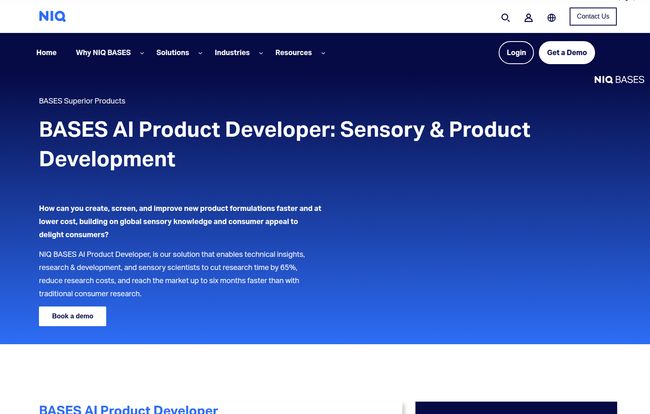
But what if you could trade that gamble for something more like a calculated science? That’s the promise of tools like NIQ BASES AI Product Developer. I’ve been watching the AI space in marketing and product development for a while, and this one caught my eye because it tackles one of the most subjective things in the world: taste.
So, What Exactly is NIQ BASES AI Product Developer?
Okay, let’s break it down. Forget thinking of this as just another analytics dashboard with pretty charts. NIQ BASES is a predictive intelligence engine. Think of it less like a report on what happened yesterday and more like a crystal ball for your product’s future success. It’s built on the foundation of NielsenIQ, a name that carries some serious weight in the world of consumer data, so this isn’t some fly-by-night startup.
The platform essentially ingests an absurd amount of information—we’re talking sensory profiles from over 200,000 products and insights from more than 21 million consumer reviews across 40 countries. It then uses its AI models to predict how a new product formulation will be received by specific consumer groups. Before you even have a physical prototype.
Visit Gastrograph.ai
Ditching the Focus Group for Predictive Intelligence
The traditional product development cycle is painfully slow. You have an idea. You create dozens of lab samples. You ship them out for internal tasting. You tweak them. You run a small consumer panel. You tweak them again. All of this takes months and a small fortune in R&D, materials, and shipping costs.
NIQ BASES aims to turn that whole process on its head. Instead of physically creating and testing every single iteration, you can run virtual scenarios. The AI acts as your global, always-on focus group that has already tasted everything. It can tell you things like, “This level of acidity will resonate well with millennials in Western Europe, but you’ll need to dial up the sweetness for Gen Z in Southeast Asia.” That’s a level of granularity that’s almost impossible to get from traditional methods without a massive budget and timeline.
The Power of Sensory Data
When we say “sensory data,” we’re going way beyond simple labels like “sweet” or “spicy.” The platform analyzes the intricate web of flavor profiles, aromas, textures, and even aftertastes that define a product experience. It’s the difference between saying a coffee is “strong” and defining its notes of dark chocolate, its level of bitterness, its mouthfeel, and how those attributes compare to the top-selling coffee in Brazil versus Canada. This allows brands to innovate with precision, finding the exact “white space” on the flavor spectrum that consumers are craving but no one is currently serving.
The Tangible Benefits: Cutting Costs and Beating the Clock
Here’s where it gets really interesting for brand managers and product developers. NIQ makes a bold claim on their site: get to market up to 6 months faster. In an industry where trends can live and die on TikTok in a matter of weeks, that’s not just an improvement; it’s a fundamental competitive advantage.
Imagine being able to concept, test, and validate a new energy drink flavor in a month instead of eight. That’s the potential here. And it’s not just about speed. Think about the cost savings. Fewer failed prototypes, less wasted ingredients, and most importantly, a drastically reduced risk of launching a product that nobody wants to buy. It’s about minimizing those costly duds, like that sparkling water I still have nightmares about.
Let’s put it in a table to see it clearly.
| Feature | Traditional R&D | NIQ BASES AI Approach |
|---|---|---|
| Speed | 6-18 months | Drastically shorter, with claims of saving up to 6 months |
| Cost | High (physical prototypes, shipping, panels) | Lower (virtual testing minimizes physical waste) |
| Data | Small-scale, localized, often biased | Global, massive dataset, objective |
| Risk | High chance of market failure | Reduced risk through data-driven prediction |
Who is This For? (And Who It Might Not Be For)
In my opinion, a tool like this is a godsend for large-scale CPG companies. If you’re a brand manager at a major food or beverage corporation juggling multiple product lines and looking at global expansion, the business case is pretty clear. Innovation teams can use it to validate their boldest ideas, and marketing teams can use the insights to craft more resonant messaging.
However, it might be overkill for a small, artisan craft soda company that produces one batch at a time. The real power of BASES AI comes from its scale. There’s also the human factor to consider. This isn’t a magic wand. You can’t just press a button and have a perfect product pop out. You still need smart, creative people to interpret the data, ask the right questions, and make the final strategic decisions. It requires a certain level of expertise to translate the AI’s output into a real-world product strategy. So, a team needs to be ready to embrace a data-first culture to really make it sing.
Let’s Talk Pricing and Accessibility
If you’re looking for a simple pricing page with neat little tiers, you won’t find one. And that’s not surprising. The big “Get a Demo” button is a dead giveaway that this is an enterprise-level solution. The pricing is almost certainly bespoke, tailored to your company’s specific needs.
And that makes sense. The cost will depend on factors like how many users you have, which global markets you need data for, and the sheer volume of product scenarios you want to run. My advice? If you’re serious about this, don’t be shy. Book the demo. See what it can do for one of your current projects. That’s the only way to know if the investment makes sense for your bottom line.
My Final Take: Is NIQ BASES a Revolution or Just Hype?
So, what’s the verdict? In an ironic twist, I saw NIQ has a resource on their own site titled “Modern snake oil…” which I found amusing. It shows they’re aware of the skepticism surrounding new methodologies. And honestly, I get it. The world of marketing tech is full of overblown promises.
But from my analysis, this isn’t snake oil. The logic is sound. Using massive historical datasets to predict future outcomes is the foundation of almost every major tech advancement of the last decade, from stock market analysis to content recommendation engines. NIQ is simply applying that proven model to one of the last frontiers of qualitative guesswork: human sensory experience.
It’s not going to replace the need for human creativity, brand storytelling, or the final spark of inspiration that creates a truly iconic product. But it provides an incredibly powerful guide rail. It can prevent you from making huge, costly mistakes and point you in directions you never would have considered. In today’s competitive market, that’s not just an advantage; it’s becoming a necessity.
Frequently Asked Questions (FAQ)
How is this different from regular consumer surveys?
Traditional surveys ask consumers for their opinions after trying a product. NIQ BASES AI works differently; it uses its existing vast database of sensory information and consumer preferences to predict how a product will perform before it’s even widely tested. It’s predictive, not just reactive.
Do I need a data scientist on my team to use NIQ BASES?
While you don’t necessarily need a dedicated data scientist, it helps to have team members who are comfortable with data analysis and can translate insights into actionable product strategy. NIQ likely provides support and training, but a data-curious mindset is a huge plus.
Can it predict the next big flavor trend?
It can certainly identify “white space” opportunities and emerging preference patterns that point towards potential trends. By analyzing what consumers are enjoying and what’s missing from the market, it can give you a massive head start on developing what could become the next big thing.
What kind of products can be analyzed? Just drinks?
No, its capabilities extend across the food and beverage spectrum. Anything with a distinct sensory profile—from snacks and sauces to frozen meals and dairy products—can be analyzed and optimized using the platform’s AI models.
Is my proprietary product data safe with NIQ?
Given NIQ’s long-standing reputation as a trusted data partner for the world’s largest brands, data security and confidentiality are paramount. Enterprise-level platforms like this operate under strict NDAs and have robust security protocols to protect their clients’ sensitive R&D information.
Wrapping It Up
Look, the way we create and launch products is changing. The days of betting the farm on a gut feeling are numbered. Tools like NIQ BASES AI Product Developer represent a major shift from high-stakes artistry to data-informed science. It doesn’t take the magic out of creating a beloved product; it just gives that magic a much better chance of succeeding on a global scale. And for any brand trying to win in the crowded aisles of the supermarket, that’s a pretty compelling proposition.
Reference and Sources
- NIQ BASES AI Product Developer Official Page – Main source for product features and benefits.
- Forbes – The Role Of AI In The Food And Beverage Industry – General context on AI’s impact on the F&B sector.


