
Categories: AI Agent, AI Chatbot, AI Developer Tools, AI Knowledge Management, Large Language Models (LLMs)
GenWorlds Review: Building AI Agent Swarms (The Easy Way?)

Alright, let’s have a real chat. For the past year, my feeds have been absolutely flooded with the next big thing in AI: autonomous agents. You’ve seen them. Auto-GPT, BabyAGI, and a dozen others promising to be our personal AI interns, ready to take a single goal and conquer the world. And while the idea is amazing—truly—the reality has often been a bit… underwhelming. They get stuck in loops, they hallucinate, they burn through API credits faster than I burn through coffee on a Monday morning.
The problem, as I see it, is that we’ve been asking a single AI to be a jack-of-all-trades. We’re asking one musician to play an entire symphony. It just doesn’t work that way.
But what if you could build the whole orchestra? What if you could create a team of specialized AI agents, each with its own role, its own memory, and a way to communicate and coordinate with the others? That’s the promise of a tool that recently landed on my radar, and I’ve gotta say, I’m intrigued. It’s called GenWorlds, and it’s not just another AI wrapper. It’s a whole new playbook.
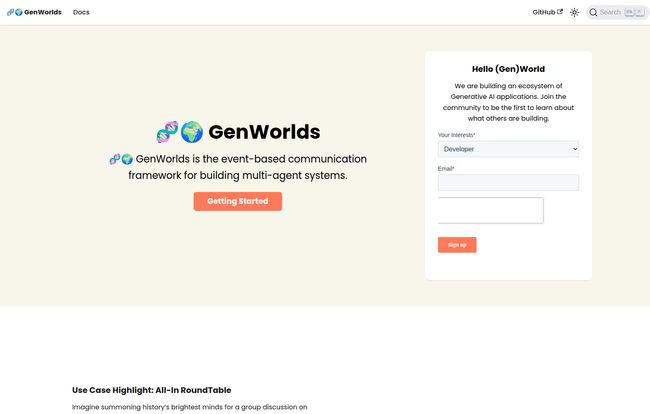
Visit GenWorlds
So, What on Earth is GenWorlds, Really?
In the simplest terms, GenWorlds is an open-source framework for building multi-agent systems. Think of it less as a finished product and more like a high-tech LEGO set for AI developers. It provides the foundational blocks and the instruction manual for creating interactive worlds where multiple AI agents can live, breathe, and work together on complex tasks.
The official description calls it an “event-based communication framework.” That sounds a bit jargony, I know. A better analogy might be to think of it like a game engine. A tool like the Unreal Engine gives game developers the physics, lighting, and character models to build a virtual world. GenWorlds, built by the team at Yeager.ai, gives AI developers the tools to define an environment, create specialized agents, and set up the rules for how they interact. It’s about creating a society of AIs, not just a solitary one.
The Core Features That Got My Attention
I’ve seen a lot of AI platforms, and most of them have a pretty similar feature list. But a few things about GenWorlds stood out. This isn’t just about stringing API calls together; there’s some real architectural thought here.
Truly Customizable Worlds
This is the big one for me. You’re not just giving a generic bot a prompt. You’re designing the entire context it operates in. You define the world, the available tools, and even the specific goals and memories of each individual AI agent. Imagine setting up a virtual marketing team: one agent specialized in SEO research, another in writing ad copy, and a third in analyzing performance data. With GenWorlds, you can build that sandbox for them to play in.
Giving Your Agents a Brain (Cognitive Processes)
Okay this is just cool. GenWorlds lets you choose the “brain” or the cognitive process for your agents. Are you dealing with a complex problem that requires exploring multiple paths? You can equip your agent with a “Tree of Thoughts” process. Is it a more straightforward, sequential task? A “Chain of Thoughts” process might be better. This level of control means you can match the agent’s thinking style to its job, which is a massive step up from the one-size-fits-all approach.
Making Them Work Together (Coordination Protocols)
This is the secret sauce. Having a bunch of smart agents is useless if they can’t coordinate. GenWorlds provides different protocols for making them work as a team. You can have them take turns on a task in a serialized way or use a more complex token-based system for passing control. You get to be the manager, defining the workflow for your AI team. No more digital anarchy.
It Plays Well with Others
Wisely, the creators know developers don’t want to start from scratch. The framework is designed to be “plug-n-play,” with a repository of ready-made components and tools. More importantly, it supports integration with other existing agents and worlds. This means you can leverage the wider AI ecosystem, which is critical for an open-source project to thrive.
Let’s Get Real: The Good, The Bad, and The Beta
No tool is perfect, especially not in the fast-moving world of AI. It’s important to go in with your eyes open. So here’s my honest take.
The biggest plus is that GenWorlds is open-source. This fosters a community, encourages transparency, and usually leads to faster innovation than a closed, corporate product. The customizability is off the charts, and the architecture is built for scalability—meaning you can start with a simple two-agent system and theoretically grow it into a massive simulation. The project also has some serious credibility. When LangChain founder Harrison Chase says your team “keeps shipping” and he’s excited to see your framework evolve… well, that gets you noticed.
“The Yeager.ai team keeps shipping. Really exciting to see how their GenWorlds framework evolves to help people build and deploy AI agents. We’re in a paradigm shift in GenAI and I’m pleased to see the Yeager team using LangChain to do it” – Harrison Chase, Founder @ LangChain
Now, for the reality check. The website itself states clearly: “GenWorlds is an early stage product in active development.” This is code for ‘expect some bugs.’ It’s not a polished, consumer-facing product. And this leads to the second major point: it requires technical knowledge. You need to be comfortable with code, frameworks, and setting up your own environment. This is a tool for builders, not for clickers. If you’re looking for a no-code solution, this ain’t it, chief.
What’s the Price Tag on Building an AI World?
This is the question every business owner and developer asks eventually. So, how much does GenWorlds cost? As of right now, because it’s an open-source project, it appears to be free to use. You’ll have to cover your own costs for things like API keys (for whatever language models you plug in), but the framework itself is available on GitHub for anyone to download and use.
I did notice that any links to a dedicated pricing page were broken, which just reinforces the idea that it’s in a community-focused, pre-commercialization phase. My advice? Get in now while it’s free and open. Join their Discord, play around with it, and be part of the community shaping its future. That’s often where the real value is in these early stages.
So, Who is This Really For?
Let’s boil it down. GenWorlds is a fantastic prospect for a specific group of people:
- AI Developers & Researchers: This is your new playground. The framework is perfect for experimenting with agent coordination and cognitive architectures.
- Tech-Savvy Founders: If your startup’s core product involves complex, automated workflows, GenWorlds could be the engine you build it on.
- Large Companies: For building sophisticated internal tools—imagine an AI-powered SOC team or a hyper-efficient content creation pipeline—this has massive potential.
It’s definitely not for marketers looking for a quick-fix AI writer or small business owners who need a simple customer service bot. This is for the folks who want to get their hands dirty and build the next generation of AI applications from the ground up.
Final Thoughts on the AI Orchestra Conductor
I’m genuinely excited about GenWorlds. Not because it’s a perfect, finished product—it isn’t. I’m excited because it represents a shift in thinking. It acknowledges that intelligence isn’t monolithic; it’s collaborative. The future of AI that actually gets things done in the real world probably looks less like a single, all-knowing oracle and more like a well-managed team of specialists.
GenWorlds provides the blueprint for building that team. It’s a challenging, developer-centric tool with a steep learning curve, but the potential payoff is enormous. It’s a glimpse into a future where we’re not just prompting AIs, but architecting their entire societies. And for a tech nerd like me, that’s a pretty thrilling thought.
Frequently Asked Questions
Is GenWorlds free to use?
Yes, as an open-source framework, GenWorlds is currently free to use. You can access it on their GitHub. You will still be responsible for costs associated with any third-party services you integrate, like large language model API keys.
Do I need to be a programmer to use GenWorlds?
Yes, absolutely. GenWorlds is a development framework that requires coding knowledge and technical expertise to set up and configure. It is not a no-code or low-code platform for non-technical users.
What is a multi-agent system?
A multi-agent system is a computerized system composed of multiple interacting intelligent agents. Instead of a single AI trying to solve a problem, you have a collection of agents that can work independently or coordinate with each other to achieve a common objective.
How is GenWorlds different from something like Auto-GPT?
Auto-GPT is an application that tries to make a single AI agent autonomous. GenWorlds is a framework for building systems where multiple specialized agents can coordinate. It’s the difference between a single self-driving car (Auto-GPT) and an entire traffic control system that manages a fleet of them (GenWorlds).
Who is behind GenWorlds?
GenWorlds is being developed by the team at Yeager.ai, a company focused on building tools for the new generation of AI development.
Where can I get started with GenWorlds?
The best place to start is their official GitHub repository, which has the source code and initial documentation. I also highly recommend joining their community on Discord to ask questions and see what others are building.
Reference and Sources
- GenWorlds Official Website: https://www.genworlds.com/
- GenWorlds GitHub Repository: https://github.com/yeagerai/genworlds
- Yeager.ai Official Website: https://www.yeager.ai/
- GenWorlds Community Discord: https://discord.com/invite/wKds24jd
- LangChain: https://www.langchain.com/


