
Categories: AI API, AI Checker, AI Content Detector, AI Detector, AI Grammar Checker, AI Plagiarism Checker
GPTZero Review: An Honest Look at This AI Detector

There’s a weird feeling in the content world right now, isn’t there? A few years ago, our biggest worry was duplicate content or a pesky Google algorithm update. Now, we’re staring down the barrel of a content firehose, and a whole lot of it is written by robots. I’ve been in the SEO and traffic game for a long time, and I’ve never seen a shift this fast. It’s exciting, a little scary, and frankly, it makes my job a lot more interesting.
It also creates a massive headache: how do you tell what’s real anymore? When you’re managing a team of writers, vetting guest posts, or just trying to maintain a standard of quality, you need a way to spot the synthetic stuff. That’s where tools like GPTZero come into the picture, promising to be our digital bloodhound in the hunt for AI-generated text. But does it actually work? I’ve been kicking the tires on it, and I have some thoughts.
So, What Exactly is GPTZero Anyway?
Let’s get the basics out of the way. GPTZero is an AI detection tool. You feed it a piece of text, and it gives you a probability score on whether it was written by a human or a large language model (LLM). We’re talking the big names: ChatGPT, GPT-4, Gemini, Claude, you name it. It was famously started by a Princeton student, Edward Tian, which gives it a certain grassroots, David-vs-Goliath feel that I kinda like.
Its main audience, at least initially, was in academia. Professors trying to figure out if that perfectly structured essay on 18th-century pottery was the student’s work or ChatGPT’s. But its use has exploded. Now, content managers, editors, publishers, and SEOs like me are using it to protect our content quality. It’s about ensuring authenticity, which is a currency that’s becoming more valuable by the day.
My First Impressions and The User Experience
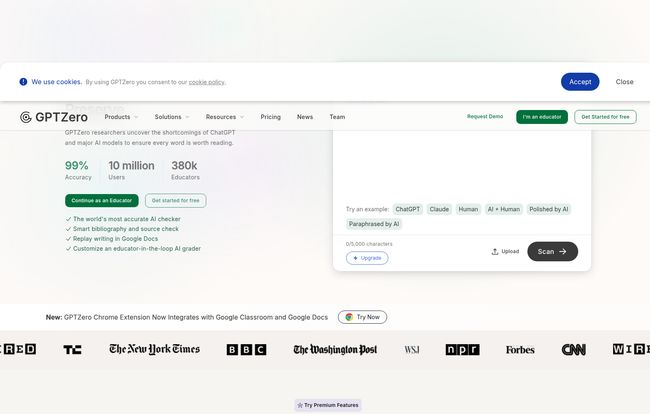
I’ve used a lot of clunky software in my day. Tools that feel like they were designed by engineers, for engineers. I was pleasantly surprised by GPTZero. The interface is clean, minimal, and gets straight to the point. No fluff. You get a big text box, a button to upload a file, and the “Scan” button. That’s it.
You paste your text, hit go, and it gets to work. For a 1,000-word article, it usually spits out a result in under 30 seconds. The report it generates is the real star, though. It doesn’t just give you a single, scary percentage. It highlights sentences and color-codes them based on the likelihood of them being AI-generated. This sentence-level analysis is, for my money, its most powerful feature. It helps you see why it thinks a text is robotic, rather than just taking its word for it.
Visit GPTZero
The Core Features That Actually Matter
A tool can have a million features, but usually only a few really move the needle. Here’s what stood out to me after spending some serious time with GPTZero.
The Main Event: How Good is the AI Detection?
This is the big question, right? And the answer is… it’s pretty darn good. But it’s not a magic wand. In my tests, throwing raw, unedited output from ChatGPT or Claude at it, GPTZero caught it almost every single time with high confidence. It’s great at spotting the classic AI tells: the slightly-too-perfect prose, the predictable sentence structures, that weirdly sterile tone.
However, the game is evolving. Some people are using complex prompts or running AI text through paraphrasing tools to “humanize” it. This is where things get murky. I’ve seen GPTZero get fooled by heavily edited AI text. It’s a cat-and-mouse game. The AI gets smarter, the detector has to get smarter. That said, I’ve found it’s more resilient than many other free checkers out there. It seems better at sniffing out the underlying statistical patterns of AI, not just surface-level clichés.
More Than Just a Robot Hunter
Initially, I thought of GPTZero as a one-trick pony. But the paid plans add a few layers to the cake that make it a more well-rounded writing assistant. The inclusion of a plagiarism checker is huge. It’s one less subscription I have to pay for, and it integrates right into the same workflow. It scans for both plagiarism and AI content in one go.
The integrations are also a big win for convenience. The ability to use it directly within Google Docs, Canvas, or Moodle is a game-changer for people who live in those ecosystems. It removes the friction of constantly copying and pasting text between windows. It’s a small thing, but those small things add up to a much smoother workflow.
Let’s Talk Turkey: GPTZero Pricing
Okay, let’s talk about the cost. Everyone wants to know if it’s worth opening the wallet. GPTZero operates on a freemium model, which I appreciate. You can get a feel for it without commitment.
Here’s a quick breakdown of their plans as of writing this (prices are based on annual billing, which saves you a fair bit):
| Plan | Price (Billed Annually) | Word Count | Key Features | Best For |
|---|---|---|---|---|
| Free | $0 /month | 10,000 words/month | Basic AI Scan, 3 Advanced Scans | Casual users, students, or just trying it out. |
| Essential | $8.33 /month | 150,000 words/month | Basic Scan, Grammar Check, Chrome Extension | Solo bloggers, freelancers, and students with regular writing assignments. |
| Premium | $12.99 /month | 300,000 words/month | Advanced Scan, Plagiarism Check, Writing Feedback | The sweet spot. Perfect for content managers, editors, and small agencies. |
| Professional | $24.99 /month | 500,000 words/month | Batch file scanning, Team features, Enterprise security | Larger agencies, educational institutions, and businesses. |
In my opinion, the Premium plan offers the best bang for your buck. It unlocks the advanced scanning and the all-important plagiarism checker, turning it into a genuine multi-tool for content integrity. The free plan is generous enough to let you know if you’ll actually use it, which is more than I can say for some other platforms.
The Good, The Bad, and The “It Depends”
No tool is perfect. Let’s be real. If anyone tells you they have a 100% foolproof AI detector, they’re selling you snake oil.
The good is clear: it’s user-friendly, fast, and the sentence highlighting is incredibly insightful. The integrations and combined plagiarism feature on paid plans are a huge plus.
The bad is the potential for false positives. Yes, it can happen. I’ve seen it flag heavily edited, jargon-filled human writing as potentially AI. Why? Because sometimes, technical or academic writing can lack the typical “human” statistical variance. It’s a machine looking for patterns, after all. You can’t treat its verdict as gospel; you have to use it as a piece of evidence in your own investigation. This is its biggest weakness, and a risk with all AI detectors, not just GPTZero.
And the “it depends” part is its ongoing battle with smarter AI. As models like GPT-5 and beyond are released, GPTZero will have to constantly update its own models. Its effectiveness today is not a guarantee of its effectiveness tomorrow. Subscribing to a tool like this is a bet on the team’s ability to keep up.
So, Who Should Actually Use GPTZero?
After all this, who is this tool really for?
- Educators: This is a no-brainer. If academic integrity is part of your job, this is one of the best tools on the market.
- Content Managers & Editors: If you manage freelance writers or guest contributors, this is your first line of defense against lazy, AI-spun submissions. It saves you the time and embarrassment of publishing robotic content.
- SEOs: While Google says it doesn’t penalize AI content, it does penalize unhelpful, low-quality content. A lot of AI content falls into that category. I use it to spot-check work to ensure we’re maintaining a human-first standard.
- Writers: This might sound weird, but it can be useful for checking your own work. Sometimes, after a long day of writing, my prose can get a little stiff. Running it through a detector can be a weirdly effective way to spot passages that need a little more personality and flair.
My Final Verdict on GPTZero
So here’s the bottom line. GPTZero is not an infallible judge, jury, and executioner for AI content. It is, however, an extremely competent and well-designed assistant. Think of it less as a lie detector and more as an expert consultant who can point out red flags you might have missed.
In a world drowning in content, tools that help us find the authentic, human-crafted gems are more necessary than ever. GPTZero is one of the best I’ve come across. It’s a solid investment for anyone serious about the quality and integrity of their words. It’s earned a permanent spot in my digital toolkit.
Frequently Asked Questions
- What is GPTZero really for?
- GPTZero is an AI detection tool designed to identify text written by AI models like ChatGPT. It’s used by teachers, content managers, and editors to check for authenticity and maintain writing standards.
- How accurate is GPTZero?
- It’s highly accurate at detecting raw, unedited AI output. However, like all detectors, it can be fooled by heavily edited or paraphrased AI text. It can also occasionally produce a “false positive,” flagging human text as AI, so it should be used as a guide, not a final verdict.
- Can GPTZero detect models other than ChatGPT?
- Yes, it’s designed to detect output from a range of large language models, including GPT-4, Gemini, Claude, and LLaMA, among others.
- Does GPTZero have a free version?
- Yes, it offers a generous free plan that allows you to scan up to 10,000 words per month, which is great for trying out its core functionality.
- Can GPTZero make mistakes?
- Absolutely. No AI detector is 100% perfect. It’s a tool based on statistical probability. It’s best used to support your own judgment rather than replace it entirely. Always review the highlighted sections and use your own expertise.
- Is GPTZero just for teachers?
- Not at all. While it’s very popular in education, it’s an invaluable tool for anyone in the content industry, including SEOs, marketing agencies, publishers, and freelance writers who need to verify the originality of their work.


