
Categories: AI Agent, AI Answer, AI Data Mining, AI Excel Formula Generator, AI For Data Analytics, AI For Finance, AI Marketing, AI Models, AI Paragraph Generator, AI Predictions, AI Productivity Tools, AI Report Generator, AI Sales, AI Text Generator, No-Code&Low-Code, SQL Query Builder
Graphite Note Review: No-Code ML for Marketers?

How many times have you stared at a Google Analytics dashboard, a mountain of CRM data, or a sprawling spreadsheet until your eyes glazed over? You’ve got all this information—clicks, sessions, sales, sign-ups—but when your boss asks, “Okay, but what do we do next?
you’re left with… well, an educated guess.
It’s a classic problem. We’re drowning in data but starving for actual insight. For years, the answer was always, “Hire a data scientist.” For most of us, that’s just not in the cards. It’s like needing to change a lightbulb and being told you have to hire a master electrician and rewire the house first.
This is the gap where “no-code” tools have been popping up, promising to give us superpowers without needing a PhD in statistics. I’ve seen a lot of them. Some are great, some are just fancy dashboard builders. But recently, I got my hands on Graphite Note, and I’ve got to say, this one feels… different. It’s not just about showing you what happened; it’s about predicting what will happen next and telling you what to do about it. So, is it all hype, or is it the real deal?
So, What is Graphite Note, Really?
Let’s get one thing straight: this isn’t just another BI tool. Think of platforms like Tableau or Power BI as your car’s rearview mirror. They are fantastic for showing you exactly where you’ve been and what you just passed. Incredibly important, no doubt.
Graphite Note, on the other hand, is the GPS. It uses the data of where you’ve been to predict the traffic ahead, suggest the fastest route, and tell you which turn to take next to reach your destination. It’s a no-code machine learning platform designed for business folks—marketers, sales ops, founders—who need answers, not code.
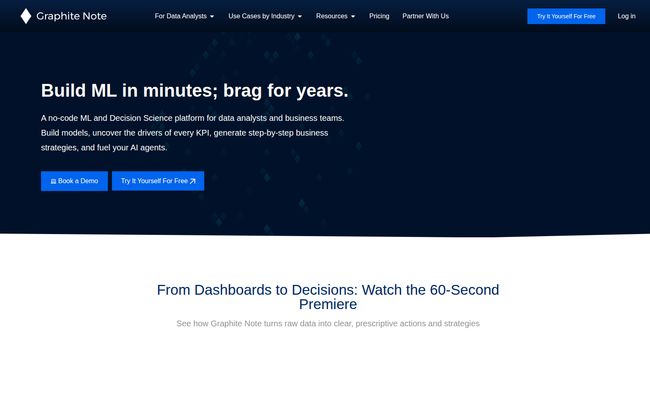
Visit Graphite Note
It promises to let you build AI models in minutes to do things like predict which customers are about to churn or which leads are most likely to convert. And honestly, the ‘in minutes’ claim made me skeptical. We’ve all been burned by those promises before. But the core idea is to bridge the chasm between looking at data and making a profitable buisness decision. A pretty bold goal.
The Features That Actually Matter
A feature list is just a list until you see how it solves a real problem. Here’s my breakdown of what makes Graphite Note tick, and why it’s more than just a spreadsheet on steroids.
From CSV to Crystal Ball: The No-Code Model Building
This is the heart of the platform. The idea is you can take a flat file—a simple CSV of your customer data, for example—upload it, tell Graphite Note what you want to predict (like ‘Customer_Churned’ or ‘Lead_Converted’), and it does the heavy lifting. It runs your data through different machine learning models and finds the one that works best.
For anyone who’s ever tried to even think about setting up a Python environment and installing scikit-learn, the simplicity here is a breath of fresh air. You don’t need to know the difference between a random forest and a gradient-boosted tree. You just need to know what question you want to answer. That’s it. This is the democratization of data science we’ve been hearing about for years.
Beyond the ‘What’ to Uncover the ‘Why’
Here’s where things get interesting. A prediction is nice, but knowing why the prediction was made is where the money is. Graphite Note has a killer feature for KPI driver analysis. It doesn’t just say, “20% of these customers are at high risk of churning.” It tells you why. It might say, “High-risk customers tend to have logged fewer than 3 sessions this month, haven’t used Feature X, and are on the Basic plan.”
Suddenly, you have a strategy. You’re not just staring at a churn number; you’re building a targeted campaign to re-engage users who haven’t tried Feature X. That’s moving from being reactive to being proactive.
Data Storytelling for People Who Hate Data
As a blogger and a marketer, this part really speaks to me. You can have the most brilliant insight in the world, but if you can’t convince your team or your boss to act on it, it’s useless. Graphite Note includes a “data storytelling” tool that helps translate the nerdy model outputs into plain English and compelling visuals. It builds a narrative around your findings. It’s the difference between showing someone a page of equations and telling them a story about how you can save the company a million dollars. Guess which one gets the budget?
Who Should Use Graphite Note? (And Who Shouldn’t)
Look, no tool is for everyone. If you’re a seasoned data scientist at Google building custom algorithms, you’re probably going to stick with your Jupyter notebooks, and that’s fine. This tool isn’t for you.
But if you are a:
- Marketing Manager trying to figure out which leads to prioritize.
- SaaS Founder desperate to reduce customer churn.
- Sales Ops Lead trying to create more accurate sales forecasts.
- Data Analyst who wants to deliver more predictive insights without spending months on a single model.
…then you’re the person Graphite Note was built for. The main caveat is its focus on tabular data. We’re talking spreadsheets and database tables. If your work involves image recognition or complex natural language processing, you’ll need a more specialized toolset. But for the vast majority of business problems, the answers are hiding in rows and columns.
Let’s Talk Money: The Graphite Note Pricing
Ah, the big question. Is it worth it? The pricing is definitely a step up from your average marketing tool, so it’s an investment. Let’s break it down.
| Plan | Price | Best For |
|---|---|---|
| Sprout | $295 / month | Individuals and tiny teams working with CSV files. |
| Growth | $995 / month | Small teams needing integrations and more robust ML. |
| Enterprise | Custom | Larger organizations with a focus on data storytelling and deeper integrations. |
My take? The $295/mo Sprout plan is the most accessible. Think about it this way: if its predictions help you prevent just one or two high-value customers from churning each month, or help your sales team close one extra deal by focusing on the right leads, the tool has already paid for itself. The barrier isn’t the technology anymore; it’s the price. But for a growing business, the cost of not having these insights can be much, much higher.
My Honest Take: The Good, The Bad, and The Bottom Line
So, where do I land? I’m genuinely excited about what Graphite Note represents. The ability to quickly get predictive insights is a game-changer. The focus on actionable steps and data storytelling is what sets it apart from more technical platforms.
Of course, it’s not perfect. The pricing will be a hurdle for freelancers or very early-stage startups. And its reliance on tabular data means it’s not a one-size-fits-all solution for every AI problem on the planet. But it doesn’t pretend to be.
The bottom line is this: Graphite Note is a powerful, well-designed tool that successfully puts the power of machine learning into the hands of the people who can actually use it to make decisions. It’s a massive step in the right direction for making data science practical.
Frequently Asked Questions about Graphite Note
- What exactly is no-code machine learning?
- It’s a way to build and use AI prediction models using a visual interface with clicks and dropdowns instead of writing code. You provide the data and define the goal, and the platform handles the complex statistical work behind the scenes.
- So I really don’t need to code to use Graphite Note?
- Correct. That’s the whole point. If you’re comfortable with something like Excel or Google Sheets, you have the technical skills you need to get started.
- How is this different from a BI tool like Tableau or Looker?
- BI tools are primarily for descriptive analytics—they show you what happened in the past. Graphite Note is for predictive and prescriptive analytics—it uses past data to forecast the future and recommend actions. They can work together, but they solve different problems.
- What kind of data works best?
- Structured, tabular data is its sweet spot. Think CSV files, Excel spreadsheets, or tables from a database that have clear rows and columns.
- How does it actually help with lead scoring?
- You would feed it data about your past leads—both those who converted and those who didn’t—along with their characteristics (company size, job title, website activity, etc.). The platform would then build a model that can look at a new lead and assign a score based on its likelihood to convert, helping your sales team focus their energy.
- Is there a free trial available?
- You’ll want to check their website for the latest offers. Many platforms like this offer demos or limited trials, so it’s always worth heading over to their pricing page to see what’s current.
Final Thoughts
For too long, predictive analytics has been locked away in an ivory tower, accessible only to those who speak the language of code. Tools like Graphite Note are picking the lock. It’s not about replacing data scientists; it’s about empowering business experts. It’s about spending less time wrestling with data and more time making smart, informed decisions. And in this crazy, fast-moving world, that might be the biggest competitive advantage of all.
Reference and Sources
- Graphite Note Official Website: https://graphite-note.com/
- Graphite Note Pricing Page: https://graphite-note.com/no-code-machine-learning-pricing/
- Forrester Report on Low-Code Platforms: An example of industry analysis on this trend. A quick search on Forrester’s site for “low-code development platforms” will yield current reports.


