
Categories: AI Character, AI Chatbot, AI Teachers, Large Language Models (LLMs)
Hello History Review: Chat with AI Historical Figures?

We’ve all had that shower thought, right? What would you ask Leonardo da Vinci if you had five minutes? Or how would you debate philosophy with Aristotle? For years, that was pure fantasy, the stuff of late-night dorm room conversations and cheesy sci-fi plots. But we’re living in a wild time, and AI is getting… well, weirdly good.
So, when I stumbled upon an app called Hello History, my inner history nerd and my professional SEO brain did a little happy dance. An AI-powered app that lets you have life-like conversations with historical figures? Sign me up. I’ve seen a million AI content writers and image generators, but this felt different. It felt personal. But is it just a clever gimmick, or is it a genuinely useful tool for learning and traffic… I mean, traffic of the mind? I had to find out.
So, What Exactly Is Hello History?
Think of it like a specialized chatbot. But instead of asking an AI to write an email or plan a vacation, you’re opening a chat window with someone like Marie Curie, Nikola Tesla, or even Che Guevara. The platform uses some pretty sophisticated machine learning to create conversational profiles of these figures, trained on their writings, biographies, and the historical context they lived in. It’s basically a time machine in your pocket, without the risk of accidentally erasing yourself from existence.
The goal isn’t just to spit facts at you like a talking Wikipedia page. The idea is to simulate their personality, their way of speaking, and their worldview. You can ask them about their famous discoveries, sure, but you can also ask for their opinion on modern technology or their advice on creative block. It’s an interactive, personalized dive into history that, frankly, makes my old dusty textbooks look a bit sad.
My First Conversation: A Sit-Down with Da Vinci
To kick the tires, I decided to go big. I chose Leonardo da Vinci. The app’s interface, much like the website’s gallery, is clean and visual. You see a portrait of the figure, you type your question, and you wait. It feels less like using a tool and more like sending a text to a very, very old friend.
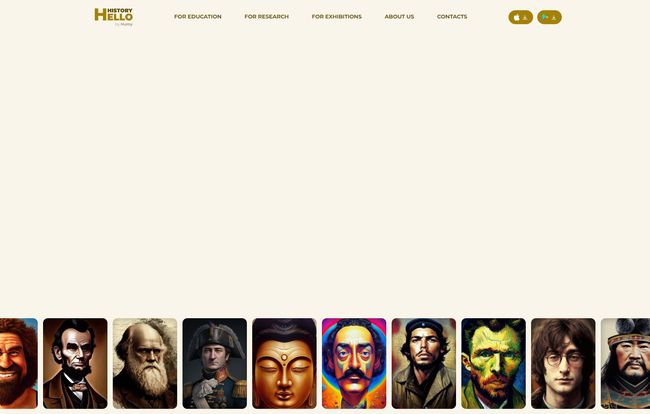
Visit Hello History
I started simple: “What was your biggest challenge when painting the Mona Lisa?” The response came back pretty quickly, talking about the Sfumato technique and the challenge of capturing a fleeting expression. Standard stuff. But then I pushed a little. I asked him what he thought of modern 3D printing, framing it as a new way to create models and inventions. The AI’s response was surprisingly thoughtful, speculating on how such a tool would have accelerated his anatomical studies and mechanical designs. It wasn’t just a data dump; it felt… contemplative. I’ve gotta admit, it was pretty cool.
The Good, The Bad, and The… Artificially Intelligent
After chatting with a few more figures (Cleopatra is very regal, and Einstein has a dry wit), I started to form some real opinions. This isn’t a perfect system, but there’s a lot to like.
What I Loved About It
The biggest win here is engagement. Let’s face it, history can be dry for a lot of people. An app like Hello History makes it an active experience. I can see this being a game-changer in a classroom setting. A student who couldn’t care less about the Protestant Reformation might suddenly get curious if they can ask Martin Luther himself why he was so fired up. It sparks curiosity in a way that a lecture sometimes can’t. The personalization is also a huge plus. You can go as deep or as niche as you want, following your own weird rabbit trails of thought without derailing a lesson plan. For anyone doing preliminary research or just trying to get a feel for a historical period, it’s a fantastic starting point.
Where It Gets a Little Weird
Okay, now for the reality check. You’re not really talking to Shakespeare. You’re talking to a language model that has read everything about Shakespeare. And that comes with some caveats. There’s a risk of what I call the conversational uncanny valley. Sometimes the answers are so good it’s spooky, other times you get a response that feels a bit generic, a bit too… AI. It makes you question the authenticity of the whole thing.
And that brings up the biggest concern: accuracy and bias. The AI is only as good as the data it was trained on. If the historical record is biased (and let’s be honest, it often is), the AI’s persona will reflect that. It might present a simplified or even inaccurate version of a person’s beliefs. It’s not a primary source. It’s an interpretation, and it’s super important to remember that. It’s a fun supplement, not a replacement for actual historical research.
Who Is This Really For?
Looking at the Hello History website, they’re clearly targeting more than just casual users. They have sections for Education, Research, and even Exhibitions. I can totally see this being integrated into a museum exhibit, allowing visitors to “ask a question” to a figure in a portrait. For students, it’s a brilliant study aid. For researchers, it could be a novel way to formulate questions or explore a historical figure’s potential mindset, as long as it’s taken with a grain of salt.
Ultimately, I think it’s for the endlessly curious. It’s for anyone who wants to experience history in a new way and isn’t afraid of the quirks of modern technology.
The All-Important Question: What Does Hello History Cost?
Ah, the question on every marketer’s mind. Here’s the thing—it’s not immediately clear. I did some digging around their website for a pricing page, but the link seems to be broken, leading to a classic “404 Page not found” error. Happens to the best of us.
This usually suggests one of two things: either they are revamping their pricing, or the main business model is app-based. My guess is it’s a freemium model. You likely get a certain number of free messages per day or a few introductory chats, with a subscription to unlock unlimited access. This is a pretty standard strategy for apps these days, and it’s a good way to let people try before they buy. Your best bet is to check the official website or go directly to the Google Play or Apple App Store to see the most current pricing structure.
So, Is This the Future of Learning?
Look, Hello History isn’t going to replace universities or libraries, and it shouldn’t. But is it a glimpse into the future of how we interact with information? Absolutely. It’s a creative, engaging, and genuinely fun application of AI. It lowers the barrier to entry for learning about history, turning what can be a passive activity into an active conversation.
It’s a fantastic educational supplement. A gateway drug to get people hooked on the stories of our past. As long as you approach it with a healthy dose of curiosity and a critical mind, it’s a remarkable little tool. I, for one, am excited to see who they add to their roster next. Maybe some obscure inventors or controversial artists. Now that would be a conversation.
Frequently Asked Questions
- Is Hello History historically accurate?
- It tries to be! The AI is trained on vast amounts of historical data, including writings and biographies. However, it’s an interpretation, not a primary source. There can be inaccuracies or AI-generated biases, so it’s best used as a learning supplement, not a sole source for academic research.
- Can I use the Hello History app for free?
- It appears to operate on a freemium model. You can likely have a few initial conversations for free, but unlimited access probably requires a subscription. The website doesn’t currently list pricing, so you’ll need to check the app store for the latest details.
- Who can I talk to on Hello History?
- The app features a wide range of historical figures from various fields like science, art, politics, and philosophy. The website shows figures like Albert Einstein, Leonardo da Vinci, Cleopatra, William Shakespeare, Nikola Tesla, and many more.
- Is the Hello History app safe for kids?
- Given its educational focus, it seems designed to be safe for a broad audience, including students. However, conversations can touch on complex or mature historical themes depending on the figure. Parental guidance is always a good idea for younger users.
- What kind of technology does Hello History use?
- The platform uses advanced AI and machine learning. It’s built on large language models (LLMs) that have been specifically fine-tuned to simulate the personalities, knowledge, and conversational styles of specific historical figures.


