
Categories: AI Copilot, AI For Data Analytics, AI Productivity Tools
Houseware Review: AI Product Analytics on Your Warehouse?

How many times have you found yourself in a meeting, staring at a dashboard, and thinking, “This number just doesn’t feel right”? You’ve got your product usage data in Mixpanel or Amplitude, sales data in Salesforce, and support tickets in Zendesk. Getting them to talk to each other feels like trying to host a dinner party where none of the guests speak the same language. It usually ends with someone (probably you) exporting a bunch of CSVs at 1 AM, trying to stitch them together in a spreadsheet that’s one wrong formula away from a total meltdown.
I’ve been in the SEO and traffic game for years, and the story is always the same. Data is siloed. And when data is siloed, you get conflicting metrics, endless debates about what an ‘active user’ actually is, and a whole lot of wasted time. We’ve been promised a solution for ages, but most tools just create another island of data.
Recently, I’ve been hearing a lot of chatter about a new approach. The “warehouse-native” model. And one name that keeps popping up is Houseware. They call themselves a “3rd-Gen Product Analytics Platform,” which sounds fancy, but what does it actually mean for those of us in the trenches? I decided to take a look.
What Exactly is Houseware?
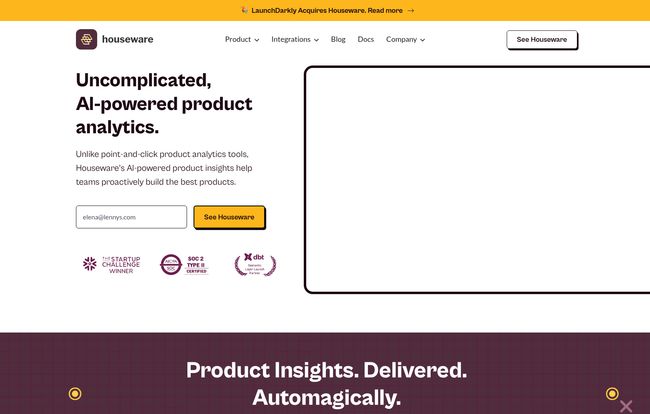
Houseware isn’t another tool that asks you to send a copy of your data to their cloud. Instead, it sits directly on top of your existing data warehouse—your Snowflake, BigQuery, Redshift, or what have you. This is a fundamental shift. Think of it like this: traditional analytics tools are like renting a furnished apartment. It’s quick to move in, but you’re stuck with their furniture, their rules, and you can’t knock down a wall if you need more space.
The warehouse-native approach is like building a custom house on your own plot of land. Your data warehouse is the foundation and the land. Houseware comes in as the architect and the high-tech interior designer, helping you build exactly what you need with the materials you already own and trust. Your data never leaves your control. It’s your single source of truth, for real this time.
This means the definition of a “user” or “conversion” is consistent across your entire organization, from the product team to the marketing team to the sales team. No more arguments. Hallelujah.
Let an AI Be Your Data Sous-Chef
Here’s where it gets interesting. Houseware leans heavily into AI to deliver what they call “automagical” insights. Now, I’m usually skeptical of AI buzzwords. But the way they frame it makes sense. It’s not about replacing the product manager; it’s about giving them a ridiculously smart assistant.
They claim their AI helps PMs save about a third of their time. How? By proactively digging through your data to find opportunities and flag problems before they become dumpster fires. For instance, it might identify a segment of users who are showing signs of churning or spot a feature that’s suddenly seeing a drop-off in engagement. It’s like having a junior analyst who never sleeps and is constantly asking, “Hey, have you seen this?”
This is designed for the folks who are driving growth—the Growth PMs, RevOps and Marketing Ops specialists, and even product-led sales teams. It connects product behavior (like ‘user clicked X button’) with revenue context (‘and this user is on a $10k/year plan’), which is the holy grail of product-led growth (PLG).
The Holy Grail: A Single Source of Truth
The biggest win with a tool like Houseware is the death of the data silo. Because it plugs directly into your data warehouse, it can see everything. It doesn’t just see the product events you’ve decided to track; it can see customer data from your CRM, subscription data from Stripe, and support data from Intercom. All of it, in one place.
This is made possible by a low-code “semantic layer.” In simple terms, this is a business-friendly map that sits over your complex database tables. It lets you define a metric like “Product Qualified Lead (PQL)” once, using data from multiple sources, and then everyone in the company can use that metric without needing to write a single line of SQL. Consistency is king, and this is the key to the kingdom.
Playing Nice with Your Entire Tech Stack
A tool is only as good as its ability to fit into your workflow. A platform that you have to log into separately all the time just creates more friction. Houseware seems to get this. With over 150 out-of-the-box integrations, it’s designed to connect to the tools you’re already using every single day.
Visit Houseware
But the real magic for me is the smaller, workflow-focused integrations. They have a Chrome Extension to pull up customer insights while you’re browsing LinkedIn or your own app. And, crucially, a Slack app. You can get alerts, share insights, and collaborate on data directly in the channels where your team is already working. This is how you make data a part of the daily conversation, not just a report that gets reviewed once a month.
Okay, But How Much Does Houseware Cost?
Alright, let’s talk turkey. Pricing for these platforms can often be a bit… vague. I appreciate that Houseware puts it right out there on their site. It looks like they have three main tiers based on your monthly event volume.
| Plan | Price | Key Features |
|---|---|---|
| Essentials | $499 / month | For up to 20M events/month. Includes unlimited collaborators, chart creation, segmentation, and product analytics essentials. |
| Growth | $2,499 / month | For up to 100M events/month. Adds Houseware AI Co-Pilot and intelligent, automatic insights. |
| Enterprise | Contact Us | For over 100M events/month. Adds audit logs, dedicated success partner, and is optimized for scale. |
One cool thing on their pricing page is the calculator to estimate your data warehouse costs. This is a smart, transparent move. Since Houseware runs on your warehouse, you’ll have compute costs from Snowflake or BigQuery. This calculator helps you get a ballpark figure for what that might be, which is super helpful for budgeting.
The Real Scoop: Pros and Some Things to Consider
No tool is perfect, so let’s get balanced here. From my analysis, the advantages are pretty clear. You get proactive, AI-driven insights that can genuinely save you time. The warehouse-native architecture is, in my opinion, the future for any serious data-driven company—it ensures accuracy and a single source of truth. And it’s built specifically for the operational teams (RevOps, Marketing Ops) who are often left out of product analytics conversations.
However, there are a few things to keep in mind. First, you need a data warehouse. If you’re a very early-stage startup still running everything off a production database, you’ll need to set up a warehouse first. That’s an extra step. Second, while the AI is powerful, it’s not a silver bullet. You still need smart humans to validate the insights and make the final call. Don’t just blindly follow the machine. Finaly, for teams not used to thinking in terms of a centralized data warehouse, there might be a bit of a learning curve. It’s a mindset shift, but probably a worthwhile one.
Answering Your Burning Questions about Houseware
So what does ‘warehouse-native’ actually mean?
It means the platform operates directly on top of your own data warehouse (like Snowflake, BigQuery, etc.) instead of requiring you to send a copy of your data to its own servers. This gives you more control, better data consistency, and a single source of truth.
Is Houseware just for Product Managers?
No, not at all. While PMs are a core audience, it’s also designed for Revenue Ops (RevOps), Marketing Ops, Growth teams, and product-led sales teams. The goal is to connect product usage data with revenue and customer data, which is something all those teams care about.
How hard is it to switch from a tool like Mixpanel or Amplitude?
Houseware claims the transition is seamless. Since it connects to the raw data you’re likely already sending to your warehouse, you don’t have to re-instrument all your tracking. You’re essentially just pointing a new, smarter lens at the data you already have.
What is a ‘semantic layer’?
Think of it as a translation layer. It sits between your complex database and the business user. It allows you to define key business metrics (like ‘Active Users’ or ‘PQLs’) once, in plain language, so that everyone in the company can use them consistently without needing to know SQL.
Do I need to know how to code to use Houseware?
For the most part, no. It’s designed for collaboration across teams without coding. Building dashboards, creating user segments, and exploring insights is done through a user-friendly interface. The initial setup and semantic layer definition might require some technical help, but day-to-day use is low-code.
Is Houseware the Right Move for Your Team?
So, what’s the verdict? In my experience, the industry is moving decisively towards the centralized, warehouse-native model. The days of having ten different analytics tools that all give you ten different answers are numbered. It’s just not sustainable.
If you’re a growth-stage company that already has a data warehouse and you’re feeling the pain of siloed data, Houseware looks like a very compelling option. It’s a tool that seems to understand that product analytics don’t exist in a vacuum—they need to be connected to revenue, marketing, and sales to be truly actionable.
It’s not the cheapest solution on the block, but it’s not trying to be. It’s aiming to solve a much deeper, more systemic problem. If you’re ready to stop arguing about whose numbers are right and start focusing on building a better product, you should probably give Houseware a serious look.


