
Categories: AI Agent, AI Assistant, AI Call Center, AI Chatbot, AI Copilot, AI Customer Service, AI Knowledge Base, AI Response Generator, AI Workflow, No-Code&Low-Code
Intercom Review: The AI Customer Service Tool Worth It?

Trapped in a customer support loop, bouncing between a chatbot that only knows three phrases and a support agent who clearly has five other chats going on. It’s frustrating. It makes you want to throw your laptop out the window. For years, I’ve watched companies bolt on chat widgets as an afterthought, a little blue bubble of false hope in the bottom corner of their website.
But something’s changed recently. The whole conversation around customer experience (CX) has shifted, and AI is no longer a clumsy sideshow; it’s taking center stage. And right in the middle of all this is a name many of us recognize: Intercom. But this isn’t the Intercom you might remember from five years ago. They’ve gone all-in on AI, and I’ve been digging in to see if it’s just marketing fluff or if they’ve genuinely built the future of customer service.
So, grab a coffee. Let’s get into what Intercom is offering today, who it’s for, and whether the price tag is justified.
Visit Intercom
First Off, What Even Is Intercom Anymore?
Forget just being a messenger. Intercom now calls itself an “AI-first customer service company.” That’s a bold claim, but looking under the hood, it’s not just talk. They’ve built a complete system designed to handle customer interactions from start to finish, with artificial intelligence woven into almost every part.
At its heart, the modern Intercom is a combination of four key things:
- A hyper-intelligent AI agent named Fin.
- An omnichannel inbox and ticketing system.
- A proactive support system for outbound messaging.
- A customizable help center.
Think of it less like a single tool and more like an entire command center for your support team. It’s designed to stop your team from drowning in repetitive questions and to give customers what they actually want: fast, accurate answers.
The Main Event: Let’s Talk About Fin AI Agent
Okay, this is where things get interesting. Fin is Intercom’s proprietary AI agent, and it’s the star of the show. We’re not talking about a simple chatbot that matches keywords to canned responses. Fin is built on GPT-4 and is designed to have genuinely human-like conversations. It connects to your knowledge base, your help articles, and even your internal app data to provide answers.
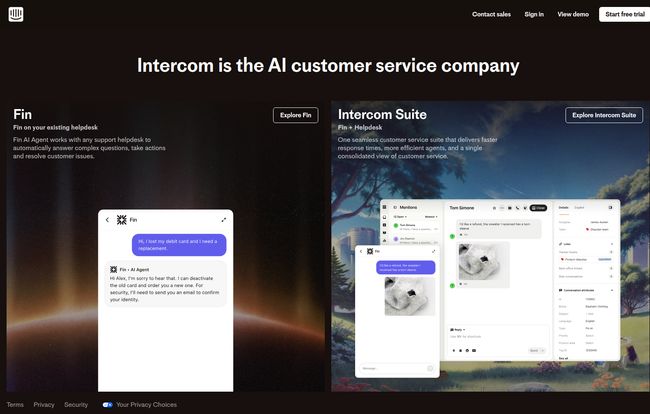
The image on their homepage shows a perfect example. A user says, “Hi, I lost my debit card and I need a replacement.” A basic bot might just spit out a link to a FAQ page. Fin, however, responds, “Hi Alex, I’m sorry to hear that. I can deactivate the old card and order you a new one. For security, I’ll need to send you an email to confirm your identity.”
See the difference? It doesn’t just answer; it acts. It understands intent and can trigger workflows. For me, as someone who obsesses over user experience and conversion funnels, this is huge. Every moment of friction a user experiences is a chance for them to leave. An AI that can resolve an issue instantly without needing to escalate to a human is an absolute game-changer for customer retention.
You can even use Fin on its own, plugging it into an existing helpdesk like Zendesk or Salesforce, which is a pretty smart move on their part.
Beyond the AI: The Rest of the Intercom Suite
While Fin gets all the headlines, the supporting cast of features is what makes it a complete system. Having a brilliant AI agent is one thing, but if it’s connected to a clunky backend, the whole experience falls apart for your team.
A Unified Inbox to Tame the Chaos
I’ve worked with startups where the support team was managing customer questions from Gmail, Twitter DMs, and a separate chat app. It’s a recipe for disaster. Intercom brings all those conversations—chat, email, and even phone support—into one shared inbox. The AI doesn’t just talk to customers; it helps the agents too. The “Copilot” add-on can summarize long conversations, help draft replies, and basically act as a personal assistant for your support reps, which is pretty neat.
Automation That Doesn’t Require a Computer Science Degree
Another thing that caught my eye was their workflow builder. It’s a visual, drag-and-drop tool that lets you set up rules for all sorts of things. For instance, you could create a workflow that automatically routes conversations from VIP customers to your most experienced agents. Or maybe you want to automatically follow up on a bad CSAT score with a personalized email. This is the kind of stuff that separates professional support operations from amateur hour.
The Million-Dollar Question: Intercom’s Pricing Structure
Alright, let’s talk about the elephant in the room: the cost. Intercom’s pricing can feel a bit… complicated at first glance. It’s not a simple flat fee. Most plans are a combination of a per-seat cost and a per-resolution cost for Fin. I’ll try to break it down simply.
| Plan | Price | Who It’s For |
|---|---|---|
| Essential | $29/seat/mo + $0.99/Fin resolution | Small teams needing the core AI agent, inbox, and help center. |
| Advanced | $85/seat/mo + $0.99/Fin resolution | Growing teams that need workflow automation and multiple inboxes. |
| Expert | $132/seat/mo + $0.99/Fin resolution | Large companies needing advanced features like SSO, HIPAA support, and SLAs. |
That $0.99 per resolution for Fin is the key part. A “resolution” is when Fin successfully answers a customer’s question without needing a human. Some might balk at this, but I think it’s actually a pretty fair model. You’re paying for successful outcomes, not just for having the tech turned on. They also have a ton of add-ons, like Proactive Support for outbound tours and surveys ($99/mo) and the aforementioned Copilot for agents ($29/agent/mo).
So, Is It Overpriced?
It depends entirely on your perspective. If you’re a solopreneur with 10 support tickets a month, then yes, this is probably overkill. But if you’re a scaling business with thousands of customer interactions, the math changes. You have to ask yourself: how much does it cost to have a human agent handle that same query? When you factor in salary, training, and the potential for human error, that $0.99 for an instant, perfect resolution starts to look pretty attractive.
The Good, The Not-So-Good, and My Two Cents
No tool is perfect, and I’m not here to be a cheerleader. In my experience, even the best software has its quirks.
The really good stuff? The power of the integrated system is undeniable. Having a top-tier AI, an omnichannel inbox, and powerful automation all living in one house is a massive advantage. The stats they quote—like a 70% reduction in first response time—feel believable when you see how the system works. It’s a well-thought-out product for serious businesses.
Where could it be better? For new users, the platform can be a bit intimidating. There’s a definite learning curve to get the most out of all the features, especially the workflow builder. And as we discussed, the pricing model requires some careful calculation to make sure it fits your budget. It’s not a plug-and-play and-forget-it kind of expense.
My biggest hesitation, and this is a philosophical one, is the over-reliance on AI for every interaction. Some conversations just need empathy and a human touch from the start. Intercom does make it easy to escalate to a human, but I think businesses need to be very intentional about where they draw that line. An AI can’t replicate a genuinely heartfelt apology. Not yet, anyway.
Also Read: Vanna.AI Review: An AI That Writes Your SQL?
My Final Take: Is Intercom the Right Move for You?
After spending a good amount of time with the new Intercom, I’ve come to a conclusion. It’s not for everyone, and it’s not trying to be. Intercom is for the business that has outgrown its simple chat widget and is ready to invest in a professional, scalable customer service operation. It’s for the company that sees customer support not as a cost center, but as a growth engine.
If you’re drowning in support tickets and a huge chunk of them are repetitive questions, Intercom’s Fin could genuinely change your business. If your support team is struggling to keep up with conversations across multiple channels, the unified inbox could be a lifesaver.
But if you’re just starting out or have very low support volume, the cost and complexity might be more than you need. There are simpler, cheaper options out there. This is the premium, AI-powered choice.
The world of customer service is changing fast, and platforms like Intercom are at the forefront of that change. It’s an impressive piece of technology that offers a glimpse into a future where getting help is instant, intelligent, and maybe, just maybe, a little less frustrating for all of us.
Frequently Asked Questions
How does Intercom’s pricing actually work?
Most of Intercom’s plans have two main costs: a monthly fee for each agent (a ‘seat’) and a cost per ‘Fin resolution,’ which is each time the AI successfully resolves a customer issue on its own. The exact price varies by plan (Essential, Advanced, Expert) and any add-ons you choose.
Can I use the Fin AI Agent with my current helpdesk?
Yes, you can. Intercom offers a standalone version of Fin AI Agent that can integrate with other popular helpdesks like Zendesk and Salesforce. This is a great option if you’re happy with your current ticketing system but want to add powerful AI capabilities.
What is a ‘Fin resolution’ and how is it counted?
A ‘Fin resolution’ is counted each time the Fin AI Agent successfully answers a user’s question or completes their request without needing to hand the conversation over to a human agent. You’re essentially paying for each ticket the AI successfully closes for you.
Is there a free trial for Intercom?
Yes, based on their pricing page, Intercom offers a 14-day free trial for its plans. This lets you test out the platform’s features, including the Fin AI Agent, to see if it’s a good fit for your team before committing.
Who is Intercom best for, B2B or B2C companies?
Both. Its features are flexible enough to serve different business models. B2C companies with high support volume can benefit immensely from the AI’s ability to handle common queries. B2B companies can use the powerful automation and proactive support features to manage complex client relationships and provide high-touch service to key accounts.
How is Intercom different from competitors like Zendesk or HubSpot?
While all three are major players in the customer service space, Intercom’s main differentiator is its “AI-first” approach. Its core design philosophy is built around the Fin AI Agent. While Zendesk and HubSpot have also incorporated AI, Intercom’s integration feels deeper and more central to the entire product experience, from the inbox to the automation.


