
Categories: AI Agent, AI Answer, AI Assistant, AI Models, AI Search Engine
Internet.io Review: Compare All AIs in One Place?

Okay, confession time. My browser is a certified disaster zone. As an SEO, I live and breathe content, research, and data. And for the past year or so, that’s meant living and breathing AI. I’ll have a tab open for ChatGPT to brainstorm keyword clusters, another for Claude 3 Opus to help me flesh out a creative brief, one for Perplexity to find sources, and maybe even a stray Gemini tab for a different perspective. It’s chaos. It’s like trying to herd cats, but the cats are all digital super-brains with different personalities and my computer’s fan is screaming for mercy.
It’s the new normal, right? We’re all trying to figure out which AI does what best. Which one is less likely to hallucinate a completely fake statistic? Which one has the best ‘voice’ for a particular brand? It’s a constant, tab-switching dance.
So when I stumbled upon a tool called Internet.io, my first thought was, “Oh great, another one.” But then I looked closer. The headline wasn’t about being a better AI, it was about seeing “how every AI thinks.” Now that got my attention. Could this be the tool to finally tame my AI-driven chaos?
So, What Exactly is Internet.io?
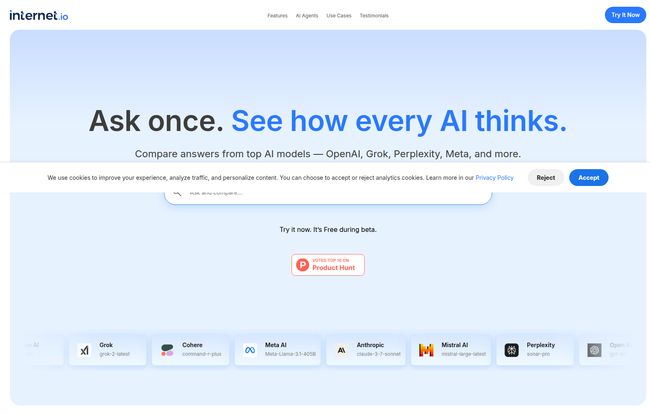
Let’s get one thing straight: Internet.io isn’t another AI model trying to win the AI arms race. Thank goodness. Instead, think of it as a master control panel or a universal remote for the top AI models out there. It’s an aggregator. You pop in one question, one prompt, and instead of getting one answer, you get a whole panel of them, side-by-side, from the likes of GPT-4, Claude, Llama, Mistral, and others. It’s like an AI tasting flight. You get to sample everything at once.
The whole idea is to stop the endless copy-pasting between different AI windows and centralize your creative and research workflow. A single prompt, multiple perspectives, all on one screen. Simple, but honestly, kinda brilliant.
Visit Internet.io
My First Spin with the Platform
Getting started is dead simple. You land on a clean page with a big, inviting search bar that says, “Ask us anything.” No complex setup, no fifty-step onboarding. I love that. I decided to give it a typical SEO-style task.
My prompt: “Act as a senior content strategist. Generate 5 compelling blog post titles about the importance of topical authority for B2B SaaS companies. Make them witty and intriguing.”
I hit enter, and the magic happened. The screen split into columns. In one, GPT-4 started churning out its logical, well-structured titles. In another, Claude 3 offered up its slightly more creative, fluid-sounding options. A few other models chimed in too. It was fascinating. Instantly, I could see the different ‘flavors’ of each AI. No more guesswork or tab-flicking. I could cherry-pick the best title from one model and maybe a concept from another. This is a huge time-saver.
The Power of a Side-by-Side AI Comparison
This comparison feature is, without a doubt, the star of the show. For anyone who uses AI for more than just asking for a dinner recipe, this is a big deal. In my line of work, nuance is everything. GPT-4 might give me a technically perfect, keyword-rich title, but Claude might give me one with more emotional punch that will actually get clicked. Seeing them together is where the real strategy happens.
You start to notice their little quirks. For certain technical queries, one model might consistently outperform others. For creative writing, another one shines. Internet.io makes this process of discovery visual and immediate. You can even drag and drop to reorder the models, putting your favorites front and center. It feels like you’re conducting an orchestra of AIs, not just talking to one.
Building Your Own Army of AI Agents
Okay, this is where Internet.io goes from a “cool tool” to a “potential workflow revolution.” It has a low-code platform for building your own custom “Agents.”
What’s an Agent? It’s basically a pre-programmed AI assistant designed for a very specific task. Instead of typing out a long, complex prompt every time, you build an Agent with those instructions baked in. For instance, I could create:
- An “SEO Meta Description Writer” Agent that always follows my preferred structure and character count.
- A “Witty Tweet Generator” Agent that takes a blog post URL and spits out three promotional tweets in a specific brand voice.
- A “Code Refactor” Agent for my developer friends that takes messy code and suggests cleaner alternatives using a specific programming philosophy.
The platform guides you through it. You give it a name, a purpose, and the core instructions. Then, with one click, you can run any query through your custom-built specialist. You can even share these agents with the community, which is a fantastic touch. I can already see a future where people are sharing and selling highly specialized agents for niche tasks.
Who Will Get the Most from This Tool?
Based on their site and my own experience, I see a few key groups falling in love with this. The platform itself highlights personas like Students, Founders, and Developers. A student could build an agent to summarize academic papers, while a founder could have one for drafting investor updates. A developer can have an agent that explains complex code snippets. But from my seat, I’d add Marketers and Content Creators to the top of teh list. The ability to quickly compare creative outputs and build task-specific writing assistants is just too good to pass up.
The Good, The Not-So-Good, and My Two Cents
No tool is perfect, right? Especially one that’s still in beta. After playing around for a while, here’s my honest breakdown.
What I Genuinely Liked
The sheer efficiency is the biggest win. Consolidating all my AI interactions into one dashboard immediately cleaned up my workflow. The side-by-side comparison is more than a novelty; it’s a genuinely smarter way to work with these large language models. And the agent-builder… well, it’s got my mind racing with possibilities for automating the more tedious parts of my job. I also appreciate the ability to save and organize your favorite responses. It’s a small thing, but it shows they’re thinking about real-world use.
A Few Things to Keep in Mind
First off, Internet.io is a window, not the room itself. Its output is 100% dependent on the quality of the AI models it integrates. If GPT-4 has a bad day or Claude starts hallucinating, Internet.io will faithfully show you those flawed results. It’s a conduit, so you still need a critical human eye. Secondly, while the agent builder is “low-code,” it’s not “no-code.” There’s still a bit of a learning curve if you want to build something truly complex. You need to get good at writing detailed, effective prompts to build a truly effective agent. It’s a skill in itself, something many people still underestimate.
What About the Price Tag?
Here’s the best part, for now at least. Internet.io is currently in its free beta phase. You can head over to their site and start using it right now without pulling out a credit card. I couldn’t find a dedicated pricing page, which is typical for a product at this stage. My guess? They’ll probably go with a freemium model down the line – a generous free tier with some limitations, and paid plans for power users who need more agents, more queries, or access to premium AI models. For now, though, it’s a free-for-all, which makes it a no-brainer to try.
My Final Take: Is Internet.io Worthy of a Bookmark?
Yes. Absolutely. For me, it’s an enthusiastic yes.
Internet.io isn’t trying to reinvent the wheel. It’s building a better car around the best wheels that already exist. It solves a real, tangible problem that I—and I suspect many of you—face every single day: AI overwhelm. It brings order to the beautiful chaos of modern AI.
If you’re an AI power user, a developer, a marketer, a writer, or just a deeply curious person who wants to understand the subtle differences between the big players in AI, you need to try this platform. It might just be the thing that finally lets you close all those extra tabs.
Frequently Asked Questions about Internet.io
- 1. What is Internet.io in simple terms?
- Think of it as a search engine that queries multiple AIs at once. You ask one question and get answers from models like GPT-4, Claude 3, and others, all displayed on one page for easy comparison.
- 2. What AI models does Internet.io support?
- The platform integrates several of the top AI models, including those from OpenAI (GPT-4), Anthropic (Claude), Meta (Llama), Mistral AI, and Google (Gemini).
- 3. Is Internet.io free to use?
- Yes, as of right now, Internet.io is in a free beta period. This means you can use its core features without any cost, though they may introduce paid plans in the future.
- 4. How is this different from just using ChatGPT or Claude directly?
- The main difference is efficiency and comparison. Instead of opening multiple browser tabs and copy-pasting your prompt into each AI platform separately, Internet.io does it for you in one go, letting you see all the responses side-by-side instantly.
- 5. Do I need to know how to code to create an AI Agent?
- No, you don’t need to be a programmer. The platform uses a “low-code” interface, which means you build agents primarily by writing plain English instructions and prompts, not by writing traditional code. However, understanding how to write a good prompt is beneficial.


