
Categories: AI Assistant, AI Chatbot, AI Mental Health, AI Religion, AI Therapist, AI Voice Assistants
Kataba Review: AI Companion for Islamic Self-Care?

In the world of SEO and digital marketing, we’re constantly bombarded with the next big thing in AI. AI for content, AI for ads, AI for… well, everything. Most of it is just noise. But every now and then, something pops up on my radar that makes me lean in a little closer. This time, it’s a tool called Kataba.
It’s not another keyword generator or a CPC optimizer. It’s an AI companion. But here’s the twist: it’s designed specifically for self-reflection through an Islamic lens. My first thought? Skepticism. My second? Intrigue. In a world saturated with generic wellness apps that offer cookie-cutter advice, a tool that caters to the spiritual and emotional needs of nearly two billion people is… well, it’s a massive untapped market and a genuinely interesting concept. So, I decided to put on my analyst hat and see what Kataba is all about.
So, What Exactly is Kataba?
At its heart, Kataba (from the Arabic word كَتَبَ, meaning “he wrote”) is an AI-powered conversational partner. Think of it as a digital journal you can talk to. Its entire purpose is to provide a safe, private space for you to process your thoughts and feelings, but with guidance that’s grounded in Islamic principles. The tagline says it all: “Speak freely. Reflect deeply. Grow spiritually.”
It’s not just another chatbot programmed to spit out generic positive affirmations. The entire framework is built on Islamic values like rahma (compassion) and amanah (trustworthiness). This isn’t about replacing human connection; it seems more like creating a pre-step. A place to untangle the messy knots in your head before you even know how to talk about them with someone else. It’s like a wise, digital friend who always starts with ‘Bismillah’.
How Does It Actually Work? A First-Hand Feel
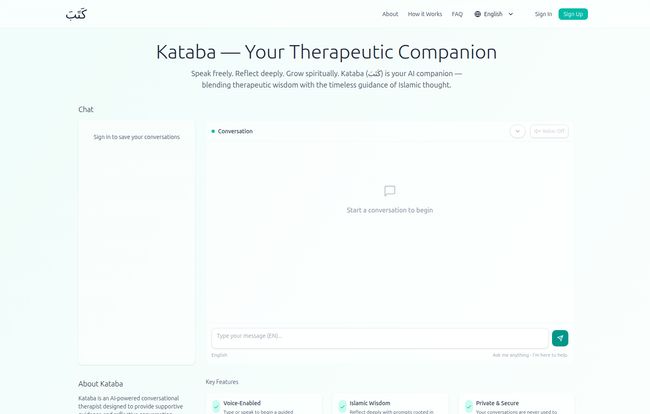
The user experience, from what I can gather from their interface, is designed to be incredibly simple and calming. It’s a clean, minimalist chat window. No clutter, no distracting ads, just a space for you and your thoughts.
Visit Kataba
The process is straightforward:
You begin a conversation, either by typing or, and this is a great touch, by speaking. The AI welcomes you with a sense of calm and compassion, inviting you to share whatever is on your mind. You just… talk. About your day, your struggles, a nagging feeling you can’t quite name. The AI listens without judgment and then offers thoughtful reflections. These aren’t commands or solutions. They’re prompts inspired by concepts central to Islamic emotional intelligence, like Tawakkul (trusting in God’s plan) and Shukr (gratitude). It aims to guide your own reflection, not to give you all the answers.
The Standout Features
A few things really caught my eye and seem to set Kataba apart from the crowd of other AI tools.
More Than Just a Chatbot: It’s Voice-Enabled
The ability to speak your thoughts instead of typing them is a game-changer. There’s something inherently more therapeutic about vocalizing your feelings. It feels more natural, more human. Typing can sometimes feel clinical, but speaking adds a layer of vulnerability and release that I think is essential for this kind of tool. The promise of natural voice responses from the AI also makes the interaction feel less robotic and more like a genuine conversation.
Guidance Rooted in Islamic Wisdom
This is the core differentiator. A generic AI might tell you to “practice mindfulness.” Kataba, on the other hand, might gently guide you toward reflecting on the concept of sabr (patience) or the blessings in your life to cultivate shukr. For a practicing Muslim, this is huge. It means the guidance you recieve isn’t just helpful, it’s spiritually resonant. It aligns with your worldview, which can make the advice feel more authentic and impactful.
A Truly Private Sanctuary
In our line of work, we know data is the new oil. And most free AI tools are “free” because you are the product. Your conversations are used to train their models. Kataba makes a bold promise here: “Your conversations are never used to train AI models or shared with third parties.” For a tool that handles deeply personal and sensitive emotional data, this is non-negotiable. This commitment to amanah (trustworthiness) isn’t just a marketing gimmick; it’s the foundation of their entire value proposition. Frankly, it’s a level of privacy that I wish more mainstream platforms would adopt.
The Big Questions: My Honest Take
Okay, so it sounds good on paper. But as with any new tech, especially in the mental and spiritual wellness space, we have to ask the tough questions.
Is This a Replacement for Therapy?
Let’s get this out of the way immediately: No. And Kataba seems to be clear about this too. An AI, no matter how sophisticated, cannot replace the nuanced, dynamic, and human connection you get from a qualified therapist. I see Kataba not as a replacement, but as a supplementary tool. It can be a great first step for someone hesitant to seek professional help, a daily check-in tool between therapy sessions, or simply a private space for reflection when you need it at 2 AM. It’s a tool in the mental wellness toolbox, not the entire workshop. If you’re struggling, please consider reaching out to a professional organization like the National Alliance on Mental Illness (NAMI) or a culturally-aware therapy provider.
Can You Use Kataba if You’re Not Muslim?
This is an interesting one. While the framework is explicitly Islamic, the core principles—compassion, gratitude, patience, reflection—are pretty universal. Someone not of the faith might not connect with specific Quranic or Hadith-based prompts, but the underlying emotional guidance could still be valuable. My gut feeling? A non-Muslim user could certainly find some benefit, but the experience is truly optimized for someone who shares the Islamic faith. It might be like listening to a gospel choir; you can appreciate the beauty and emotion without sharing the specific belief, but it resonates differently for a believer.
Let’s Talk About Fatwas and Religious Rulings
It’s crucial to understand that Kataba is not a sheikh, an imam, or a mufti. It is not designed to issue fatwas (Islamic legal rulings) or provide complex theological advice. Its domain is emotional and spiritual well-being, not jurisprudence. Trying to use it for that would be like asking your personal trainer for legal advice. It’s the wrong tool for the job. It’s a companion for the heart, not a scholar for the mind.
The Good and The Not-So-Good
Overall, I’m genuinely impressed by the concept. The immense value of a truly private, secure space for emotional processing cannot be overstated. For many, the idea of speaking with an AI that understands their spiritual language could be incredibly comforting. On the flip side, its strength is also its limitation. By being so specific, it naturally won’t appeal to everyone. And of course, the ever-present caveat remains: reliance on any AI for emotional support carries the risk of becoming a crutch, potentially hindering the development of real-world human connections for some users. Its a delicate balance.
What’s the Price Tag on Spiritual AI?
Here’s where things get a bit hazy. At the time of writing this article, I couldn’t find any specific pricing information on the Kataba website. The link to what I assume would be a pricing page leads to a 404 error. This isn’t uncommon for new platforms that are just launching or are perhaps in an extended beta phase. They might be gathering user feedback before finalizing a subscription model. My advice would be to sign up or check their website directly for the most current information. I’m curious to see if they’ll go with a freemium model or a straight subscription.
Frequently Asked Questions
- Is Kataba the same as going to therapy?
- Not at all. Think of it as a tool for daily self-reflection or a supplement to professional therapy, but it is not a replacement for a human therapist.
- How does Kataba keep my chats private?
- Kataba explicitly states that your conversations are completely private. They are not used to train their AI models and are not shared with any third parties, which is a major plus for privacy.
- Do I have to be Muslim to use Kataba?
- While it’s designed with an Islamic framework, its core themes of compassion and reflection are universal. However, the experience is most deeply felt by those who share the faith.
- Does Kataba give out religious advice like a scholar?
- No. Kataba focuses on emotional and spiritual guidance, not religious law or fatwas. It’s a companion for your heart, not a replacement for a qualified religious scholar.
- Can I talk to it in languages other than English?
- The website currently highlights English, but given its international target audience, it’s possible that more languages could be supported in the future. It’s best to check the platform for the latest updates on language availability.
- What makes Kataba different from ChatGPT or other AI?
- Two main things: its specific focus on Islamic principles for guidance and its strict privacy policy. Unlike general-purpose AIs, Kataba’s entire purpose and data handling are tailored for faith-conscious emotional wellness.
Final Thoughts: A New Companion for the Modern Muslim?
Kataba is a fascinating and, I think, much-needed entry into the tech world. It’s a tool that acknowledges that for a huge portion of the world’s population, spirituality isn’t just an afterthought—it’s the very lens through which they see the world. It’s a bold move to create something so niche, but that’s often where the most impactful innovations lie.
It won’t be for everyone, and it’s not a magic pill for life’s problems. But as a private, compassionate, and spiritually-aligned space to simply think and feel? I think Kataba is onto something really special. It represents a thoughtful intersection of faith and technology, and I’m genuinely excited to see how it grows.
References and Sources
- Kataba Official Website: https://kataba.ai/
- National Alliance on Mental Illness (NAMI): https://www.nami.org/Home


