
Categories: AI For Data Analytics, AI Product Manager, AI Productivity Tools, AI Research Tool
Lancey AI Review: An AI Co-Pilot for Your Eng Team?

If you’re in product or engineering, your life probably revolves around a few core truths: the coffee machine is the most important piece of hardware, a ‘quick sync’ is never quick, and your backlog is a bottomless abyss of customer feedback, feature requests, and bug reports. It’s a constant battle, trying to figure out what to build next while also keeping the current ship from sinking.
We’ve all been there. Drowning in Zendesk tickets, Slack messages, Intercom chats, and Jira tasks. It feels like you need a team of archaeologists just to sift through the feedback and find the golden nuggets. So when a tool like Lancey comes along, claiming it has “multiplayer agents for your engineering team,” my ears perk up. But my skepticism meter also goes into overdrive. Another AI tool promising to solve all our problems? Yawn.
But… this one feels a little different. Backed by the likes of Y Combinator and the former CTO of PagerDuty, Lancey isn’t just about organizing feedback. It claims to actually do stuff with it. Like, write code. So, I decided to pop the hood and see if it’s just more AI hype or a genuinely useful co-pilot for teams that want to ship faster.
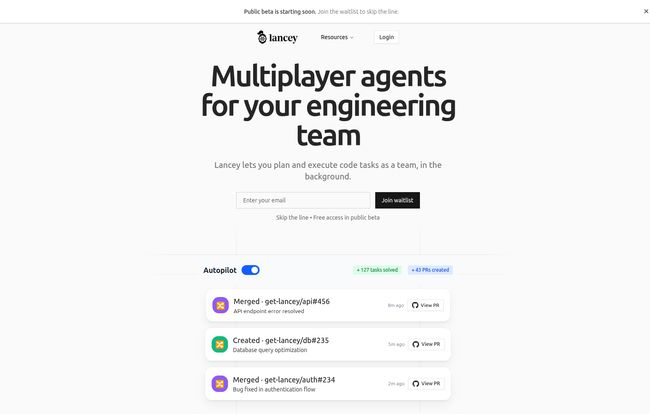
Visit Lancey
So, What is Lancey, Really?
Think of Lancey as a hyper-intelligent, slightly obsessive-compulsive intern for your product and engineering teams. An intern that never sleeps, never complains, and actually understands your tech stack. Its main job is to take the chaotic storm of customer feedback and turn it into something actionable. It connects to the places where your customers are already talking to you—your support desk, your community Slack, you name it—and starts making sense of the madness.
But here’s the kicker that separates it from a hundred other feedback tools I’ve seen. It doesn’t just categorize things into neat little buckets like ‘Bug Report’ or ‘Feature Request’. It aims to connect the dots all the way from a customer complaint to a ready-to-review pull request in GitHub. It’s an ambitious promise, for sure.
Taming the Customer Feedback Tsunami
Every product manager has that one recurring nightmare. The one where you’re standing in front of a giant wall of post-it notes, and they just keep multiplying. That’s basically the reality of managing customer feedback manually. It’s messy, time-consuming, and prone to whatever bias the loudest person in the room has.
From Raw Data to Real Direction
Lancey’s first order of business is to automate the most soul-crushing part of the job: analysis. By plugging directly into platforms like Zendesk, Slack, and Intercom, it automatically processes, tags, and categorizes incoming feedback. The real magic, though, is in the ‘custom product taxonomy.’ This isn’t just generic tagging. You can teach Lancey the specific language of your product—your features, your modules, your user flows.
This means feedback gets triaged with a level of context that a human might miss after their third coffee. Suddenly, you’re not just seeing ’10 people want a new button.’ You’re seeing ’10 enterprise-tier users from the finance sector are struggling with the Q3 report export feature, costing us potential renewals.’ See the difference? It’s the difference between guessing and knowing. This is how you start making data-driven product decisions instead of just placating the most vocal customers.
Closing the Loop (Without Losing Your Mind)
One of the most powerful things you can do for customer retention is to follow up. Imagine telling a customer who reported a bug six months ago, “Hey, we fixed that thing you mentioned!” The loyalty you build is immense. But who has the time to track all that? Well, Lancey does. It helps facilitate closing those feedback loops by making it easier to notify customers when a feature they asked for is shipped or a bug they reported is squashed. That’s a massive win for customer satisfaction.
Hold On, Did You Say AI Agents for Code?
Okay, this is where I went from ‘intrigued’ to ‘leaning forward in my chair’. Analyzing feedback is one thing. Dozens of tools do that. But using that analysis to generate code? That’s next level. Lancey frames this as giving your team “multiplayer agents,” which is a fancy way of saying AI assistants that can take on and execute coding tasks.
Ready-to-Review PRs Sound Too Good to Be True
I’ll be honest, the idea of an AI creating a pull request that’s instantly ready for human review sounds like science fiction. And in some ways, it still is. But what Lancey is doing is a huge step in that direction. It takes a well-defined task—say, a bug report with clear reproduction steps that it has already analyzed from a Zendesk ticket—and generates a PR to fix it.
Crucially, this operates on a ‘human-in-the-loop’ principle. This isn’t Skynet taking over your codebase. The AI generates the code, but a human engineer always has the final say. You review the changes, test them, and merge them. The AI is the short-order cook prepping all the ingredients; your engineer is the head chef who gives the final approval. This could drastically cut down the time spent on small, repetitive tasks and bug fixes, freeing up your senior devs to work on the big, meaty architectural problems.
Let’s Talk Turkey: The Pricing Structure
So, what’s all this AI goodness going to cost? I was pleasantly surprised to see a pretty reasonable and transparent pricing page. No ‘Contact us for a demo and a hard sell’ for their main plans, which I always appreciate.
| Plan | Price | Best For | Key Features |
|---|---|---|---|
| Basic | Free | Individuals or small teams testing the waters | 1 repository, 5 free tasks/month, basic support |
| Pro | $25/month | Scaling teams who are getting serious | 50 tasks/month, concurrent tasks, SOC2 compliant |
| Enterprise | Custom | Large organizations with complex needs | Assigned support, custom integrations, SSO, audit logs |
The Free plan is a genuine free tier, not just a 14-day trial. It’s limited, sure, but it’s more than enough to integrate with a single project and see if the workflow… works for you. The Pro plan at $25/month seems like the sweet spot for most growing startups and SMBs. The cost is low enough to be a no-brainer if it saves even a few hours of developer time each month. The Enterprise plan is the classic ‘if you have to ask, it’s for you’ option, with all the security and support bells and whistles big companies need.
Who Is Lancey Built For? (And Who Should Pass?)
Lancey looks like a fantastic tool for product-led tech companies, especially those with active engineering teams that are feeling the strain of a high volume of user feedback and a packed roadmap. If you’re a Head of Product, an Engineering Manager, or a PM who lives in Jira and Slack, this is built for you.
However, it’s not a magic wand. Its effectiveness is directly tied to the quality and quantity of the feedback you’re feeding it. If you only get a handful of customer emails a month, you probably don’t need this level of automation. Also, there’s an initial setup cost—not just in money, but in time. You have to integrate it with your systems and, more importantly, put some thought into your custom product taxonomy to get the most out of it. It’s a tool for teams ready to invest a little time upfront to save a lot of time later.
Some might argue that relying on an AI for code suggestions is risky. And they’re not wrong. But the ‘human-in-the-loop’ design is the key here. It’s not about replacing developers; it’s about augmenting them. It’s about letting machines handle the grunt work so humans can focus on creative problem-solving.
Frequently Asked Questions about Lancey AI
Is Lancey just for fixing bugs?
Nope! While it’s great for automating bug fixes, its feedback analysis can be used for much more. It’s designed to surface insights for new features, validate product ideas, and help you prioritize your entire roadmap based on what customers are actually saying.
How does the ‘human-in-the-loop’ part really work?
Think of it as a suggestion, not a command. When Lancey generates a pull request, it sits in your GitHub (or similar platform) waiting for review. A human engineer on your team must look at the code, test it, and manually approve and merge it. The AI doesn’t have permission to push code directly to your main branch. You always have the final say.
How hard is it to set up?
From what I can tell, the basic integrations with tools like Slack, Zendesk, and Jira are fairly straightforward, using standard API authentications. The real ‘work’ is in thoughtfully building out your custom product taxonomy. You’ll need to teach Lancey about your product’s specific features and terms to get the best results. Plan for a bit of an onboarding process.
What about data privacy and security?
This is a big one for any AI tool. Lancey offers a SOC2 Type 2 compliant Pro plan, which is a strong indicator of their commitment to security. For larger companies, the Enterprise plan includes features like audit logs and SSO, providing even more control and visibility. As always, review their privacy policy and terms of service to ensure they align with your company’s standards.
Can it work with any coding language or framework?
The website doesn’t specify limitations, which suggests it’s designed to be fairly language-agnostic, especially for the feedback analysis part. The code generation capabilities would likely be strongest with popular languages and frameworks like Python, JavaScript, and Ruby on Rails, but you’d want to talk to their team for specifics on your particular tech stack.
My Final Verdict: A Worthy Co-Pilot?
After digging in, I’m genuinely optimistic about Lancey. We’re past the point of being scared of AI; we’re now in the phase of figuring out how to use it to make our jobs less tedious. Lancey seems to have a very clear, practical answer for product and engineering teams.
It’s not just another dashboard to add to your collection. It’s a tool that takes input (messy human feedback) and produces tangible output (organized insights and even code). It connects the two departments that are often at odds—product and engineering—with a shared, data-driven foundation. Will it magically solve every problem and write your next major feature for you? No. But it could very well be the co-pilot that helps your team navigate the feedback storm, clear out the backlog of small tasks, and ultimately, ship better products faster. And in this market, that’s a massive competitive advantage.


