
Categories: AI Assistant, AI Language Learning, AI Social Media
Lingotrack Review: The Social Tool for Language Nerds

Alright, let’s talk. If you’ve ever tried to learn a new language, you know the cycle. You start strong. Duolingo notifications are your best friend. You can confidently order two beers and find the bathroom. Life is good. And then… you hit it. The dreaded intermediate plateau. It’s a vast, lonely desert where every Netflix show is either too simple or way too complex, and your motivation starts to nosedive. You know you need to consume more content—what the experts call “comprehensible input”—but finding the right stuff feels like a full-time job.
I’ve been there. I’ve spent more hours searching for a decent B1-level German series than I’ve actually spent watching one. It’s a grind. That’s why when I stumble across a tool that promises to solve this exact problem, my ears perk up. Enter Lingotrack.
At first glance, it looks like another tracker. But I’ve been playing around with it for a while now, and it’s… different. It’s less of a chore and more of a community. Let’s get into it.
So, What’s the Big Deal with Lingotrack?
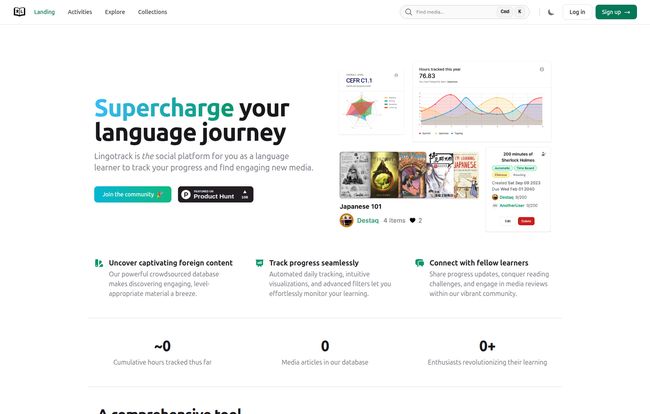
Imagine if Goodreads, Letterboxd, and your language learning journal had a baby. That baby would be Lingotrack. It’s a social platform designed specifically for us language nerds. The core idea isn’t just to log what you’re doing, but to help you discover what to do next and to see what other real people are using to successfully learn.
It’s built on a simple but brilliant premise: the best people to recommend learning content are other learners. Not algorithms that don’t get the nuance, not publishers trying to sell you a book, but actual people who are just a few steps ahead of you on the path.
The platform helps you uncover foreign media, track your consumption with surprisingly little effort, and connect with a community of fellow learners who are just as obsessed as you are. It turns a solitary struggle into a shared quest.
Visit Lingotrack
The Core Features That Actually Matter
Any platform can throw a bunch of features at you. But as someone who’s seen dozens of these tools come and go, I only care about the ones that solve a real problem. Lingotrack has a few that really hit the mark.
Your Personal Librarian for World Media
This, for me, is the star of the show. Lingotrack has a massive, crowdsourced database of media—books, TV shows, movies, you name it. But here’s the kicker: it’s all organized by difficulty, and it includes learner-focused details like word counts and user-generated difficulty ratings. This is a game-changer.
No more guessing if that French movie is going to be full of slang you won’t understand. You can see what other intermediate learners thought of it. You can browse “collections” that other users have curated, like “Spanish TV Shows for Beginners” or “Japanese Light Novels under 20,000 words.” It’s like having a hundred personal librarians who know exactly what you need.
Effortless Progress Tracking That Feels Like Magic
I hate logging my study time. I always forget, or it feels like homework. Lingotrack seems to get this. Logging an activity is often a one-click action. Watched an episode of a show you found on the platform? Click “Log Activity.” Done. It pulls the data and adds it to your stats.
The Pro version takes this a step further with GPT-powered verbal logging. You can literally just tell the AI what you did, and it logs it for you. It’s a small thing, but it removes so much friction. And seeing those beautiful graphs and stats fill up with your listening, reading, and watching hours? Chef’s kiss. It’s the dopamine hit I need to keep going.
A Community That Gets It
Learning a language can be isolating. Your friends and family might think it’s cool, but they don’t really get the excitement of finally understanding a tricky grammar point or the frustration of a word that just won’t stick. Lingotrack’s social layer fixes this.
You can follow other users, see what they’re logging, and get inspired by their progress. It creates this wonderful sense of accountability and shared discovery. Seeing someone else who is also learning Polish binge-watch a new series is all the motivation I need to check it out myself. It’s social media without the toxicity; just a bunch of people cheering each other on.
Breaking Down the Lingotrack Pricing
Okay, let’s talk money. Or, in this case, the lack of it. Lingotrack has a surprisingly generous free tier.
Here’s a quick look at the plans:
- Free Plan ($0/month): You get a ton of value here. Unlimited activity and media logging, access to all the advanced graphs and statistics, and the ability to create endless collections. The only real limitation is that you can only track one language. For someone just starting out or focusing intently on a single language, this is honestly more than enough.
- Pro Plan ($3/month): If you’re a polyglot-in-training or just want all the bells and whistles, the Pro plan is ridiculously affordable. For the price of a fancy coffee, you can track unlimited languages. You also get the cool AI verbal logging, image-based journaling, custom profile options, and a little “Pro” badge to show off. If you pay yearly, you get two months free, which is a nice little bonus.
For most people, I’d say start with the free plan. It’s powerful. You’ll know pretty quickly if you’re the kind of person who needs to track multiple languages and wants the extra Pro features. The fact that the core discovery and tracking tools are free is a huge plus in my book.
My Unfiltered Opinion on Lingotrack
I’ve seen a lot of hype. I’ve seen a lot of tools. So, does Lingotrack live up to it? For the most part, yeah. But it’s not perfect, because nothing is.
The Things I Absolutely Love
The whole concept of a community-curated library is just brilliant. It solves the biggest content-discovery problem for intermediate learners. The interface is clean and aesthetically pleasing—it’s just a nice place to be. And I’m a sucker for good data visualization, so the progress graphs make me genuinely happy. It gamifies the process in a way that feels mature and motivating, not childish. It truly feels like a tool built by people who have actually struggled with learning a language.
A Few Caveats to Consider
Now, for the reality check. Because the database is crowdsourced, you might find some inconsistencies. One person’s “easy” might be another’s “mind-numbingly difficult.” It’s the nature of the beast, but something to be aware of. The system gets better as more people use it, but it’s not infallible.
Also, the social features, while a huge pro for me, could be a distraction for others. If you’re the type to get lost scrolling, you might need to be disciplined. And finally, some of the coolest features, like the AI logging and unlimited languages, are locked behind that Pro subscription. It’s not expensive, but it’s not free, either.
Is This Tool Right for You?
So, who should drop what they’re doing and sign up for Lingotrack? In my opinion, it’s ideal for a few types of people:
- The Stuck Intermediate: If you know the basics but are struggling to find content that will push you to the next level, this tool was made for you.
- The Data Nerd: If you love tracking metrics, seeing graphs, and quantifying your progress, you will feel right at home.
- The Social Learner: If you thrive on community and need external motivation to stay on track, the follow features and shared activity logs will be a huge boost.
- The Aspiring Polyglot: For just $3 a month, managing your progress across multiple languages becomes incredibly streamlined.
If you’re a total beginner who is still working through the absolute basics on an app like Duolingo, you might not need Lingotrack just yet. But once you’re ready to step into the world of real-world content, you should have this site bookmarked.
Your Lingotrack Questions Answered
Frequently Asked Questions
- How exactly does Lingotrack track my progress?
- It tracks progress based on the media you log. When you log reading a book, watching a show, or listening to a podcast, it adds the time or word count to your stats. It then visualizes this data in graphs, showing you how much you’re consuming over time.
- Is the crowdsourced media database reliable?
- It’s generally very helpful, but it’s subjective. The reliability comes from the law of averages. A piece of media rated “A2” by 50 different users is probably a pretty safe bet for an A2 learner. I’ve found it to be more accurate than not, especially for popular content.
- Is the Pro plan really worth the $3 a month?
- If you’re learning more than one language, absolutely. The ability to track them all in one place is worth the price alone. If you’re only learning one language, the free plan is fantastic. You can always upgrade later if you decide you want the extra features like AI logging and customization.
- Can I use Lingotrack for any language I want?
- Yes! Because the media database is crowdsourced, you can add content for any language, even less common ones. The platform’s effectiveness for a specific language grows as more users learning that language contribute to it.
- What are the ‘collections’ on Lingotrack?
- Collections are user-curated lists of media. Think of them like Spotify playlists, but for language learning content. For example, a user might create a collection called “Easy French Movies on Netflix” or “My Favorite Italian Books for Beginners.” They are an amazing resource for discovery.
- How is this different from Duolingo or Babbel?
- Lingotrack isn’t a course; it’s a companion tool. Apps like Duolingo teach you the language with structured lessons. Lingotrack helps you apply and track what you’ve learned by immersing yourself in real-world content like books, music, and TV. They work great together.
My Final Word
In a world of a million language apps that all promise the world, Lingotrack feels refreshingly honest and genuinely useful. It’s not trying to be a magic pill. Instead, it’s a thoughtfully designed tool that solves one of the most persistent problems for self-directed learners: finding the right content and staying motivated to consume it.
It successfully turns the lonely grind of language immersion into a shared, data-rich adventure. If you’ve been feeling stuck or just want a better way to organize your learning journey, I’d say give the free plan a shot. You really have nothing to lose, and you might just find the community and the content you’ve been looking for.


