
Categories: AI Agent, AI API, AI Developer Tools, AI Knowledge Base, AI Knowledge Management
Llongterm Review: Giving Your AI a Human-Like Memory

You spend twenty minutes meticulously explaining your project needs to a chatbot, outlining every detail, every constraint, every brilliant idea you had in the shower. The AI seems to get it. It’s helpful! Then you close the tab. The next day, you come back, ready to pick up where you left off, and the bot greets you with a cheerful, “Hello! How can I help you today?”
It has no idea who you are. It’s the digital equivalent of meeting someone new every single day. Frustrating, isn’t it?
This AI amnesia, this fundamentally stateless nature of most chatbots, has been one of the biggest roadblocks to creating truly personal and helpful AI assistants. We’re pouring all this effort into making models smarter, faster, more creative… but we’ve mostly ignored giving them a decent memory. Well, it seems a new player in town, Llongterm, is looking to change that. And I’ve got to say, their approach is pretty interesting.
What Exactly is Llongterm? And Why Should I Care?
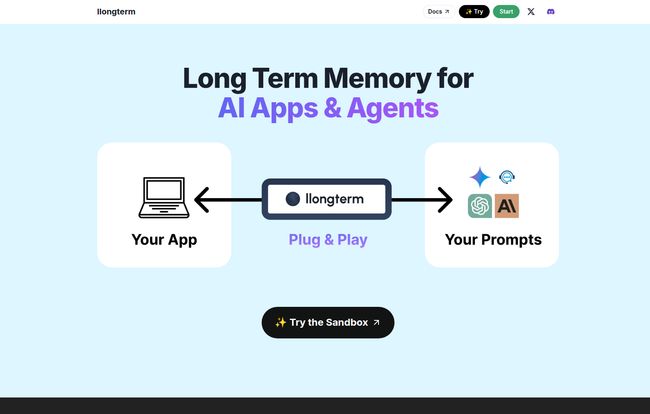
In a nutshell, Llongterm is an API that acts as a long-term memory for your AI applications. It’s not a chatbot itself. Instead, it’s a clever bit of infrastructure that sits between your application (your custom GPT, your support agent, whatever) and the AI model, like OpenAI’s GPT-4 or Anthropic’s Claude. It listens, it learns, and most importantly, it remembers.
Think of it like giving your AI a personal diary it can actually read and understand contextually. Every interaction, every preference you state, every little detail gets filed away not just as raw text, but as a structured, meaningful piece of a larger puzzle. You mention you’re a visual learner? It notes that down. You tell it you hate apples? Filed away for future reference. The next time you interact, the AI can draw on this rich history to give you a response that feels… well, like it knows you.
This isn’t just about remembering your name. It’s about building a continuous, evolving relationship with a user, which completely shifts the dynamic of how we can use these tools.
Visit Llongterm
The Goldfish Problem: A Quick Detour into AI’s Memoryless State
Why do we even need a tool like this? The core issue is that most large language models are, by design, stateless. They process a prompt and generate a response. The only “memory” they have is the conversation history you feed them in that single session, which is limited by something called the context window. Once that window is full or the session ends, poof. It’s all gone.
Developers have cooked up some clever workarounds, of course. Using vector databases like Pinecone or Chroma to store chat history and retrieve relevant chunks is a popular method (this is part of what’s known as Retrieval-Augmented Generation, or RAG). It works, but it can be a bit clunky. It often feels like you’re just searching a document, not tapping into a genuine memory. It lacks structure and relationship. Llongterm seems to be aiming for something more sophisticated, more… human.
A Peek Inside the “Mind”: Llongterm’s Core Features
So what’s under the hood? Based on their site, Llongterm isn’t just a simple database. They call their memory structures “Minds,” which is a pretty cool bit of branding. Each user gets their own Mind. Here’s what makes them tick.
Human-Readable Memory: The Transparency We’ve Been Asking For
This, for me, is the absolute standout feature. One of the scariest things about AI can be its “black box” nature. Data goes in, an answer comes out, and we’re not always sure why. Llongterm makes its memory entirely human-readable. The example on their site shows a ‘Student Profile’ broken down into clear, editable keys and values: learning style, problem-solving preferences, academic background.
“All Llongterm memory is fully human readable.”
That’s not just a feature; it’s a statement of philosophy. It gives developers a powerful debugging tool and gives users a potential window into what the AI knows about them. This is a massive step for transparency and trust.
Knowledge Maps and Timelines: More Than Just Facts
Llongterm talks about a “Knowledge Map” for detailed recall and a “Timeline” to place events. This suggests it’s not just storing isolated facts but understanding the relationships between them over time. It’s the difference between a grocery list and a personal biography. A grocery list tells you what to buy now; a biography tells you why you stopped buying junk food after that health scare last year. This contextual understanding is what separates simple data storage from genuine memory.
Self-Structuring and Sharable Minds
The system is designed to build its own taxonomy based on conversations. It’s dynamic. This is smart because you don’t have to pre-define every single thing you want the AI to remember. It adapts and grows with the user. Even more intriguing is the idea of “Sharable Minds.” Imagine a suite of educational apps where an AI tutor in one app can access the user’s Mind to see what they learned in another. The potential for a connected ecosystem is huge, though it does raise some interesting privacy questions that developers will need to handle with care.
Getting Your Hands Dirty: The Developer Experience
Alright, so how do you actually use this thing? It’s an API, so this is one for the coders. From the Javascript snippet they show, it looks pretty straightforward:
const memory = await llongterm.mind.embed(thread)
That seems simple enough. You take a conversation thread and embed it into the user’s Mind. However, the documentation also mentions the need for “careful management of memory usage,” which is a little vague. Does that relate to cost, API rate limits, or performance? That’s a detail I’d want to clarify before going all-in on a big project.
A big point for many in teh AI space: Python support is listed as “Coming soon.” Given that Python is the lingua franca of machine learning, this is a must-have for them to get broad adoption. I’m sure it’s at the top of their list.
The Big Picture: How Persistent Memory Changes the Game
Let’s zoom out. An AI that remembers you isn’t just a novelty. It fundamentally changes what’s possible.
- An AI Teaching Assistant could remember a student struggles with algebra but excels at geometry, tailoring future lessons accordingly.
- A mental health chatbot could build on weeks of conversation, recalling progress and past coping strategies without the user having to repeat their trauma.
- A customer service agent could see your entire history—previous issues, products owned, even your level of frustration from the last call—and provide truly informed support.
This is how we move from generic, one-size-fits-all AI to genuinely personal companions and assistants. It’s a foundational piece of the puzzle that’s been missing.
What’s the Catch? A Few Things to Consider
No tool is perfect, especially a new one. Llongterm is promising, but there are a few realities to keep in mind. First, as mentioned, it’s an API. This isn’t a plug-and-play solution for non-technical users. You’ll need a developer to integrate it.
Second, the Python SDK isn’t here yet. That will be a barrier for a significant chunk of its target audience until it lands.
And finally, the elephant in the room: pricing. As of this writing, clicking the ‘Pricing’ link leads to a 404 page. This is pretty common for startups in beta or early launch; they’re likely still figuring out their pricing model. Will it be based on API calls, storage size, or a monthly fee? Who knows. For now, it’s a black box, which makes it hard to budget for a potential project.
My Final Thoughts on Llongterm
Despite the unknowns, I’m optimistic. The problem Llongterm is tackling—persistent, structured AI memory—is one of the most important ones in the entire field right now. Their approach, especially the emphasis on human-readable memory, feels right. It’s thoughtful. It acknowledges the need for transparency and control in an industry that can often feel opaque.
Is it the ultimate solution? It’s too early to tell. But it’s a massive step in the right direction. It moves the conversation beyond just making models bigger and toward making them better partners in our digital lives. I’ll be keeping a very close eye on Llongterm, and the moment that Python SDK drops, you can bet I’ll be giving their sandbox a try. This isn’t just another API; it feels like a glimpse into the next generation of AI interaction.
Frequently Asked Questions about Llongterm
- Is Llongterm a standalone chatbot?
- No, it’s not a chatbot itself. Llongterm is an API (Application Programming Interface) that provides a memory layer for other AI applications, chatbots, and agents. You integrate it into your own custom-built AI tools.
- What programming languages does Llongterm support?
- Currently, their documentation and examples feature Javascript. They have stated on their website that support for Python is “coming soon,” which will be a critical addition for the machine learning community.
- Is my data safe with Llongterm?
- Data security is a shared responsibility. While Llongterm provides the infrastructure, the developer implementing the API is responsible for handling user data securely and being transparent about what is being stored. The human-readable nature of Llongterm’s memory is a big plus for transparency and auditing.
- How is Llongterm different from just using a vector database?
- That’s a great question. A vector database is excellent for semantic search—finding chunks of text similar to a query. Llongterm appears to offer a higher level of abstraction. It’s not just storing text; it’s creating a structured “Knowledge Map” and “Timeline,” which implies it understands relationships, context, and time. It’s more like a managed knowledge graph than a simple retrieval system.
- How much does Llongterm cost?
- As of late 2024, pricing information is not publicly available on their website. This is typical for a new platform that may still be in a beta or early access phase. You’ll likely need to contact them directly or wait for a public announcement.
Reference and Sources
- Llongterm Official Website
- What is RAG? – Pinecone (For background on a common AI memory technique)
- Emerging Architectures for LLM Applications – a16z (For a broader view on the tech stack for AI apps)


